 Archives
Multimedia
Donate
About
Sign In
Archives
Multimedia
Donate
About
Sign In



 Omar Ahmed


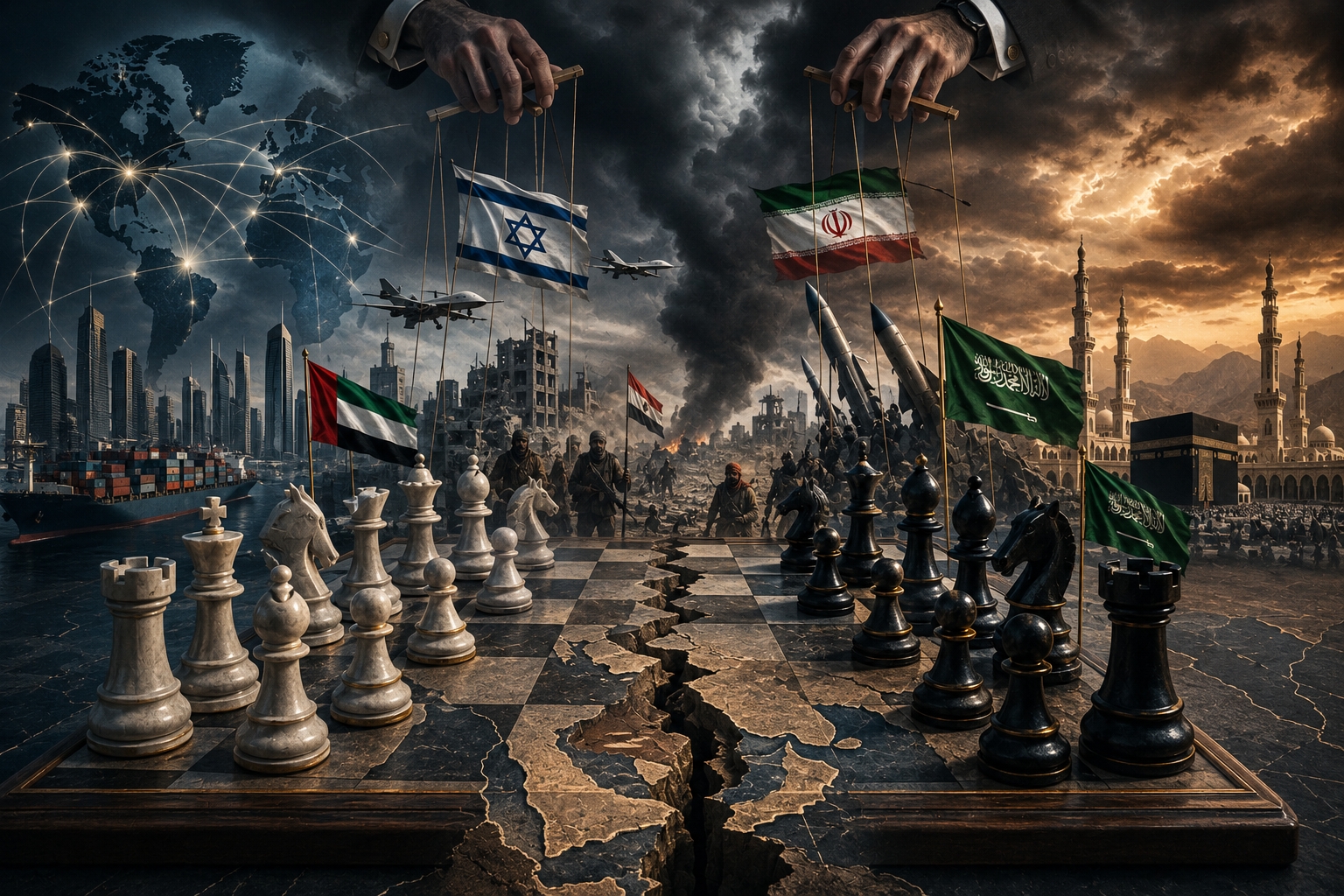
On April 28, the UAE announced its decision to leave the Organization of Petroleum Exporting Countries (OPEC). The decision took effect on May 1. The announcement sent shockwaves through global energy and political circles, because such a rupture would have been almost unthinkable even a year earlier.
Leaving OPEC is not merely about gaining greater freedom to set oil prices independently. It carries deeper consequences for the unity of the Gulf Cooperation Council (GCC) and, more broadly, for Saudi Arabia’s claim to regional leadership.
At the same time, the OPEC exit was only the most explicit move in a long, drawn-out regional contest that had been unfolding for years. The regional map has been rewritten by new alliances, new players, and rival visions of power.
Competing models
The UAE presents a model distinct from that pursued by Saudi Arabia, whose weight rests on control and influence over the global hydrocarbons market. The UAE’s strength lies in shipping, ports, logistics, and global financial markets. For Abu Dhabi, stability and access across international trade chokepoints—from the Strait of Hormuz to the Horn of Africa—are central to its rise.
Saudi Arabia’s position is different. With its central location in the wider Muslim world and the sheer scale of oil production on which global markets depend, Riyadh has long assumed the mantle of regional leadership.
Riyadh is a key member and power center within OPEC, the Arab League, the Organization of Islamic Cooperation (OIC), and the GCC. This diplomatic capital has shaped world events in line with Saudi goals before, most famously during the 1973 Ramadan War, when Riyadh responded to continued US support for the zionist entity through the oil weapon.
The same capital was wielded by Saudi Arabia during critical regional turning points: the Soviet invasion of Afghanistan, the eight-year imposed war on Iran, the end of the Lebanese Civil War, Operation Desert Storm, and the so-called Global War on Terror, including the 2003 US invasion of Iraq.
Over decades, Saudi Arabia’s diplomatic architecture has grown into a network extending across the wider OIC, pulling in states that seek Saudi patronage to hedge their geopolitical positions. Bahrain and Pakistan are notable examples.
Riyadh’s cross-border influence campaigns have historically relied on the spread of the Wahhabi interpretation of Islam. Today, that influence also moves through capital-intensive investments in foreign real estate, hospitality, sports, and other global markets.
The UAE, by contrast, has defined itself since the 2010s through opposition to “Islamic” movements and on-going support for Europe’s far-right.
This position was signaled through Abu Dhabi’s crackdown on local Muslim Brotherhood cells. It gained further clarity through UAE support for the Southern Transitional Council (STC) in Yemen. The now-dissolved STC was a movement that claimed continuity with the former socialist South Yemen and emphasizes secularism.
The geographical value of Yemen to Abu Dhabi’s vision of becoming an indispensable logistics and financial empire is obvious. That same logic has driven UAE actions in Sudan, close ties with Ethiopia, and intervention in the Somali crisis, particularly in the coastal regions of Puntland and Somaliland.
Over time, this path evolved into a competing vision for the regional order. Riyadh’s dominance over regional diplomatic forums and its leadership of the GCC became increasingly stifling for Abu Dhabi.
Competing visions
More than merely having different models for approaching the world, Riyadh and Abu Dhabi hold fundamentally divergent visions for West Asia and Africa. Through its support for factions opposed to Islamic-oriented movements across conflict zones, Abu Dhabi presents itself with a cosmopolitan front. Its comparative openness to close cultural exchanges with non-Islamic powers reinforces that image.
Few close observers, therefore, were surprised when the UAE became a key partner in the controversial Abraham Accords. On August 13, 2020, the UAE recognized the zionist entity and established official diplomatic ties, becoming the first GCC state to do so. In quick succession, the relationship expanded to include military cooperation and strategic alignment.
Somaliland has been the clearest example of this alignment. While Israel’s recognition of the breakaway autonomous state of Somaliland captured headlines, a quieter process had already unfolded: the UAE had become Somaliland’s largest direct foreign investor. DP World has made significant investments in the development of the Berbera Corridor and the expansion and management of the port of Berbera, establishing a vital commercial route linking East Africa and the Gulf of Aden.
To be fair, the decision to invest in Somaliland carries its own logic. Despite the anger of the central government in Somalia, Somaliland has maintained stability and relative safety across the territories under its control for 30 years since its unilateral declaration of independence.
Somaliland acted as a laboratory of sorts, testing the limits of UAE–zionist entity strategic cooperation. East Africa has, in fact, become a flashpoint for a wider set of strategic causes, including Sudan.
Abu Dhabi’s support for the Arab nationalist Rapid Support Forces (RSF) rebel camp has generated major controversy, particularly due to massacres committed by the RSF in towns such as El Fasher. A lasting settlement to the Sudanese civil war is also sought by the occupation state, which sees such an outcome as a step toward finalizing Sudan’s entry into the Abraham Accords. That process had already begun in 2020.
By contrast, Saudi Arabia has further cemented its legacy as a leader of the Muslim world, at least among Sunni-majority states. Deepening ties with Turkiye and Pakistan signal this direction. The move has gained legitimacy from Pakistan’s rise as a reliable nuclear-armed partner willing to offer Riyadh a protective umbrella, while Turkiye is emerging as a military-industrial power in its own right.
Both partnerships allow Riyadh to hedge against the momentum of the Abraham Accords. As global outrage over the zionist entity’s mistreatment of Palestinians grows, open normalization with Tel Aviv further weakens Bani Saud’s already contested claim to leadership of the Muslim world.
Abu Dhabi, however, has been clear about its alignment with the occupation state against Iran. It now views the Islamic Republic as an active existential threat. Iran has pursued military solutions against the UAE as part of its “globalized losses” strategy, aimed at forcing the US and the zionist entity to retreat from the consequences of the latter’s aggressive actions. Logistical support for US forces attacking Iran also forms the basis of Tehran’s view that Emirati targets are legitimate.
While some Iranian munitions found their way to targets in Saudi Arabia, recent events have shown a critical divergence in how both states approach Iran.
The Iran factor
Iran offers the region a political model of revolutionary Islamic republicanism that challenges both Saudi Arabia and the UAE. Saudi Arabia organized the GCC—particularly Bahrain and Kuwait—around a posture of opposition, tension, and careful engagement with Iran. The UAE presented a different front.
Abu Dhabi offered itself as a financial refuge for Iran following sanctions imposed under US pressure in previous years. This must be understood within Abu Dhabi’s conception of itself as an indispensable financial and logistical hub, empowered by geography.
During the 2000s and 2010s, Tehran pursued regional normalization despite the expanding US sanctions architecture designed to isolate the Islamic Republic. Abu Dhabi exploited those externally imposed pressures, presenting itself as a commercial lifeline for embargoed Iran while retaining the ability to weaponize that dependency on behalf of Washington and Tel Aviv. Shortly after Operation Epic Fury, Emirati authorities moved to freeze Iranian assets and financial holdings accumulated over years in UAE territory.
Iran is also an OPEC member, and the UAE decision to leave the organization and sell oil through the limited-capacity Fujairah–Habshan pipeline places further pressure on Iran’s war economy. This pressure comes on top of the US blockade of the Strait of Hormuz, which prevents Iranian oil vessels from leaving.
Following the effective dissolution of the STC in Yemen in December 2025, the UAE’s current plan for East Africa now faces another threat: the possibility that the Ansarallah-aligned armed forces could disrupt flows through Bab al-Mandab at any moment. The UAE’s alignment with the zionist entity, therefore, also points toward covert support for Iranian opposition camps, even if Abu Dhabi has avoided signaling this publicly.
For Saudi Arabia, the equation is more delicate. Tehran had already spent the 2010s arguing that regional security could not be built through sectarian mobilization or dependence on Washington. Riyadh, meanwhile, remained caught between its contested claim to Islamic leadership and the US security architecture that has long underwritten the kingdom.
With the Islamic Republic of Iran now under a lingering threat from a UAE–zionist entity–US axis, an olive branch from Riyadh would be the most powerful safeguard imaginable.
It would also remove Tehran’s need to pursue nuclear weapons, particularly with Pakistan included in the Saudi axis. Pakistan, for its part, has little interest in seeing another state on its western flank aligned with the occupation state.
Easing pressure on Bahrain—which has endured a disproportionate share of Iranian projectiles while facing a renewed uprising by its majority Shia population—may be a concession Riyadh would seek from Tehran in such a scenario. Yet all of this depends on where the question of ownership over the Strait of Hormuz goes.
This key geographic chokepoint is of paramount importance to both the UAE and Saudi Arabia, whose commercial operations depend heavily on it. Through ongoing negotiations with the US, Iran wants to secure global recognition of its control over the Strait of Hormuz. Saudi Arabia’s position on that question in the coming months will determine its response to the UAE axis with the zionist entity.
Given Tel Aviv’s role in this equation, it is safe to assume that the Saudi–UAE rivalry has entered a far more serious phase.

Saudi and Emirati rulers are overjoyed with Trump’s return to power. They believe happy days are here again but their euphoria may be misp...

The UAE ruler, Muhammad bin Zayed is punching way above his weight. His tight embrace of the zionist entity has created fissures in the arti...

The Gulf Cooperation Council is actually a gathering of conspirators that was established to undermine the Islamic Republic. It has failed m...