 Archives
Multimedia
Donate
About
Sign In
Archives
Multimedia
Donate
About
Sign In



 Mohamed Ousman


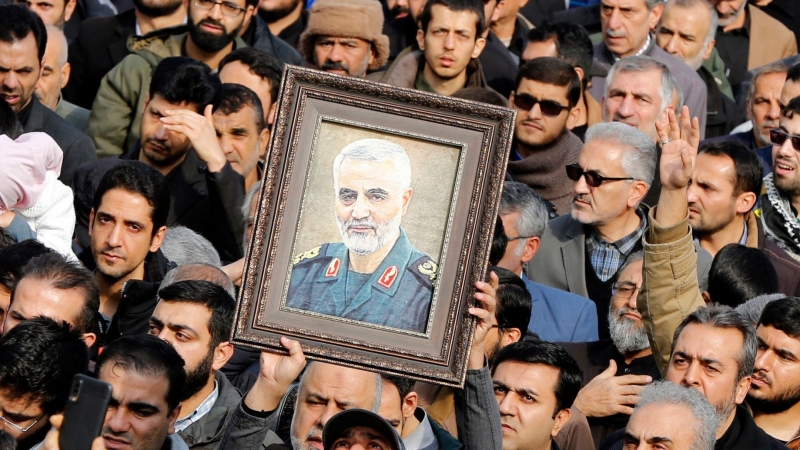
The martyrdom of Qassem Soleimani on January 3, 2020 represents a critical moment in contemporary Muslim political history.
While commonly analyzed through the lenses of geopolitics and security studies, Soleimani’s death also invites deeper examination within Islamic intellectual traditions concerned with power, leadership, and resistance.
This article analyzes the significance of Soleimani’s death using Imam Zafar Bangash’s Sirah-based model of power, Dr Kalim Siddiqui’s theory of Islamic movements and Imam Muhammad al-Āsī’s critique of Muslim reliance on non-Islamic powers.
Comparative reflections with Malcolm X and Khalid ibn al-Walid are employed to situate Soleimani within a longer historical continuum of leadership, transformation and martyrdom. Soleimani’s death functions as a test case for the coherence, independence, and moral foundations of contemporary Muslim resistance movements.
The killing of the Islamic Resistance General Qassem Soleimani by a US drone strike in Baghdad was widely understood as a strategic act aimed at deterrence and escalation management.
However, beyond its immediate political consequences, the event resonated deeply within Muslim political discourse.
Soleimani was not merely a military commander but a symbol of resistance against western intervention in the Islamic heartlands.
Zafar Bangash’s Sirah Model and Power in Islamic History
Zafar Bangash’s Sirah model emphasizes that Prophet Muhammad (ﷺ) confronted entrenched systems of power not through imitation or dependency but through moral clarity, strategic patience, and Islamic ideological independence.
Power, in this framework is not merely coercive capacity but the ability to shape history in alignment with divine guidance.
Within this model, the targeting of leaders by hegemonic forces is neither new nor decisive. The Sirah records repeated attempts to neutralize the Prophet by isolating or eliminating key figures within the nascent Muslim community.
Yet such actions only strengthened resolve and clarified moral boundaries.
Viewed through this lens, Soleimani’s death appears as part of a recurring historical pattern in which imperial powers seek to dismantle resistance movements by eliminating symbolic leaders.
The Sirah model suggests that the true measure of a movement’s strength lies not in the survival of individuals but in the endurance of its moral and ideological foundations.
Dr. Kalim Siddiqui and the Islamic Movement Theory
Dr. Kalim Siddiqui argued that Islam is inherently political and that Islamic movements arise in response to oppression, fragmentation, and the imposition of secular or colonial power structures.
Central to his theory is the rejection of reliance on non-Islamic systems for legitimacy, security or progress.
Dr. Siddiqui warned against movements becoming overly personalized, noting that revolutionary struggle must be institutionalized within the ummah rather than concentrated in charismatic individuals.
From this perspective, Soleimani’s death serves as a critical diagnostic moment.
It raises the question of whether contemporary Muslim resistance narratives are grounded in mass political consciousness or dependent on elite military figures.
If the removal of one individual destabilizes an entire movement, Dr. Siddiqui would argue that the movement has failed to mature.
Conversely, if the movement adapts and re-articulates its objectives, the death may function as a catalyst rather than a defeat.
Imam al-Āsī and the Ethics of Reliance
Imam Muhammad al-Āsī’s critique directly addresses a central contradiction in contemporary Muslim politics: “It is the peak of hypocrisy for Muslims to verbalize iyyāka naʿbudu wa iyyāka nastaʿīn, and then, when they need help, be it political, economic or military, they turn to the mushriks and the Yahūd” (Āsī, 2008, Vol. 1, p. 7).
Al-Āsī further argues that committed Muslim leaders recognize that Islam’s enemies are structurally incapable of offering genuine support, prompting them to turn to Allah rather than imperial alliances.
This position is not merely rhetorical but rooted in a Qurʾanic conception of tawakkul that demands political consequences.
For al-Āsī, reliance (istiʿānah) is inseparable from conformance to Allah (ʿibādah, mistranslated as “worship”), making dependence on hostile powers a form of practical theological contradiction/negation.
This critique resonates strongly in debates surrounding Soleimani, who is often contrasted with Muslim leaders who rely on western military protection and economic patronage.
In this light, debates surrounding Soleimani often hinge on whether resistance politics can sustain such principled independence under modern conditions.
Whether one agrees with Soleimani’s methods or political affiliations, his positioning as an opponent of western military dominance aligns with al-Āsī’s insistence on theological and political consistency between īmān and action.
Malcolm X and Khalid ibn al-Walid
Comparative analysis helps situate Soleimani within a broader historical and ethical framework. Malcolm X and Khalid ibn al-Walid represent two distinct but instructive models of transformative leadership.
Malcolm X evolved from a nationalist framework into an internationalist, anti-imperialist consciousness that linked Black liberation to global struggles against oppression.
His assassination, like Soleimani’s, did not end the discourse he advanced; rather, it amplified and embedded it within a wider revolutionary tradition.
Khalid ibn al-Walid, offers a different but equally relevant comparison.
His removal from military command by Khalifah ʿUmar ibn al-Khattab was not due to failure but to prevent the Ummah from idolizing and personalizing victory.
Khalid’s continued obedience demonstrated that Islamic struggle transcends individual heroes.
Together, these figures illuminate a key principle: leadership in Islamic and revolutionary traditions is significant not because of personal glory, but because of its role in advancing collective moral purpose.
The significance of Soleimani’s death extends far beyond strategic calculations.
Through Zafar Bangash’s Sirah model, it appears as part of a recurring historical confrontation between hegemonic power and principled resistance.
Dr Siddiqui’s Islamic movement theory frames the event as a test of movement maturity and ideological depth.
Imam al-Āsī’s critique of Muslim hypocrisy underscores the theological stakes of political dependency.
Comparisons with Malcolm X and Khalid ibn al-Walid demonstrate that the death or removal of leaders often clarify, rather than conclude, historical struggles.
Ultimately, Soleimani’s death forces Muslim thinkers and movements to confront a perennial question: whether resistance is rooted in enduring Islamic ideological consciousness or contingent upon individuals within fragile power structures.
Bibliography
Al-Āsī, Muhammad. The Ascendant Qur’an: Realigning Man to the Divine Power Culture. Vol. 1. Institute of Contemporary Islamic Thought, Toronto (2008).
Bangash, Zafar: Power Manifestations of the Sirah. Toronto: ICIT. (2011).
Siddiqui, Kalim: Issues in the Islamic Movement 1980–1981. London: The Open Press, (1982).
Siddiqui, Kalim. Stages of Islamic Revolution. London: The Open Press, (1996).