
 Archives
Multimedia
Donate
About
Sign In
Archives
Multimedia
Donate
About
Sign In



 Mohamed Ousman


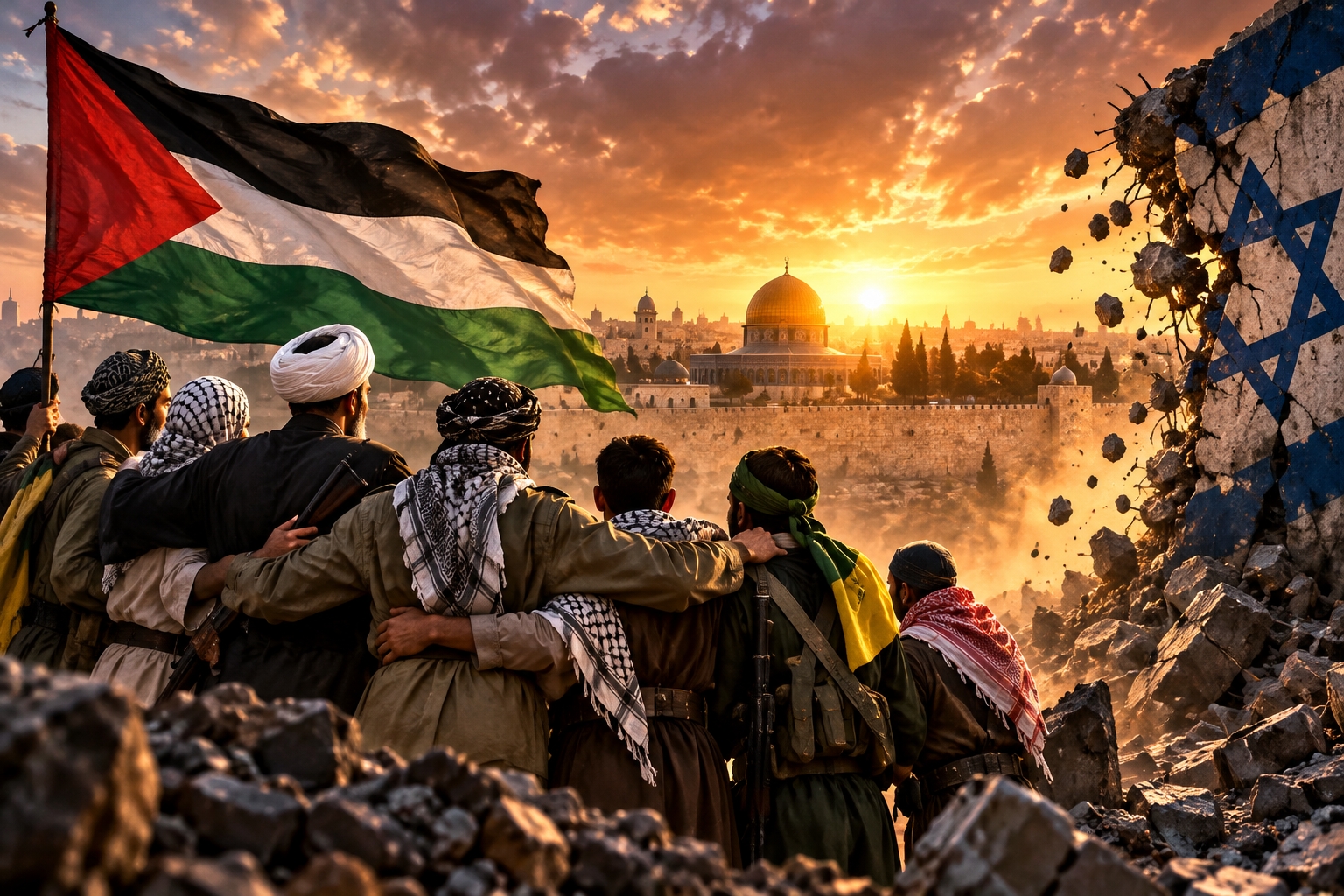
Sectarianism fractures Muslims into identities when the liberation of Palestine demands solidarity.
Islamic Iran’s large Sunni “minority”, Yemen’s mixed Sunni-Zaydi society, Sunni Palestinians, Sunni Iraqis, Sunni Lebanese and “minority” Shi‘i communities across the Gulf show that Muslim political realities cross sectarian boundaries.
Demographic estimates also complicate simplistic narratives.
The struggle for Palestine has involved actors from different settings. Hamas and Palestinians are Sunni; Hizbullah and the Islamic Republic are Shi‘i; and Ansar-Allah emerged from Yemen’s Zaydi-Sunni environment.
Treating sacrifices by Islamic Iran, Hizbullah, Hamas, Ansar-Allah, Hashd Al Sha‘bi and others as sectarian obscures common commitments.
Sectarianism becomes dangerous when Muslims mistake inherited artificial labels for moral or political qualifications.
The examples cited above cross those boundaries: Islamic Iran contains a substantial Sunni “minority”; Yemen comprises large Sunni and Zaydi communities; Palestine is predominantly Sunni; Iraq and Lebanon contain substantial Sunni populations; and Gulf states include Shi‘i communities.
Estimates vary, but this demographic picture challenges claims that Palestine belongs naturally to one sect.
Supporters of the Islamic resistance likewise point to martyred Imams Ali Khamenei, Ebrahim Raisi, Hassan Nasrallah, Hashem Safieddine, Ismail Haniyeh and Yahya Sinwar as figures whose deaths became symbols of sacrifice connected to a broader struggle involving Palestine.
Martyrs should not become sectarian property. An accurate reading recognizes differences while asking whether leaders and movements serve justice, protect civilians, resist domination and build Muslim solidarity rather than converting grief into exclusive sectarian competition or claims to virtue.
Imam Muhammad al-Asi’s Qur’anic framework: from sectarian identity to accountable leadership
Using al-Asi’s Qur’anic framework, the central distinction is not between Sunni and Shi‘i leadership but between leadership defined by Allah-directed service and leadership captured by collective ego (The Ascendant Qur’an: Realigning Man to the Divine Power Culture, Vol. I-12. ICIT, 2008-2020).
Al-Asi’s concept of ibadan lana— “honorable subordinates of Ours” who belong especially to Allah—makes leadership an ethical category.
In his reading, pioneers who confronted Bani Isra’el did not act primarily as Arabians or Persians, nor Sunnis or Shi‘is.
Their identity was subordinated to a higher obligation.
Applied to Palestine, this shifts attention from which sect claims the cause to whether leaders demonstrate disciplined commitment, sacrifice, justice and fidelity to Qur’anic principles.
Asi’s criterion is explicit: “Allah’s rule is that erroneous work never leads to heaven irrespective of religious affiliation, sectarian preference or ‘chosen people’ club membership; but whoever surrenders to Allah and sincerely dedicates their work to Allah can hope for heavenly reward.”
He argues that Allah “does not favor any nation, religion, sect or individual,” while dedicated labor “annuls glorification of ancestry, history, the ‘chosen race,’ etc.”
Leadership supportive of Palestine becomes meaningful not because a leader is Arab, Persian, Sunni or Shi‘i, but because of what the leader actually does.
The Talut narrative sharpens this point.
Al-Asi states that “the choice of Talut disrupted Isra’eli ‘sectarianism’ and ‘classism’.”
Talut was selected through merit rather than inherited prestige: Allah enhanced his understanding and physical capacity, while objections reflected status anxiety.
Al-Asi, therefore, argues that leadership qualifications should be evaluated through capability and commitment rather than cultural or genealogical preference.
His warning that “popular sentiment” can be deceptive and that commitment should be tested by making people responsible during war suggests that leadership is revealed through responsibility under pressure, not slogans.
This framework exposes dangers on both sides of the Sunni-Shi‘i divide.
Al-Asi criticizes a Sunni reading of Qur’an 4:59 that can become submission to an imposed ruler, even when that ruler is “unqualified, imposed, unjust and immoral.”
Conversely, he criticizes a Shi‘i reading that treats leadership as inherently reserved for the Prophet’s lineage, arguing that the verse itself does not establish familial, tribal, racial or national qualification.
His conclusion is that misreadings can produce either passive endurance of oppression or rationalized political quietism.
This does not mean sectarian differences are meaningless.
Rather, Al-Asi argues that they not become the decisive measure of leadership.
He notes that Sunni-Shi‘i polarization rendered imamah and shura, despite being Qur’anic themes, sources of tension.
The martyrdom of major figures illustrate why this distinction matters.
Imam Khamenei was martyred in US-Israeli strikes in February 2026; President Raisi was martyred in a helicopter crash in 2024; Shaykh Nasrallah was martyred in an Israeli strike in 2024.
Safieddine was subsequently reported martyred; and Ismail Haniyeh and Yahya Sinwar were martyred in 2024.
Supporters describe these deaths as martyrdom within the struggle for Palestine, while opponents differ.
The ibadan lana framework adds a criterion beyond labels: sacrifice alone does not automatically establish righteousness; leadership must be measured by intention, accountability, conduct and consequences.
Consequently, the shift from sectarian leadership to ibadan lana leadership is a shift from “Who are we?” to “Whom do we serve, and what do we actually accomplish?”
It rejects nationalism and sectarianism as forms of collective self-worship.
For Palestine, solidarity should, therefore, be judged by sustained service, protection of human life, political responsibility, justice, consultation and principled public accountability to Allah.
It cannot by judged by whether the leader is Sunni, Shi‘i, Arabian, Persian, Palestinian, Iranian or Lebanese.
Imam Zafar Bangash’s Seerah and Covenant of Madinah Framework: Trans-sectarian solidarity
Read through Bangash’s seerah-oriented approach, the relevant model is leadership that turns fragmented communities into a politically responsible community without erasing their identities.
The Prophet Muhammad’s Madinah experience is important because the Covenant of Madinah organized relations among Muslims and other constituent groups through reciprocal obligations, security, adjudication and collective responsibility (Power Manifestations of the Sirah: Examining the Letters and Treaties of the Messenger of Allah, ICIT, Toronto (2011).
Its significance for Palestine is, therefore, methodological: unity does not require uniformity; it requires a political ethic capable of integrating different communities around justice, security and common obligations.
Historical scholarship describes the document as regulating relations among the diverse groups of Madinah, including Muslims and Jewish communities.
Applied to contemporary Muslim politics, this challenges leadership that begins with “Which sect?” rather than “What responsibility do we share?”
Sunni Palestinians, Shi‘i Lebanese and Iranians, Zaydi Yemenis, and Muslims elsewhere can occupy different theological positions while recognizing Palestine as a common struggle.
The seerah model also warns against reducing leadership to charisma or ancestry.
Prophetic leadership combined legitimacy with institution-building, consultation, treaty-making and discipline.
The Covenant of Madinah further suggests that solidarity is strengthened when rights and obligations are defined rather than left to sentiment.
This is relevant when sectarian entrepreneurs portray Muslims as internal enemies.
A Madinan approach would instead ask whether disagreement can coexist with collective protection and justice.
Contemporary summaries of the covenant emphasize “religious” autonomy alongside common political and security obligations.
Bangash’s seerah framework, therefore, helps explain why support for Palestine can become a unifying political project without requiring Sunnis to become Shi‘is or Shi‘is to become Sunnis.
The danger lies in reversing that process: sectarian leadership fragments the community, converts theological difference into political exclusion, and makes exploitation by external powers easier.
The alternative is not theological homogenization but a leadership culture in which diverse Muslims relegate their traditions while coordinating around principled objectives.
In this reading, Palestine becomes a test of whether Muslim leadership can reproduce the Madinan capacity to transform diversity into responsible collective action.
Dr. Kalim Siddiqui’s Islamic Movement Theory: post-national leadership
Siddiqui’s Islamic Movement Theory provides a complementary explanation for why Palestine exposes the limitations of sectarian leadership.
His argument begins from the transformation of political reality: “with globalization, leadership based primarily on geography, nationality, ethnicity belonged to the past,” while leadership must respond to “hard political facts.” (Bangash, Zafar (ed): In Pursuit of the Power of Islam: Major Writings of Kalim Siddiqui, Open Press, Toronto (1996). Siddiqui, Kalim: Stages of Islamic Revolution: Open Press, London (1996)).
Palestine illustrates this tension because its consequences cross borders, while Muslim responses are still frequently organized through states, national interests and sectarian identities.
Siddiqui’s treatment of the Islamic Revolution in Iran is especially relevant to the Sunni-Shi‘i question.
Although the revolution occurred within the Shi‘i tradition, he argues that it “opened the doors of ijtihad” and produced “a new kind of leadership” that compelled Sunnis to re-examine their assumptions and methods.
The point is not Sunni acceptance of every policy of Islamic Iran but recognition that a movement from one tradition can generate questions across sectarian boundaries.
This perspective reframes Palestine away from a sectarian possession into the Ummah’s political problem.
Leadership is evaluated by whether it can understand power, mobilize institutions, sustain consciousness and respond to changing conditions.
Sectarian leadership, by contrast, narrows the field of political imagination: it may treat another Muslim movement’s contribution as suspect simply because its theodological vocabulary differs.
Siddiqui’s framework, therefore, complements Al-Asi’s ibadan lana: Al-Asi supplies a Qur’anic ethical criterion, while Siddiqui supplies a movement-theoretical criterion.
The first asks whether leadership belongs to Allah through sincere, principled work; the second asks whether leadership can translate that commitment into organized political action today.
The challenge is to build solidarity without demanding uniformity.
The strategic question becomes whether diverse Muslim communities can recognize shared political realities while collapsing sectarian doctrinal differences.




At the same time that Muslims are elated at Hizbullah's brilliant victory over Israel's war machine, they are deeply troubled by the mayhem ...

