 Archives
Multimedia
Donate
About
Sign In
Archives
Multimedia
Donate
About
Sign In



 Mohamed Ousman


The contemporary Left and social democratic parties have generally presented themselves as champions of human rights, international law and the rights of oppressed peoples. Yet their practical record on Palestine reveals a profound contradiction between rhetoric and policy.
While frequently condemning excessive Israeli military actions and advocating humanitarian relief, leading centre-left governments have consistently accepted the political legitimacy of the zionist entity. They have merely sought to only regulate rather than dismantle the structures of zionist settler colonialism.
Consequently, their support for Palestine has remained confined within the parameters of the “two-state solution.”
This framework leaves intact the political foundations established through the displacement of Palestinians even before 1948 and the subsequent colonization of Palestine in 1967.
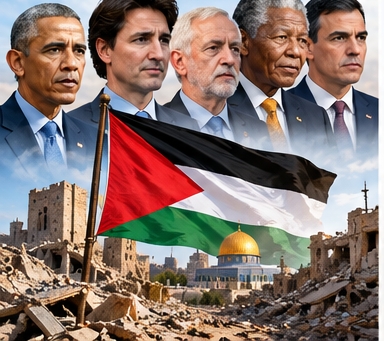
The experiences of Barack Obama, Justin Trudeau and Pedro Sánchez regimes illustrate this contradiction. Obama entered office promising a new relationship with the Muslim world.
His 2009 Cairo address generated considerable optimism by acknowledging Palestinian suffering and calling for a halt to Israeli settlement construction. Nevertheless, his regime ultimately demonstrated the structural limits of American liberalism.
Military aid to Israel reached unprecedented levels, culminating in the 2016 Memorandum of Understanding that guaranteed approximately $38 billion in military assistance over ten years.
Despite periodic diplomatic disagreements with Israeli Prime Minister Benjamin Netanyahu, the Obama regime continued to provide Israel with diplomatic protection in international forums while preserving America’s long-standing strategic commitment to Israeli military superiority.
Obama’s criticism of settlements, therefore, functioned as a disagreement over policy rather than a challenge to the zionist political project itself.
Trudeau’s record followed a similar pattern within Canadian politics. His government consistently affirmed Israel’s right to exist and defend itself while simultaneously expressing concern over humanitarian conditions affecting Palestinians.
Canada has frequently voted against or abstained from United Nations resolutions critical of Israel and has maintained close diplomatic, economic and military relations with the zionist state.
Although Trudeau’s government occasionally criticised settlement expansion and expressed support for increased humanitarian assistance to Gaza, such positions never translated into meaningful political or economic pressure capable of altering Israeli policy.
Canada’s official commitment to a negotiated two-state settlement consequently preserves the existing balance of power while portraying neutrality in a conflict characterised by profound structural inequality.
Jeremy Corbyn represents a more radical strand of European social democracy, combining support of Palestinian statehood with sustained criticism of occupation, settlements and British complicity. However, as Labour leader, while he advocated recognition of Palestine, end to the Gaza blockade and settlement expansion, he called for the two-state solution. In parliament, he repeatedly challenged British policy, arguing that Palestinian rights required ending occupation and addressing the refugee question.
Nevertheless Corbyn remained committed to a negotiated two-state framework and recognized Israel’s right to exist. His record, therefore, confirms the thesis of uniform Leftist betrayal.
Nelson Mandela presents a similar point as the western social-democratic Left. His position combined recognition of Israel with Palestinian self-determination. In 1993, Mandela stated that the ANC recognized both Palestinian nationalism and zionism as nationalism, while insisting upon Israel’s existence within secure borders alongside Palestinian self-determination.
Notwithstanding his insisting upon Israel’s existence, in 1997 he called for greater support for the Palestinian struggle for self-determination and famously linked South African and Palestinian liberation. Critically, Mandela oddly demonstrates support for a two-state settlement, negotiated peace with opposition to occupation, injustice and colonial domination.
Spain under Prime Minister Pedro Sánchez has adopted considerably stronger rhetorical criticism of Israeli military operations than both the US and Canada. He has condemned civilian casualties in Gaza and Lebanon, criticised violations of international humanitarian law, advocated the suspension of aspects of the European Union-Israel Association Agreement, and supported the recognition of a Palestinian state.
These positions have led many observers to portray Spain as one of Europe’s strongest defenders of Palestinian rights. Yet this appearance requires careful qualification.
Spain remains firmly embedded within NATO’s strategic architecture and continues to maintain extensive defence cooperation with the US through military facilities located on Spanish territory.
Its foreign policy remains integrated into the broader western security framework within which Israel occupies a privileged strategic position. Moreover, Spain’s recognition of Palestine is explicitly tied to the two-state solution, meaning that it simultaneously recognises and affirms the continued existence and legitimacy of the zionist entity within internationally recognised borders.
Rather than advocating the dismantling of zionist political structures or supporting alternative constitutional arrangements for historic Palestine, Spain seeks a negotiated accommodation between Israel and a future Palestinian state.
This distinction is significant.
Support for Palestinian humanitarian relief or criticism of Israeli military conduct should not automatically be conflated with opposition to zionism as a political project.
Liberal and social democratic governments frequently distinguish between opposing particular Israeli regimes or military operations and questioning the legitimacy of the Israeli state itself. Their preferred objective is the preservation of Israel alongside an “independent” Palestinian state.
Consequently, criticism of occupation, settlement expansion or disproportionate military force operates within accepted international diplomatic parameters rather than outside of them.
The broader pattern demonstrated by Obama, Trudeau and Sánchez reveals the limitations of contemporary social democratic approaches to Palestine. Their policies may differ in tone and degree, but not fundamentally in principle.
Obama combined diplomatic criticism with unprecedented military support; Trudeau coupled humanitarian concern with unwavering diplomatic recognition; Sánchez has employed more forceful language while remaining committed to the same political end-state recognised by most western and eastern regimes.
Each, therefore, illustrates a politics that seeks to mitigate the consequences of the conflict without fundamentally challenging its underlying constitutional framework. For critics of liberal internationalism, this represents the central paradox of the Left.
Its commitment to international law and human rights often stops short of questioning the political structures from which Palestinian dispossession emerged. The result is a politics that condemns humanitarian suffering while simultaneously accepting the permanence of the political order responsible for producing such suffering.
From this perspective, the two-state solution functions less as a programme of decolonisation than as a mechanism for reconciling Palestinian aspirations with the continued legitimacy of the existing Israeli state, thereby preserving rather than resolving the central political dispute.