 Archives
Multimedia
Donate
About
Sign In
Archives
Multimedia
Donate
About
Sign In



 Waseem Shehzad


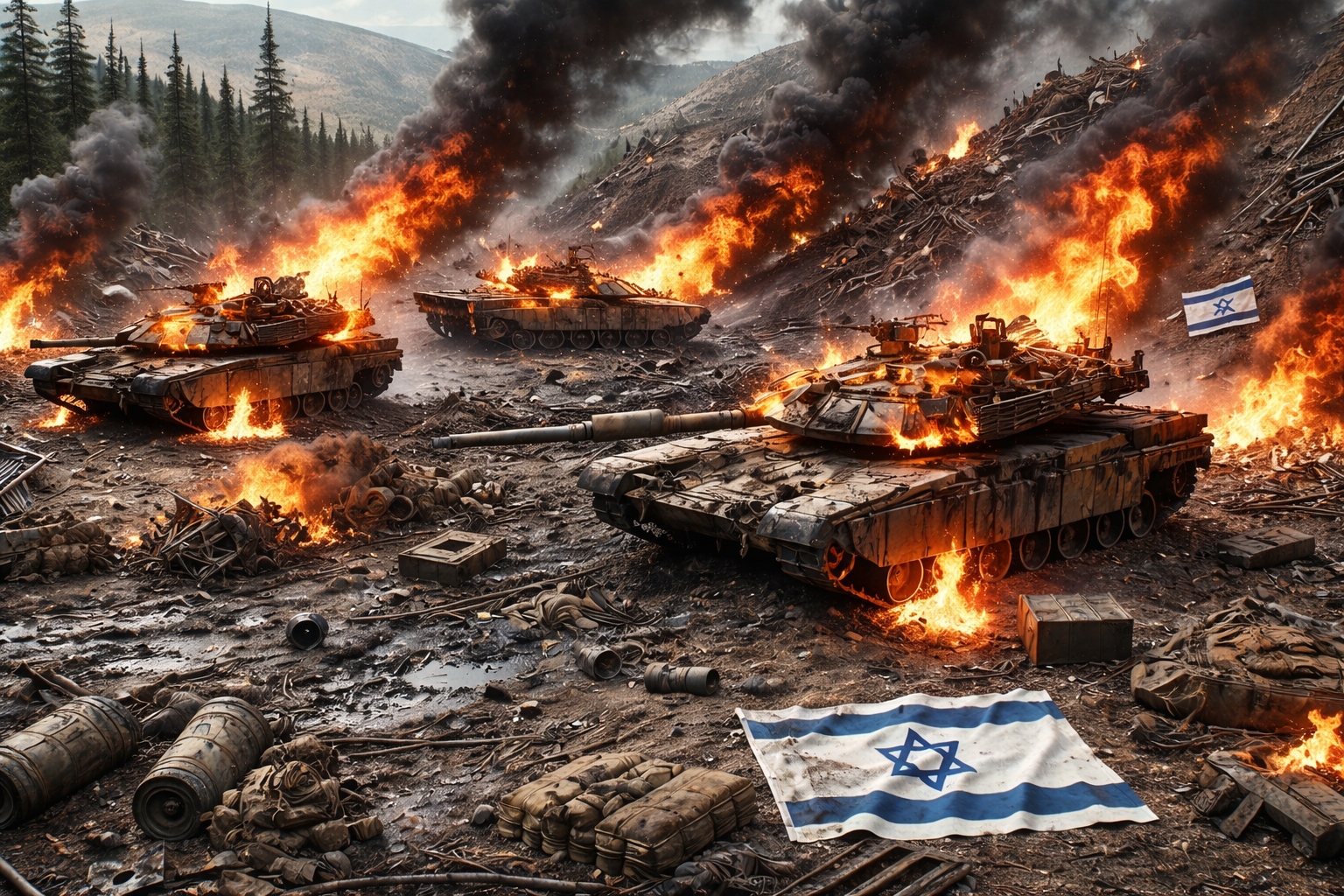
Between 2023-2025, zionist mouthpieces were full of bombastic news headlines about how they had destroyed 70-80 percent of Hizbullah’s weapons stockpiles. The past several months have revealed the zionist “success” in Lebanon as wishful thinking.
However, since Israel and its western backers continue to benefit from advantage in the information domain, these regimes still manage to project developments in a manner that obscures the underlying strategic realities. As a result, people fall victim to Israeli fake news narratives.
To understand the current reality, it is useful to examine what would constitute the best possible outcome for Israel in Lebanon.
Let us assume that Israel succeeds in retaining control over parts of southern Lebanon, maintains military positions and establishes what it calls a ‘security zone’. Let us further assume that Israel achieves this.
Even under this optimistic scenario, Israel still faces a strategic failure.
Occupation Guarantees Hizbullah’s Relevance
The first and most consequence would be the preservation of Hizbullah’s political legitimacy as an armed resistance movement fighting to restore the territorial integrity and sovereignty of Lebanon. If the genocidal entity’s occupation forces remain on Lebanese soil, that justification remains politically and legally intact.
In practical terms, this means that Israel has failed to achieve one of its primary long-term objectives: the disarmament of Hizbullah.
The zionist political and military establishments have repeatedly argued that any sustainable solution in Lebanon requires the elimination of Hizbullah as an independent military force. Yet an Israeli occupation, however limited, would guarantee the exact opposite outcome.
Hizbullah would continue to present itself not merely as a political actor but also a resistance movement confronting foreign occupation.
This reality would significantly weaken domestic and international efforts aimed at pressuring Hizbullah to surrender its military capabilities. As long as Israeli troops remain on Lebanese soil, calls for disarmament would encounter a fundamental contradiction: disarmament in the presence of occupation would appear to many Lebanese not as preserving sovereignty but as a surrender of sovereignty.
Rather than solving Israel’s Hizbullah problem, occupation would institutionalize it.
A Security Zone That Produces Insecurity
The second consequence concerns Israel’s long-term security environment.
Even if Israel succeeds in establishing a ‘security zone’, it will not achieve genuine stability within occupied Palestine. Rather, it will create permanent instability on the border with Lebanon.
History offers a precedent. Israeli occupation of southern Lebanon between 1982 and 2000 did not produce security. Instead, it generated a prolonged war of attrition that ultimately resulted in Israel’s defeat and humiliating retreat. The occupation itself became a mechanism for resistance mobilization.
A renewed Israeli presence in southern Lebanon would likely recreate similar dynamics but on a much larger scale, since Hizbullah’s military capabilities today are are greater than 1982-2000.
Hizbullah would not even require conventional military superiority to impose costs. It would merely need to ensure that Israeli forces remain under constant pressure and that the possibility of renewed escalation never disappears.
Under such circumstances, the perception of security among Israeli settlers in the north would continue to erode. The challenge for Israel is not simply military; it is psychological, demographic and economic.
For years, Israel has sought to encourage settlement and population growth in areas close to the Lebanese border. Yet long-term settlement requires confidence in future stability. If the occupiers of Palestine see that another round of conflict is inevitable, many will hesitate to return, invest or permanently establish themselves in vulnerable areas.
A security zone that remains under threat is not a symbol of strength. It is evidence that security remains unresolved and creates a permanent state of instability.
Political Exhaustion Before Military Defeat
There is another contradiction embedded in the Israeli desire for a long-term security zone in southern Lebanon.
Even if Israel succeeds in maintaining a military presence there, the occupation itself would become a source of gradual political exhaustion. Military deployments do not exist in isolation. They require political consensus, economic resources, diplomatic support and public willingness to sustain the costs associated with prolonged confrontation.
The longer Israeli forces remain in Lebanon, the greater the burden placed upon the zionist regime. Every casualty, every military incident and every cycle of escalation would reignite debate within Israeli society regarding the purpose and effectiveness of deployment. This is already happening.
This dynamic is particularly significant because Israel has already committed enormous resources toward confronting Hizbullah and failed in delivering decisive blows to this non-state entity.
For decades, Hizbullah has been the primary military challenge on Israel’s northern frontier. During that period, Israel has benefited from virtually unlimited military and political backing from leading western regimes.
Yet despite these advantages, Israel has not succeeded in eliminating Hizbullah.
This reality deserves careful consideration. If a non-state actor has survived years of confrontation against a cabal of advanced militaries of the world, backed by the full weight of western regimes, it raises fundamental questions about the feasibility of Israel’s objectives.
The issue is not whether Israel can inflict damage on Hizbullah. The issue is whether it can achieve decisive political and military outcomes that significantly reduce Hizbullah’s ability from inflicting significant damage on Israel. The evidence increasingly suggests otherwise.
As a result, Israeli occupation of southern Lebanon creates a strategic trap. The occupation would continue consuming political, economic and social capital while failing to eliminate the force it was intended to neutralize.
History repeatedly demonstrates that military defeats are often preceded by political defeats. Despotic regimes rarely abandon costly campaigns because they suddenly lose the ability to fight. Rather, they reach a point where the political, economic and social costs of continuing exceed the perceived benefits.
This is precisely what occurred during the US-NATO occupation of Afghanistan and Israel’s previous occupation of South Lebanon.
Renewed occupation risks recreating similar conditions. The longer Israeli forces remain exposed to an enduring resistance campaign, the greater the possibility that political fatigue, social pressure and strategic frustration will accumulate. At some point, those pressures translate into military setback or withdrawal that would be widely interpreted across the region as another victory for the Axis of Resistance.
The Psychological Consequences of Strategic Failure
The broader regional implications may prove even more significant.
The current conflict has been widely portrayed by Israel and its allies as an opportunity to fundamentally reshape the strategic balance of the region. Enormous military resources have been committed toward weakening or dismantling the Axis of Resistance.
Yet if the conflict concludes with Hizbullah intact once again, and Iran politically and economically more empowered, a different outcome emerges.
Today, the consensus among many experts is that despite employing maximum pressure, Israel and the US failed to achieve their stated objectives. This reality carries profound psychological consequences.
Military conflicts are not decided by a kill ratio. If this were the case, Algeria would still be occupied by France. Wars are determined by perceptions of victory and defeat. Today, “92 per cent of Israelis believe Iran has won the war.”
If the Israeli public comes to believe that repeated military campaigns cannot deliver decisive results, confidence in the zionist project will collapse, as military dominance via western backing is the key aspect sustaining the occupation of Palestine
The inability to translate battlefield power into lasting political outcomes will generate frustration, polarization and growing skepticism in the zionist society. Taking into account that Israel is surrounded by over 100 million people who view it as an existential threat, the unfolding reality is a death sentence for Israel.
The Changing Global Order
The international environment further complicates Israel’s position.
The global order dominated by western regimes is eroding. While the US remains a powerful military actor, it no longer operates in the unipolar environment that existed between 1990-2006.
The rise of China, resilience of Russia despite extensive western pressure and the growing strategic autonomy of states across the Global South, have contributed to a more multipolar international landscape.
In this changing environment, western regimes face increasing domestic and international scrutiny regarding their unlimited support for Israeli crimes.
Currently there is no immediate collapse of such support. However, the ability of the Axis of Resistance to give Isreal and its enablers a bloody nose in multiple domains shows that the political costs associated with maintaining pro-zionist policies mount significantly.
Occupation Reveals the Limits of Power
Taken together, these developments point to a fundamental reality: occupation cannot solve Israel’s Lebanon problem.
Even under the most favorable assumptions, a security zone would preserve Hizbullah’s legitimacy, fail to eliminate resistance capabilities, maintain instability along Israel’s northern frontier, drain Israeli political capital and reinforce perceptions that overwhelming military force has not produced decisive political outcomes.
In strategic terms, this would amount not to victory but to a prolonged bleeding of an entity totally dependent on foreign regimes.
The central lesson is that the more Israel relies on military control, the more likely it is to find itself trapped in a permanent quagmire.
For that reason, an Israeli decision to remain in southern Lebanon will ultimately reveal not the extent of Israeli strength but the limits of Israeli and western power.
What appears today as a demonstration of resolve may become a mechanism through which Israel accelerates its demise.

The US and Israel are pushing their diabolical plot to disarm Hizbullah even if means provoking a civil war in Lebanon. Hizbullah is the onl...
Article 1 of the Memorandum of Understanding signed by the US and Iran stipulates that a ceasefire will go into effect on all fronts, includ...

Ten years after Zionist Israel’s war of aggression on Hizbullah in Lebanon, we examine the political, military and strategic dimensions of...
As museums go, Mleeta, the museum of resistance, is unique. It depicts with stunning clarity the humiliating defeat the Zionist aggressors s...