 Archives
Multimedia
Donate
About
Sign In
Archives
Multimedia
Donate
About
Sign In



 Omar Ahmed


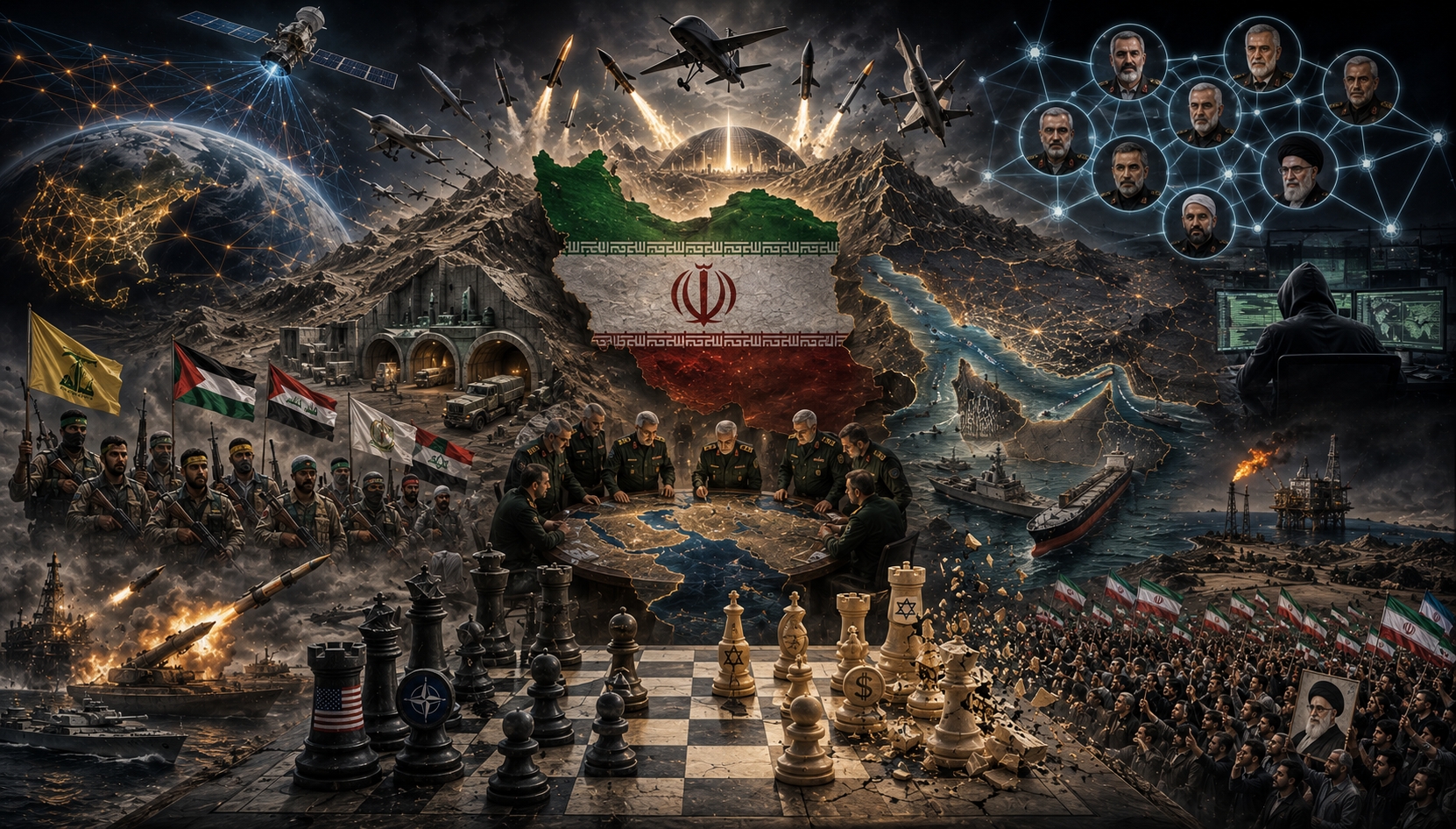
The events of 2026 have brought West Asia’s underlying alignments and state interests into sharp focus. Several developments have accelerated the contest to shape a new regional order. These include Operation Al-Aqsa Flood, the fall of Bashar al-Asad’s government in Syria, and the US–zionist war of aggression against Iran.
While some states scramble to adjust, others are positioning their political, economic, and military assets for a confrontation that may define the coming decades.
A major turning point came with the Abraham Accords between the zionist entity and several Arab League states. The UAE has since pursued ambitions extending well beyond normalisation, presenting itself as an indispensable global logistics hub while deepening strategic ties with Tel Aviv.
The emergence of a zionist-aligned state on the Strait of Hormuz has inevitably affected the calculations of every power whose security and prosperity depend on the waterway.
The outlines of West Asia’s emerging order can already be discerned.
Iran and the struggle for regional sovereignty
Iran has faced a sustained US–zionist onslaught that entered a far more direct phase with “Operation Epic Fury.” Its regional strategy rests on alliances with indigenous resistance movements that acquired legitimacy by defending communities and providing security where formal state institutions had failed.
These include Lebanon’s Hizbullah, Iraq’s Popular Mobilisation Forces (PMF), and Yemen’s Ansarallah movement. Each emerged from local conditions and constituencies, while their coordination with Tehran has created a deterrent network capable of imposing economic and military costs on aggressors across a wide geographical area.
The PMF, Ansarallah, and Hizbullah arose from grievances produced by American and zionist intervention, foreign occupation, and the failures of regional political systems. The rise of ISIS and its brutal campaign in Iraq after the fall of Saddam Hussein is especially instructive.
The Ba‘athist state had marginalised Iraq’s Shia majority and spent much of the 1980s waging a devastating, externally backed war against the newly established Islamic Republic. When ISIS threatened the country’s survival decades later, the PMF became central to defeating it and preserving Iraq’s territorial integrity.
Iran’s pursuit of a West Asian order free from US and zionist domination has established the Islamic Republic as an independent pole in the Muslim world. Its deterrence is intended to safeguard both the Iranian state and a wider regional project centred on sovereignty.
In the absence of nuclear warheads, Tehran has relied on what former MI6 chief Alex Younger described as ‘horizontal escalation’: the capacity of Iran and its allies to ensure that an assault cannot be confined to Iranian territory or fought without consequences for the military infrastructure supporting it.
This is particularly significant for neighbouring states hosting US bases while their populations overwhelmingly reject participation in a war waged for zionist interests.
By raising the cost of aggression, Iran seeks to compel Washington to abandon military coercion and accept a durable principle of non-interference. Such an outcome would also curb the zionist entity’s freedom to attack regional states with impunity.
Even if the US reduces its presence, however, competition between rival regional poles is likely to continue. Extending into East Africa, one emerging alignment brings together the zionist entity, the UAE, Ethiopia, and the separatist authorities in Somaliland.
Against this alignment, the interests of Iran increasingly overlap with those of Egypt, Saudi Arabia, and Turkiye, despite differences among them over individual regional files. Tehran’s restoration of relations with Riyadh demonstrated its willingness to manage disputes through dialogue without surrendering its principles.
Th Bani Saud, for their part, have repeatedly signalled an interest in meaningful common ground with Iran, even as US combat forces retain access to Prince Sultan Air Base. The durability of this opening will depend on Riyadh resisting external pressure to turn the Persian Gulf into a platform for renewed confrontation.
Cooperation will eventually become unavoidable, not least because the Strait of Hormuz remains essential to the economic security and prosperity of Iran, Saudi Arabia, and the wider Gulf.
Turkiye’s bid for leadership
Although Ankara and Tehran have historically differed over several strategic questions, Turkiye’s attempt to assume greater regional leadership has brought the two countries closer to a shared priority: containing the zionist entity.
Turkiye continues to maintain formal recognition and extensive commercial links with the entity, but statements by President Recep Tayyip Erdogan and Foreign Minister Hakan Fidan leave little doubt about Ankara’s growing concern over Tel Aviv’s expansionist course.
Since the 2010s, and the consolidation of Turkiye’s nationalist-conservative establishment following the removal of the Gulen movement from positions of influence, Ankara has projected itself as an advanced and capable Muslim power able to operate in an intensely competitive environment.
Despite growing secular and pro-EU sentiment among parts of Turkiye’s youth, public opinion remains strongly opposed to the zionist entity. The 2010 attack on the Gaza Freedom Flotilla remains a defining event.
Zionist naval commandos boarded the Turkish ship MV Mavi Marmara in international waters, killing Turkish citizens and turning the vessel into an enduring symbol of solidarity with Palestine. The attack continues to shape popular attitudes, particularly among Erdogan’s political base.
Repeated zionist atrocities against Gaza over the following decade have reinforced that position. The war in Syria also gave Turkiye an opportunity to establish a lasting military and political presence, culminating after 2024 in the dismantling of an autonomous Kurdish-led entity along much of its southern border.
Beyond its military interventions, Ankara has presented itself as a mediator between competing powers in West Asia and further afield, drawing on its post-2016 internal stability, defence industry, and substantial conventional capabilities.
That role has been most visible where Ankara maintains channels unavailable to many other states. Turkiye has facilitated indirect contacts between the rival Palestinian factions Fatah and Hamas, while its direct relationship with Hamas has given it a place in ceasefire and de-escalation efforts.
One of the clearest examples of its wider diplomatic reach has come in East Africa, where Ankara has sought to bring Ethiopia and Somalia to the negotiating table.
The strategic theatre of West Asia now extends into North and East Africa. Egypt’s dispute with Ethiopia over the Grand Ethiopian Renaissance Dam remains a potentially serious flashpoint and may draw greater Turkish attention as the zionist entity deepens its alignment with Addis Ababa.
Statements from zionist officials identifying Turkiye as a future enemy are, therefore, significant. Former Israeli prime minister Naftali Bennett described Turkiye as “the new Iran” and called President Erdogan “a sophisticated and dangerous adversary who seeks to encircle Israel.”
The comparison, intended as a warning, also reveals how the zionist establishment increasingly views independent regional powers capable of obstructing its military and territorial ambitions. The lines of a future regional confrontation are consequently being drawn in real time.
A regional barrier to zionist expansion
The Palestinian cause continues to galvanise the Muslim world, while the ideological and strategic conflict surrounding it shapes security calculations across West Asia. The zionist entity’s brazen air strike on Qatar on September 9, 2025 crossed a further red line. Qatar had never conducted military hostilities against Tel Aviv, yet the occupation state struck its territory in an attempt to assassinate members of the Hamas leadership hosted in Doha.
The attack served as a warning to Saudi Arabia and its neighbours, including those that had seriously considered joining the Abraham Accords. It demonstrated that normal relations offered no protection from unilateral zionist military action, whether against a resistance delegation, political officials, or any target Tel Aviv chose to designate.
Soon afterwards, Saudi Arabia and Pakistan signed landmark mutual defence agreements that included a formal security guarantee.
Pakistan’s increasingly active role since late 2025 should not have surprised close observers of regional geopolitics. Its mutual defence pact and weapons agreement with Saudi Arabia were accompanied by efforts to mediate between the US and Iran, contributing to the memorandum of understanding (MoU) reached in June 2026.
The Pakistan Air Force provided an armed escort to members of the Iranian delegation travelling to and from talks in Islamabad. In practice, the measure signalled that Pakistan would not permit the zionist entity to reproduce on its territory the attacks that had killed senior Iranian officials. Islamabad has a direct interest in Iran’s stability and does not want a zionist-aligned regime on its western frontier.
Any attempt to destabilise the Islamic Republic would also threaten Pakistan through the shared Balochistan border region, where both states confront armed separatist groups.
The June 2026 ‘R4’ meeting in Cairo reflected this shared strategic and ideological red line. Bringing together Egypt, Saudi Arabia, Turkiye, and Pakistan, the summit sought to establish a common approach to an increasingly belligerent zionist entity. It concluded by affirming that lasting peace requires withdrawal to the pre-1967 borders and East Jerusalem as the capital of an independent Palestinian state.
The growing closeness of Turkiye and Saudi Arabia to the Muslim world’s only nuclear-armed state reflects the uncertainty ahead. It may become still more important if Russia’s regional role diminishes. Much of the goodwill between Washington and Ankara once depended on Turkiye’s usefulness in containing Russia; a changing balance may give Ankara greater reason to coordinate with regional powers whose interests are not defined in Washington.
With zionist officials making little effort to conceal their hostility towards Turkiye, the stakes are unusually high. A West Asia facing either a reduced US presence or a more openly hostile Washington—depending on the course of its neo-Jacksonian foreign policy—will require stronger coordination among independent regional powers.
Iran, which has borne the heaviest costs as a state in confronting US and zionist designs, is indispensable to any viable order capable of protecting Muslim sovereignty and restraining further aggression.


The Turkiye-Saudi-Pakistan defence pact announced last month is viewed by observers differently. For some it is an alliance against zionist ...