 Archives
Multimedia
Donate
About
Sign In
Archives
Multimedia
Donate
About
Sign In



 Crescent International


The latest developments in Yemen are significant not simply because Ansar-Allah led government of Yemen has defeated Saudi and western-backed proxy forces.
The deeper importance lies in what the latest events reveal about the changing strategic balance across West Asia.
Prior to analyzing the broader picture, the mechanics of the defeat are important to keep in mind.
Western-backed militants in Yemen surrendered en-masse, openly demonstrating a total lack of will to fight for the Saudi, American and Israeli agenda in the region.
On a broader level, Washington and its regional vassals continue to play checkers.
They react to individual crises, defending isolated positions and attempting to murder opponents one at a time.
The Axis of Resistance, by contrast, increasingly appears to be playing chess, forcing its enemies to defend several interconnected political, military and economic vulnerabilities simultaneously.
Yemen has moved from the supposed periphery of regional politics to the centre of this emerging strategic contest.
For more than a decade, Washington, Riyadh and their vassals treated Yemen as an impoverished country whose resistance could eventually be crushed through bombing, economic strangulation and proxy warfare.
Instead, Ansar-Allah survived, consolidated its political position and developed military capabilities capable of influencing events far beyond Yemen’s borders.
This is particularly important because of geography.
The Strait of Hormuz remains one of the principal arteries of the global energy system.
When instability there makes Saudi oil exports from the Persian Gulf more difficult, Riyadh increasingly depends upon its East-West pipeline to move crude toward Yanbu on the Red Sea.
But this supposedly safer alternative has been struck.
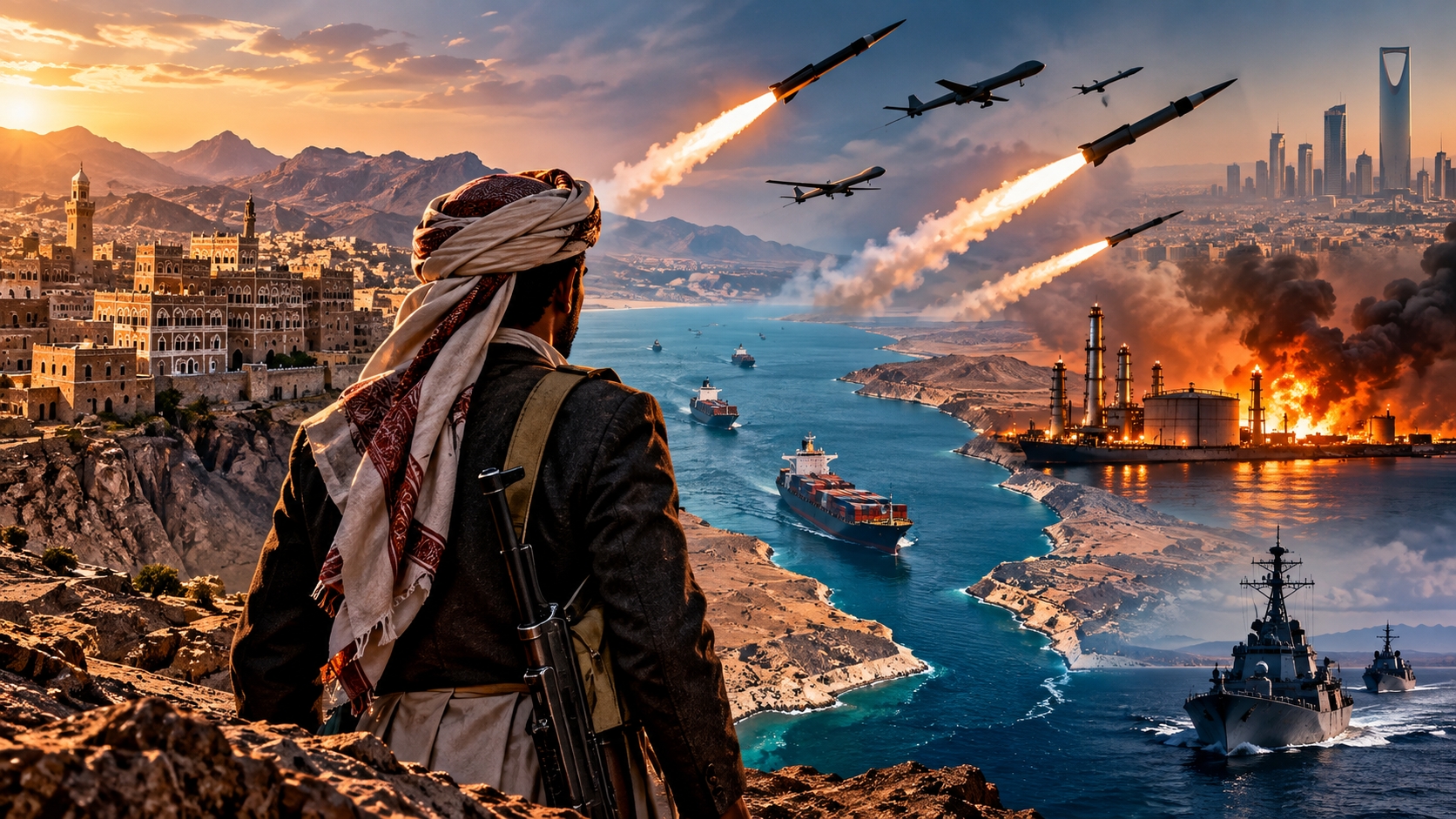
Ansar-Allah’s expanding presence near Bab al-Mandeb, combined with its ability to threaten shipping and energy infrastructure in the Red Sea, means that Saudi Arabia cannot simply escape pressure in the Persian Gulf by redirecting exports westward.
One vulnerability leads directly into another.
This is the essence of the chessboard.
Pressure around Hormuz forces Saudi Arabia toward the Red Sea.
Pressure in Yemen then threatens the Red Sea option. The East-West pipeline, designed to give Riyadh a strategic escape route has been made redundant.
Saudi Arabia’s dramatic decline in crude production illustrates the economic consequences of this transformation.
Energy corridors that once appeared to be protected by American military power are increasingly subject to disruption by regional actors Washington spent decades dismissing as incapable of challenging the imperial architecture.
This also has direct implications for the zionist regime.
Israel’s only real gain since 2023 was the disruption of the resistance geography through Syria.
The emergence of a hostile political order in Damascus damaged a vital territorial connection linking different components of the Axis of Resistance.
Yet, for now, the response has not been confined to attempting to reverse losses inside Syria.
Instead, the strategic board itself is expanding.
Yemen established itself as a permanent problem for Israel.
Not only because Yemen can fire on the zionist entity regularly, with minimal military, political, social or economic costs, but primarily for strategic reasons.
The AnsarAllah-led government of Yemen views the liberation of Palestine as a strategic foreign policy objective and now they are the only real state actor inside Yemen.
As Yemen increases pressure around Bab al-Mandeb and the Arabian Peninsula, the infrastructure supporting American and Israeli regional power becomes more difficult and costly to defend.
Weakening the Saudi regime, therefore, has consequences far beyond Saudi Arabia itself.
Riyadh forms part of the logistical, financial and political architecture through which Washington projected power for decades and protects Israel’s regional position.
Ansar-Allah’s significance, however, extends beyond missiles, drones and maritime geography.
Its success carries an important methodological lesson for Islamic movements in the region.
For decades, movements across the Muslim world were frequently trapped between two approaches: participation in political systems controlled by hostile regimes, or armed struggle detached from broader political organisation.
Ansar-Allah developed differently.
It combined political mobilisation, social organisation, negotiation and armed resistance.
That model survived one of the most intensive western-backed military campaigns of the twenty-first century.
The war launched in 2015 was intended to destroy Ansar-Allah before its example could spread.
More than a decade later, the movement Riyadh attempted to eliminate is crushing the Saudi energy routes, the entire regional political dimension of the American security architecture and the broader regional balance.
This is the strategic irony confronting Washington today.
The Resistance does not need to defeat US military power everywhere simultaneously.
It needs to make the imperial system increasingly expensive, overstretched and difficult to defend.
Washington is still counting pieces.
The Resistance controls the board.