
 Archives
Multimedia
Donate
About
Sign In



 Mohamed Ousman


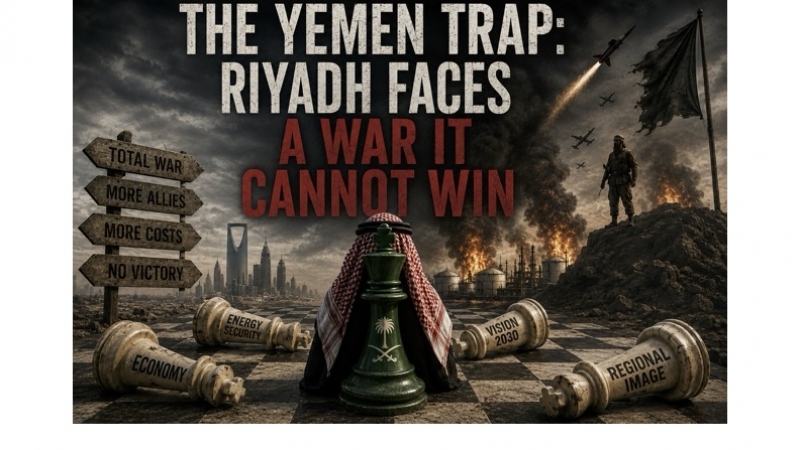
King Abdul Aziz is sometimes credited with warning his sons, while on his death bed, that Yemen posed a serious danger to the Bani Saud throne.
The broader strategic argument is that Yemen’s geography, population, independent Islamic political traditions and proximity to Saudi usurped Arabia have made relations between the two states consequential for the security of the illegitimate Saudi monarchy.
Saudi royal conduct including gambling, extramarital relationships, corruption, drug trafficking, political repression, destabilisation of neighboring countries, sectarian discrimination and improper alliances with zionist-imperialist regimes increase the threat to the illegitimate Saudi monarchy.
Imam Muhammad Al-Asi’s Qur’anic framework: custodianship, Yemen, and accountability
Al-Asi’s central argument is that political authority should be evaluated by its conduct, not merely by religious titles, ancestry, public rituals or control of sacred sites (Al-Asi, Muhammad: The Ascendant Qur'an: Realigning Man to the Divine Power Culture: (Vols 1-12). ICIT, Toronto (2008-2022)).
He challenges the assumption that rulers automatically represent Islam because they administer Makkah and Madinah.
His question is functional: who benefits from their decisions, whose security do they prioritise and whether their policies reflect justice.
Al-Asi’s approach draws on the Qur’anic principle expressed in the discussion of Prophet Ibrahim’s leadership: “My covenant shall not encompass the offenders.”
This principle challenges hereditary entitlement to Islamic legitimacy.
Under this interpretation, custodianship is a responsibility accountable to Allah rather than an unconditional privilege inherited through a dynasty.
The implications for Yemen are profound.
The Saudi regimes’s military aggression against Yemen in 2015 and the devastating humanitarian consequences invite scrutiny of whether its regional security policy has adequately protected civilian life.
Al-Asi explicitly condemns the war against Yemen and asks whether rulers who exercise power while disregarding suffering are genuinely conscious of divine accountability.
He invokes the Qur’anic discussion on injustice and the failure of the Saudi regime’s political and religious authorities to uphold divine guidance.
He connects sincere service to Allah with action rather than ritual performance.
This forms part of his wider argument that Islamic legitimacy cannot be reduced to ceremonial observance.
Al Asi’s criticism is that rulers may invoke rituals to legitimise their authority while pursuing policies that deserve independent moral scrutiny.
The relevant question is not whether Bani Saud perform Islamic rituals, but whether their conduct demonstrates justice, restraint, accountability and protection of vulnerable people.
This framework is relevant.
Yemen’s innocent civilian victims matter regardless of political allegiance.
Bani Saud’s religious identity cannot excuse their attacks on civilians.
The credibility of being the “Protectors of The Two Holy Sanctuaries”
In order to ramp up sectarian tensions, they claimed to intercept a drone around Makkah and a cruise missile around Madinah before it entered restricted airspace.
The responsibility for the alleged attacks has been rejected by Ansar-Allah.
Bani Saud have deployed no interceptors to protect the Two Holy Sanctuaries in Makkah and Madinah.
With the known threats by the zionists and imperialists to “Nuke Mecca”, the question is whether the defence posture by the regime of Bani Saud is adequate and effective against these open enemies.
It is also legitimate to ask whether the rhetoric surrounding alleged/false threats from Yemen is used to justify continued military operations or divert attention from the humanitarian consequences of the zionist-imperialist aggression in the region.
Al-Asi argues that political independence must be measured by actual decision-making rather than appearances.
He asks whether rulers are more responsive to their zionist-imperialist allies than to the Muslims whose interests they claim to represent.
His discussion of military dependence and cooperation with zionist and imperialist powers forms part of this critique.
This standard applies to the regime of Bani Saud’s security cooperation involving Israel, the United States and other states.
Such relationships should be assessed through documented agreements, military arrangements and actual policy decisions.
This raises a legitimate issue: when a government, in this case the Saudi regime, relies on zionist-imperialist military assistance, it must explain how that relationship serves its population, the Ummah, regional stability and humanitarian obligations.
Al-Asi further warns that sectarian and nationalistic identities undermine solidarity.
He argues that Muslims should not allow Sunni–Shi‘i or Arab-Persian tensions to obscure shared concerns about injustice, zionist-imperialist aggression or civilian suffering.
It also means re-examining how sectarian, national and ethnic narratives shape public support for Bani Saud’s war against Yemen and discourage criticism of powerful institutions of the regime of Bani Saud.
Al-Asi’s Qur’anic framework demands both moral criticism and intellectual discipline. Political actors should be judged by evidence, policies and consequences-not by inherited prestige or collective identity.
The title “Custodian of the Two Holy Mosques” carries exceptional Islamic and moral weight. Under Al-Asi’s framework, that weight increases, rather than diminishes, the obligation to protect life, resist injustice, scrutinise zionist-imperialist dependencies and pursue peace in Yemen.
Sacred custodianship cannot substitute for accountability and obstruct political criticism. The decisive test is whether the regime of Bani Saud ends its aggression that perpetuate conflict.
Zafar Bangash’s Seerah framework and the Covenant of Madinah
The Seerah provides a framework for examining political authority through covenant, mutual obligations, protection and the pursuit of communal security (Bangash, Zafar: Power Manifestations of the Sirah. Toronto: ICIT. (2011)).
The Covenant of Madinah, associated with the Prophet Muhammad’s (ﷺ) establishment of an organised community, illustrates the importance of agreements governing relations among different groups including negotiated coexistence and defined responsibilities.
Applied to the Saudi regime and Yemen, this framework raises three questions.
First, does security policy protect innocent people on both sides of a conflict?
The Prophet’s political leadership cannot responsibly be reduced to military victory alone. A serious Seerah-based assessment must consider the protection of noncombatants, the fulfilment of agreements and the pursuit of arrangements that prevent recurring violence.
Yemen’s humanitarian suffering therefore remains central to evaluating Saudi policy.
Second, does the Saudi regime distinguish between an armed movement and the population living under its control?
A population should not be collectively punished for the actions of its rulers or armed resistance movement.
Similarly, dubious allegations that Ansar-Allah threaten Makkah or Madinah must be assessed through reliable evidence.
Third, is religious custodianship exercised as a trust or propagandised as an instrument of political legitimacy?
Under a covenant-centred interpretation, protecting pilgrims is an essential responsibility, but it does not cancel obligations toward Yemen’s civilians.
A Seerah-based judgment should, therefore, prioritise civilian protection, fulfilment of obligations, impartial justice and reconciliation.
Dr. Kalim Siddiqui’s Islamic Movement Theory
Siddiqui’s Islamic Movement Theory examines the relationship between political power, the Islamic movement, leadership and the struggle to establish a social and political order informed by Islam (Bangash, Zafar: In Pursuit of the Power of Islam: Major Writings of Kalim Siddiqui. Toronto: The Open Press (1996); and Siddiqui, Kalim: Stages of Islamic Revolution. London: The Open Press, London (1996)).
In applying this approach, the central issue is not merely whether the Saudi regime possesses Islamic institutions or administers the Two Holy Mosques.
It is whether its political decisions reflect the ethical and collective purposes emphasized in Islam.
From this perspective, hereditary authority and religious symbolism do not independently establish political legitimacy.
The question is whether institutions serve the public interest, uphold justice and protect communities from oppression.
The Yemen conflict exposes a tension between claims of Islamic guardianship and the consequences of regional military policy.
The Saudi regime’s intervention and the suffering experienced by Yemenis demand scrutiny of the relationship between political objectives and humanitarian responsibilities.
An Islamic political assessment cannot excuse such attacks merely because they are conducted by the Saudi regime under the guise of “Guardians of the Two Holy Mosques” while serving zionist-imperialist interests.
The deeper question concerns the adequacy and purpose of the state’s security arrangements. Does the Bani Saud regime combine effective defence against the zionists and imperialists with a coherent strategy for reducing regional hostility?
Does it pursue negotiations and civilian protection or allow security rhetoric to overshadow the political causes of conflict?
Siddiqui’s framework also invites scrutiny of dependence on powerful external allies.
Foreign military partnerships are not, by themselves, proof of illegitimacy.
Their significance depends on whether they preserve meaningful political autonomy and serve the welfare of the Ummah.
Ultimately, an Islamic movement perspective calls for political accountability, institutional integrity, and a principled alternative to domination.
Custodianship should be demonstrated through responsible governance rather than titles alone. The appropriate standard is to protect the sanctuaries, safeguard civilians throughout the region, reject sectarian mobilisation and pursue a just settlement in Yemen.
Custodianship is a responsibility, not an exemption from criticism.
Its credibility depends on protecting the sanctuaries and the pilgrims, defending civilian life, exercising political power justly and pursuing regional peace.
Those standards must be applied consistently to the illegitimate Saudi regime.