 Archives
Multimedia
Donate
About
Sign In
Archives
Multimedia
Donate
About
Sign In



 Muslim Mahmood


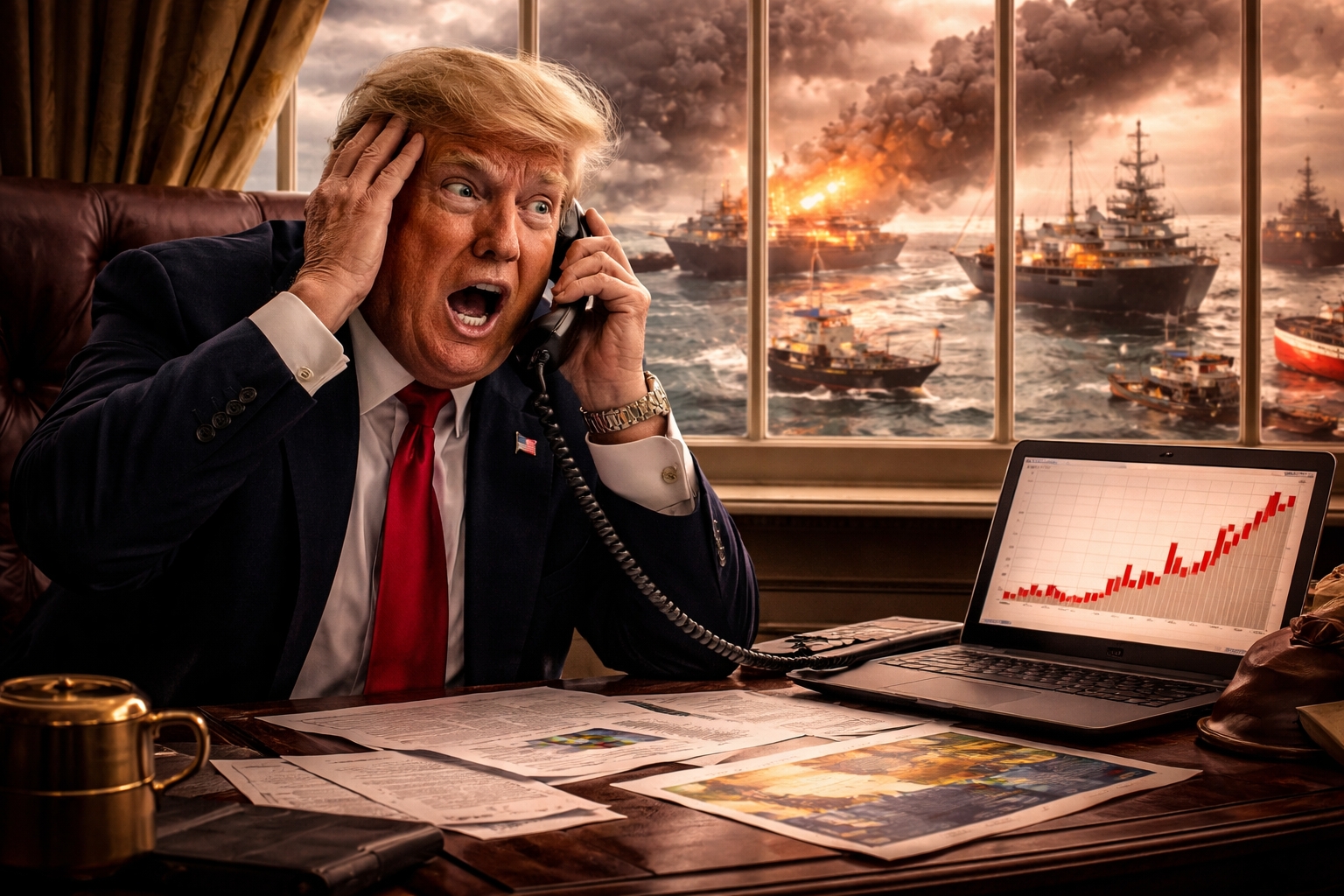
As of May 2026, the global geopolitical landscape has shifted into what many analysts describe as a “neverending story” with no “Hollywood ending”. The conflict in West Asia, characterized by a direct military attack by the United States and zionist Israel on Iran has exposed deep fractures in the post-World War II global order.
The underlying causes of this escalation, the economic burden placed on the working class, and the strategic failures that have led to what economist Yanis Varoufakis calls a “surgical autopsy of the American empire” need examining.
Dismantling of Diplomacy
The current crisis can be traced to the deliberate destruction of the 2015 Joint Comprehensive Plan of Action (JCPOA). Former Greek Finance Minister Yanis Varoufakis, in a confrontational exchange with television host Piers Morgan, argued that the western political establishment chose to dismantle a functioning, internationally verified agreement. Varoufakis noted that the 2015 deal “included extremely arduous verification processes” with cameras, sensors, and international inspectors.
According to Varoufakis, the Trump regime withdrew from the deal not because of an intelligence failure, but because of “direct political pressure from a foreign government” and a desire to “bring down anything that Obama had done”.
This abandonment of diplomacy left the US with no “Plan B” and, as Varoufakis lamented, “not even a plan A”. The result was a plunge into an “open-ended asymmetrical conflict” with a state [Iran] that controls the Strait of Hormuz, one of the most vital economic choke points on the planet.
Strategy of Attrition and the “Vietnam Trap”
Military analysts and former negotiators warn that the United States has fallen into a “Vietnam trap” by miscalculating Iran’s resilience. Rob Malley, former US special envoy for Iran, observes that the Trump regime’s strategy assumes that “economic pain will force progress toward an agreement,” but this misreads the Iranians’ mindset. Iran’s leadership, Malley argues, is “prepared to take huge costs” because they view capitulation as a “ticket for endless pressure” on their missile and drone programs.
Professor Jiang Xueqin describes the current conflict through the “strategy of attrition”. He explains that while Washinton expected “shock and awe” to lead to an “unconditional surrender” in two weeks, the plan failed when Iran “shot back” and closed the Strait of Hormuz.
The math of this war is particularly punishing for the west: Iran utilizes “cheap drones” costing $50,000 to destroy hardware worth “tens of millions of dollars”. Meanwhile, the US spends between $3 million and $10 million on each interceptor missile to shoot down these drones. “America is spending 60 times more money to defend itself than Iran is spending to attack,” Jiang notes, adding that “time is on Iran’s side”.
This asymmetry extends to the physical battlefield. Unlike the flat deserts of Iraq, Iran is mountainous and “four times the size of Iraq” with a military doctrine built over two decades specifically to “trap” an invading force inside an “exhausting multi-front conflict”.
Economic Invoice for the Working Class
While the military-industrial complex continues to receive massive funding, American and European working classes are bearing the financial brunt of these conflicts. By May 2026, the US national debt had surged to an “all-time high,” crossing $38.9 trillion. Despite this, the federal government has allocated roughly $850 billion for the War Department’s base budget, pushing total national defense spending toward $1 trillion.
The human cost is reflected in everyday expenses. Gas prices across the US have “skyrocketed to over $4.40 a gallon” or more. Inflation has reached 3.8%, and global supply chains for oil and fertilizer have fractured.
Varoufakis argues that the corporate media and political elites act “completely blindsided” by these predictable outcomes, treating the global economy like a “geopolitical casino” where ordinary citizens cover the “massive losses”.
Geopolitical Realignment and the Waning Petrodollar
The war has accelerated a shift in the global “geopolitical architecture”. Former US allies are increasingly acting independently. Japan, feeling “unceremoniously sidelined” by US policy, is pursuing alliances with other countries, including Iran, to secure its energy needs. Canada is reportedly “strengthening its Arctic defense ties with Nordic countries” as trust in the US weakens.
A central driver of this shift is the “existential threat” to the petrodollar. Since 1974, global oil trade in US dollars has required the world to hold American debt, financing the “American empire”. However, the emergence of a “Eurasian trade system” involving Russia, China, and Iran—trading in non-dollar currencies—threatens to end what Professor Jiang calls a “giant Ponzi scheme”.
The BRICS states (Brazil, Russia, India, China, and South Africa) are strengthening their ties, with world leaders “cutting bilateral deals with Iran one after another”.
The Failure of Propaganda and “Hasbara”
The zionist state of Israel, a key player in the regional conflict, is facing a “reputational problem that no amount of money or messaging can compete with”. Despite jacking up its “Hasbara” (propaganda) budget from $150 million to “almost 3/4 of a billion” dollars, public opinion continues to decline. Polling indicates that “more than 60% of Americans” now have an unfavorable view of Israel, seeing it as a “moral and economic liability”.
Benjamin Netanyahu’s attempt to control the narrative through mainstream outlets like CBS News’s 60 Minutes is struggling against the reality of “genocide, war crimes, and devastation” being “live-streamed” by audiences on the ground. Reports, such as those from the New York Times, have documented “systematic cases of rape in prisons” and sexual violence against Palestinian prisoners by soldiers and settlers.
While the Israeli regime characterized these reports as “blood libel,” the evidence of such crimes has been “openly discussed in the Israeli media” and even “proudly posted” on social media by soldiers themselves.
Asymmetric Successes and the Cost of War
The effectiveness of western military technology is also being challenged by low-cost innovations. In South Lebanon, Israeli forces have been forced to withdraw due to “Hezbollah’s $300 FPV drones”. These “cheap weapons” have successfully targeted “multi-billion dollar military systems,” including Iron Dome batteries, $6 million tanks, and command vehicles.
Simultaneously, mainstream media outlets are beginning to admit that Iran has “destroyed and seriously damaged” US military bases across West Asia. Investigations by the Wall Street Journal, CNN and the Washington Post report that Iranian strikes have hit “at least 228 structures or pieces of equipment” at US military sites since the war began.
US intelligence officials admit it will cost “tens of billions of dollars” to repair these bases, even as the US military finds itself “running out of missiles fast”.
Call for Accountability
The current trajectory points toward a “prolonged regional war” that could trigger a “severe internal political crisis” in the United States. Strategic clarity has disappeared as “mission statements have changed every 10 seconds,” leaving even the president’s own negotiators unsure of “what victory looks like”.
Varoufakis’s “masterclass” in geopolitics serves as a stark reminder that international law must not be discarded for political convenience. He asks, “When is a people allowed to rebel against their incarceration, their ethnic cleansing, their abolition from the face of the earth?”.
He rejects the idea that a US or Israeli victory is the “lesser of two evils,” calling the conflict a “criminal war” that disregards the “great success of the human spirit in 1945 of introducing international law”.
Ultimately, the findings suggest that the “Unwinnable War” is the result of a “mindset” that refuses to break with failed strategies of regime change. As the public increasingly questions the “high costs of regime-change wars and global instability,” the demand for “progressive accountability” grows. The era of letting the “architects of our decline dictate the terms of our survival” may finally be coming to an end.


The US socio-economic and political system is a complete failure but the corporate media continues to project it as a huge success. Americaâ...
The US stands at a dangerous point in its history. Donald Trump has already said that if he loses, he will not accept the election result. H...
America is a deeply divided society today. Events of the last few months have brought these divisions to the fore. Can Americans overcome su...
America’s infrastructure is on the verge of collapse. Build 60 years ago, most bridges and watermains need replacement. Its highways are f...