 Archives
Multimedia
Donate
About
Sign In
Archives
Multimedia
Donate
About
Sign In


 Mohamed Ousman


The most revealing way to examine the moral record of modern international politics is to ask a simple question: what happens to children when powerful states decide that political objectives matter more than civilian life? Iraq and Palestine provide two devastating case studies. They also expose a problem of collective memory: the suffering of Muslim children can become extraordinarily visible for a moment and then disappear from the political consciousness of the wider world.
Iraq is an especially important case because the sanctions regime that followed the 1991 US War on the country demonstrates that children can become victims without being the immediate targets of bombs. The 1999 UNICEF survey reported that, in central and southern Iraq, child mortality had risen dramatically and estimated that there would have been approximately 500,000 fewer child deaths between 1991 and 1998 had the mortality decline of the previous decade continued.
The figure was subsequently disputed. The historical point, however, survives the statistical controversy: sanctions contributed to a profound humanitarian crisis in which children bore an extraordinary burden.
That distinction matters. Moral criticism should not depend upon an uncontested number. Whether the appropriate figure is 500,000, substantially lower, or calculated differently, the underlying phenomenon was real: Iraqi children suffered from the destruction of infrastructure, economic isolation, deteriorating health services, malnutrition and the broader consequences of war and sanctions. The controversy over the number should therefore produce greater intellectual precision, not historical amnesia.
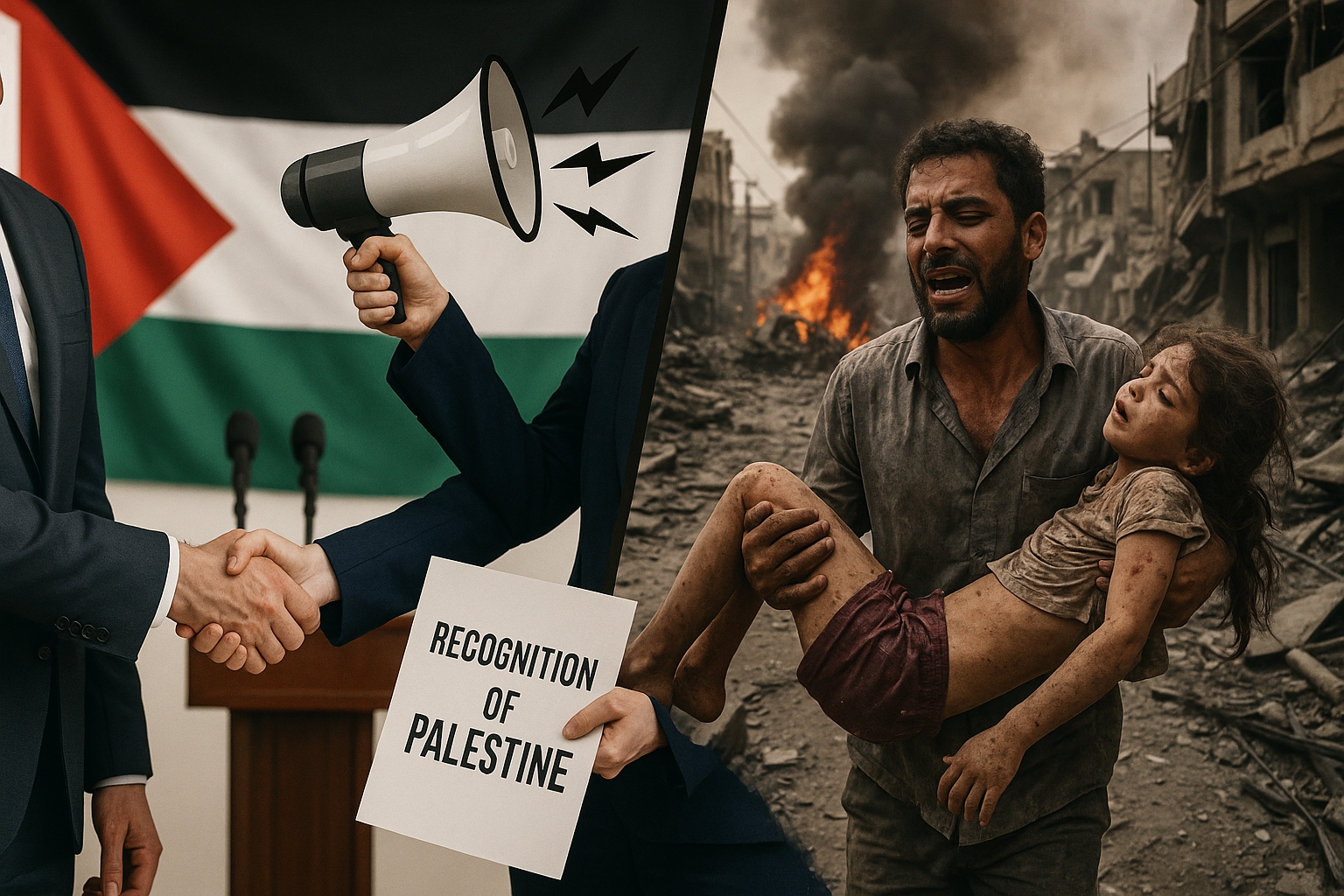
Palestine presents an even more immediate illustration. UNICEF reported that by February 3, 2026, at least 21,289 children had been reported killed in Gaza since October 7, 2023, alongside 44,500 injured children.
UNICEF also reported that children continued to die after the October 2025 ceasefire, demonstrating that a formal reduction in hostilities did not automatically produce physical security for children. In June 2026, UNICEF again reported children killed in Gaza and a seven-month-old Palestinian child shot in the West Bank, warning against allowing such deaths to become “the new normal.”
The comparison with Iraq, therefore, concerns more than numerical equivalence. It concerns the political valuation of Muslim childhood. A child does not understand sanctions, deterrence, strategic depth, occupation, alliances or geopolitical calculations. The child knows hunger, fear, displacement, the absence of parents and the destruction of home. Yet the international system repeatedly transforms these human realities into abstractions: “collateral damage,” “humanitarian consequences,” “security measures” or “unintended effects.”
This is where the argument about western inaction becomes strongest—and also where it requires nuance. It would be somewhat accurate to say that beyond rhetoric literally nobody outside the Muslim world cared about Muslim children in Iraq and Palestine.
Humanitarian organisations, journalists, activists, churches, critics of Israeli policy, anti-war movements and sections of western civil society have repeatedly protested. Social media, aside from being meaningless noise and ineffective mobilization, has enabled documentation—which were impossible at the same scale during the 1990s.
The deeper criticism is different. Moral outrage has repeatedly failed to become proportionate political power. Children are mourned without the policies producing their suffering being fundamentally changed. The existence of humanitarian sympathy is, therefore, not equivalent to justice.
That is the central lesson of Iraq and Palestine. The question is not whether the world can see dead Muslim children. It plainly can. The question is whether the western-crafted international political order that plays hide and seek between the Political Left and the Political Right will attach sufficient moral and political consequences to their deaths.
History suggests that sympathy without power, memory without institutional action, and information without political transformation can leave not only the underlying structure untouched but a false sense of consciousness.
Imam Muhammad al-Asi's Qur'anic framework
Al-Asi's Qur'anic framework offers a radically different starting point for evaluating the killing and abandonment of children. Instead of beginning with the strategic interests of states, it begins with taqwa, responsibility and the inviolability of human vulnerability. Al-Asi repeatedly places children, orphans and families at the centre of an Islamic moral order. That framework provides a powerful lens through which Iraq and Palestine can be examined.
The first principle is that military power itself is morally bounded. Al-Asi records the Prophet’s instructions to military commanders: “do not act treacherously, do not mangle or butcher, and do not kill young children”. The significance of this instruction is greater than a prohibition against one particular battlefield practice.
It establishes that victory cannot redefine morality. Military necessity does not grant unlimited permission. Power remains subordinate to Allah.
The instruction attributed to Abu Bakr reinforces the principle: “Do not kill women, children or elderly people”. The contrast with modern warfare is, therefore, profound.
Contemporary strategic discourse frequently treats civilian suffering as a regrettable by-product of legitimate military objectives. The Qur’anic framework instead asks whether the objective and the means remain within divinely defined moral boundaries.
The treatment of the orphan deepens the argument. Al-Asi observes that a truly Islamic society is distinguished by “its compassion for the weak and exposed individuals and families” and that the interests of powerless members are a priority. This transforms the child from a statistical unit into a trust placed within society’s moral responsibility. The death of a child is, therefore, not merely a private tragedy. It is an indictment of the social order that failed to protect the vulnerable.
The importance of family intensifies this obligation. Al-Asi describes the family as “the natural nest for the newborn, the infant, and the baby” and argues that within its environment children develop physically, intellectually and spiritually.
War consequently possesses a destructive capacity beyond killing individual bodies. Bombing homes, separating parents from children, producing orphans and destroying schools, hospitals and neighbourhoods, attack the social environment through which childhood itself becomes possible.
This is particularly important in Palestine. UNICEF has documented not merely deaths but injuries, displacement, loss of parents, destruction of health facilities and the collapse of essential services. A Qur’anic analysis, therefore, cannot restrict itself to counting bodies. It must ask what happens to the family system that sustains the child.
Al-Asi’s warning that social deterioration begins incrementally is equally relevant. He describes a process in which practices initially regarded as immoral gradually become normalised until “the more honest people” simply learn to live with them.
This provides a penetrating explanation of what the Iraq-Palestine comparison reveals. Repeated exposure to dead children can produce moral desensitisation. Yesterday's atrocity becomes today's headline, tomorrow's statistic and eventually background noise.
The Qur’anic framework, therefore, rejects the idea that moral responsibility disappears because violence has become routine. Indeed, repetition makes vigilance more necessary.
Al-Asi argues that the “first victims” of social decay are frequently “women, children, racial minorities, orphans, and widows”. The vulnerable are not accidentally located at the margins of his analysis; they are the diagnostic instrument through which the health of society can be judged.
This also explains why the family is repeatedly emphasised. Al-Asi writes that “a community that wants peace in society as a goal needs to have peace in its families as a means”. Peace cannot be reduced to the absence of open warfare. A society that destroys families while proclaiming humanitarian concern has misunderstood peace itself.
Applied to Iraq and Palestine, the Qur’anic question becomes uncompromising: what kind of civilisation permits children to become expendable while protecting the political and economic interests that surround their deaths? The answer cannot simply be that such suffering is inevitable in war. The Prophetic precedent establishes precisely the opposite principle: even war has limits.
Al-Asi’s Qur’anic framework thus shifts the debate from sympathy to accountability. The issue is not merely whether western societies have felt compassion for Iraqi or Palestinian children. It is whether their political institutions have allowed compassion to impose meaningful limits upon abuse of power. If compassion ends where strategic interests begin, then compassion has become sentiment rather than morality.
Imam Zafar Bangash’s Seerah framework
Viewed through a Seerah framework associated with Bangash (Power Manifestations of the Sirah, 2011) and the Islamic movement tradition, Iraq and Palestine should not be understood merely as isolated humanitarian catastrophes. They belong to a wider question concerning how Muslims understand power, responsibility, resistance and the organisation of the Ummah.
The Seerah does not present the Prophet Muhammad ﷺ as a purely private spiritual figure detached from political reality. It demonstrates the gradual construction of a community capable of defending itself, protecting vulnerable people and establishing institutions governed by moral principles. The prohibition on killing children, therefore, belongs within a larger conception of political authority: legitimate power exists to protect human beings, not to render them expendable.
This makes the child an important test of political legitimacy. When Iraq’s children suffered under war, sanctions and infrastructural collapse, and when Palestinian children continue to be killed, injured and displaced, the question becomes whether existing political structures possess the will and capacity to protect them. UNICEF’s documentation of Palestinian child casualties illustrates the continuing scale of that failure.
A Seerah-based analysis would also resist reducing Muslim responsibility to emotional solidarity. The Prophet’s community did not merely witness injustice and circulate descriptions of it. It developed relationships, institutions, political strategies and collective capabilities. The lesson is consequently not that Muslims should become spectators to suffering more efficiently, but that moral concern must produce organised responsibility.
This framework also cautions against confusing symbolic victory with complete transformation. Even a major geopolitical reversal would not automatically establish justice. The Seerah demonstrates that political success creates new responsibilities rather than abolishing them. Protecting children, widows, orphans and other vulnerable people remains a permanent obligation.
The Iraq-Palestine comparison, therefore, exposes a gap between moral consciousness and organised capacity. Muslims may possess intense emotional identification with suffering children while lacking institutions capable of converting that consciousness into sustained political outcomes. Conversely, western states possess enormous institutional capacity while repeatedly subordinating humanitarian concerns to strategic interests.
The Seerah framework brings these two failures together. It asks Muslims to develop the moral discipline, political intelligence, communal organisation and institutional capability necessary to protect life. The appropriate response to the suffering of children is, therefore, neither passive despair nor romanticisation of violence. It is the construction of power subject to moral law.
In this sense, the child becomes the measure of the movement itself: if political struggle produces greater capacity but does not produce greater protection for the vulnerable, it has failed one of the central tests imposed by the Prophetic model.
Dr. Kalim Siddiqui’s Islamic Movement Theory
Dr. Siddiqui’s Islamic Movement Theory provides perhaps the clearest explanation of why Iraq and Palestine cannot be treated simply as humanitarian stories. His starting point was the fragmentation of the Ummah and the absence of an effective political consciousness capable of challenging the structures governing Muslim societies. In The Islamic Movement: A Systems Approach (1976), he argued that if there is a single Ummah, there must also be a corresponding Islamic movement.
From this perspective, the repeated killing of Muslim children is evidence of a structural political problem. The child in Iraq did not suffer because Iraq lacked information about its humanitarian crisis. The child in Palestine does not suffer because the world lacks images of Gaza. Information exists in abundance. The problem is the unequal distribution of political power and the fragmentation of those who experience the consequences.
Siddiqui’s theory is particularly relevant to the critique of social-media activism. Digital communication can generate unprecedented consciousness, but consciousness is not identical to organised political capacity. A movement may produce millions of posts while remaining strategically fragmented. Siddiqui’s intellectual project was explicitly concerned with moving beyond such fragmentation toward an integrated global Islamic movement. His work after the Islamic Revolution in Iran focused increasingly on how that movement could acquire intellectual, institutional and political coherence.
The experience in Iraq demonstrates what happens when Muslim societies remain largely reactive. Condemnations may be issued, demonstrations held and humanitarian appeals circulated, yet the structures responsible for determining sanctions, war, diplomatic protection and economic policy remain outside Muslim control.
Palestine similarly exposes the limitations of fragmented nation-state politics. A child in Gaza is simultaneously a human being, a Palestinian and, within Islamic consciousness, a member of the wider Ummah. Yet the political institutions of Muslim-majority states frequently respond according to national calculations rather than a unified strategic conception. Siddiqui’s theory was developed precisely as a critique of this fragmentation and as an attempt to conceptualise an Islamic movement operating beyond narrow nation-state assumptions.
However, Siddiqui’s framework should not be reduced into a simplistic celebration of geopolitical confrontation. His central contribution was organisational and intellectual: Muslims needed a new consciousness, alternative political thought and institutions capable of translating principles into sustained civilizational action.
The lesson from the suffering of the children in Iraq and Palestine, therefore, is that outrage alone cannot constitute an Islamic movement. Nor can military strength alone. The political meaning of their suffering is that a movement claiming to represent the Ummah must develop sustainable capacity to protect its weakest members through lawful, disciplined and morally accountable institutions.
Under Siddiqui’s theory, a child’s death is consequently not merely a tragedy to be mourned. It is a question posed to the political consciousness of the Ummah: does the Ummah possess the organisation, institutions and political capacity necessary to ensure that its moral commitments have consequences?
That question is more enduring than any individual geopolitical prediction. It transforms remembrance from passive grief into a demand for intellectual, institutional and political responsibility.


The West’s enmity to Islam was brought home to Muslims in Britain earlier this month, when the British government published its list of pr...
Based on our understanding of global events and their impact on the Muslim world, we identify certain trouble spots that are likely to remai...
In Iraq, tens of people are dying every day as a result of Iraqi resistance operations against US, British and Iraqi government forces, oper...
US secretary of state general Colin Powell’s tour of the Middle East in February has heralded a change in America’s policy on Iraq. In a...