 Archives
Multimedia
Donate
About
Sign In
Archives
Multimedia
Donate
About
Sign In



 Editor


Two points must be made about the latest US campaign of economic terrorism launched against Islamic Iran, euphemistically referred to as Economic D-Day. First, it is an admission of US failure on the military front in its war of aggression, to resort to economic terrorism.
Second, it has not had the impact on Iran the US assumed it would. Instead, it has had far greater negative impact on US markets, even if temporarily.
There are two reasons for such failure. First, Tehran has lived with US sanctions for decades and gained much experience in dealing with them. Second, the attempted economic strangulation of Iran’s economy requires the cooperation of other countries. This has not been forthcoming. Also, Tehran has warned that any country that joins the US’s illegal economic sanctions will be considered at war with the Islamic Republic.
Most countries have refused to abide by US unilateralism. They argue, quite rightly, that these sanctions are not supported by any UN Security Council resolution.
Given Islamic Iran’s crushing military defeat of the US, other countries have become much bolder and are defying America’s unilateral actions. China is not alone in rejecting the new US sanctions on Iran.
Beijing declared its unequivocal opposition to such measures. It rejected threats of sanctions against countries trading with Iran, saying Beijing’s cooperation with Tehran is conducted in accordance with international law and should not be disrupted.
Chinese Foreign Ministry spokesperson Lin Jian made the remarks at a press conference on August 25 in response to questions about the latest US sanctions. He said “China is closely monitoring the developments,” stressing that Beijing would take all necessary measures to firmly safeguard its legitimate rights and interests.
China is Iran’s biggest trading partner. The bulk of Iran’s oil exports (80% plus) go to China. Tehran, meanwhile, imports a huge amount of good from China. Such trade cannot be stopped regardless of America’s rhetorical volleys hurled by Donald Trump through his social media platform. Few people in the world—apart from a dwindling number of his followers in the MAGA movement—take his rants seriously.
Let us look at the statistics to understand Iran’s trade situation better.
In 2024, Iran’s total exports amounted to some $56 billion to 112 countries. In the same year, it imported $68.55 billion worth of goods. These figures are based on the World Trade Organization (WTO) data for 2024. For 2025, Iran’s total trade was estimated at between $93 to $109 billion, with China accounting for more than $41 billion in Iranian crude oil imports, according to CNBC.
While the war and US naval blockade have reduced Iran’s oil exports in 2026, they have not been stopped completely, contrary to US claims. The announcement of harsher economic sanctions is proof of US failure.
Iran has benefitted from higher oil prices as well as having oil stored in supertankers that were released to the market in the early days of the US-zionist war. In the four months of 2026, $7.5 billion was deposited in Iran’s Central Bank from oil export earnings.
The Turkish daily, Yenişafak, quoting Iran’s Fars News Agency reported that the funds would cover the government’s foreign-currency expenditures from July through December, citing information obtained from Iran’s Oil Ministry. Tehran holds sufficient oil available for sale outside the blockade to meet full-year revenue targets through March 2027.
Let us, however, look at Iran’s top export partners in 2024. Leading the list is China with $14.58 billion, followed by Iraq at $11.7 billion. If China gets the bulk of Iran’s oil, Iraq gets gas for electricity generation. Tehran also sells electricity directly to Iraqi provinces in the south. Food products, building materials and manufactured goods make up the rest of Iranian supplies to Iraq.
Next on Iran’s list of export destinations are the UAE ($7.16 billion), Turkiye ($6.1 billion) and Afghanistan ($2.3 billion). Other countries include Russia, the Central Asian Republics, Armenia, Azerbaijan, Pakistan, India, Malaysia and Indonesia.
On August 19, the UAE imposed an indefinite trade embargo on Iran accusing it of firing missiles at its territory. Tehran denied the allegations, calling it a false flag operation.
The Emiratis imposed the trade ban after Trump spoke to the UAE ruler, Muhammad bin Zayed. The Emirati ban would affect the UAE more than Iran since it exported $21 billion worth of western goods to Tehran in 2024.
Based on Emirati hostility and close embrace of the US-zionist war criminals, the Islamic Republic had already made alternate arrangements for imports. The goods exported to Iran were not produced by the UAE. They were European manufactured goods and resold to Tehran. The Emiratis are so incompetent that they cannot even boil an egg.
China with its $17.8 billion worth of exports comprising machinery, electronics, vehicles and industrial components is the second largest partner followed by Turkiye with $11.1 billion exports. Iran imports machinery, chemicals, vehicles and manufactured goods from Turkiye through their shared land border. These supplies are unlikely to be affected despite US pressure to block them.
The two likely entities that may reduce or stop exports to Iran are the European Union ($6.1 billion) and India ($1.6 billion). The Europeans, mainly Germans, sell pharmaceuticals, medical equipment and machinery to Iran. India’s export comprise agricultural goods including rice, tea and pharmaceuticals. Iran can find substitute suppliers for these.
It is interesting to note that a number of countries have said they will not abide by America’s unilateral sanctions. In addition to China and Russia, Pakistan and Qatar have also openly defied US demands.
When a thug and bully gets a bloody nose from a supposedly much weaker opponent, it gives others the courage to stand up to him and defy his illegal orders. Far from harming Iran, America’s economic terrorism has boomeranged and exposed it as a giant with feet of clay.
It is time for Uncle Sam to pack his bags, military equipment or whatever is left of it, and aircraft carriers and leave the region. If it refuses, it will face even worse humiliation than what it experienced in Vietnam and Afghanistan.
The US navy is already looking for alternate ports including Diego Garcia, India and even Singapore to anchor its ships since Iran destroyed the Fifth Fleet’s base in Bahrain. Perhaps there are still some sensible people in the US military!


If the US were to try and meddle with the Iran deal, it would end up as loser.

The very idea of US-Iran talks appears far-fetched given the extreme hostility Trump showed toward Tehran during his last term as president....

What direction the indirect talks between Iran and the US would take is difficult to predict. In the latest round on April 26, the US demand...
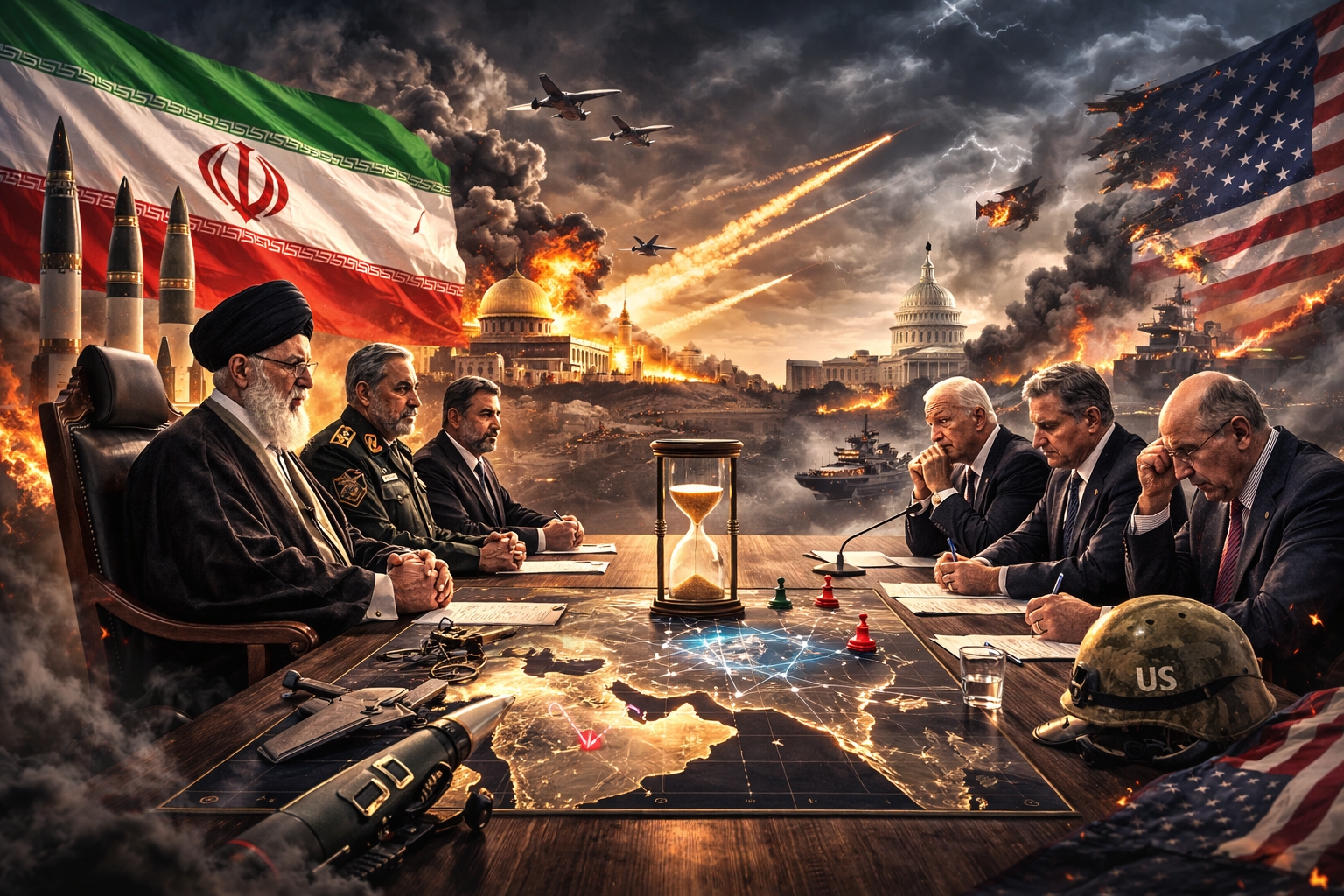
Many people ask, with good reason, why Islamic Iran continues to negotiate with the US when its record is upholding any agreement is appalli...