 Archives
Multimedia
Donate
About
Sign In
Archives
Multimedia
Donate
About
Sign In



 Brecht Jonkers


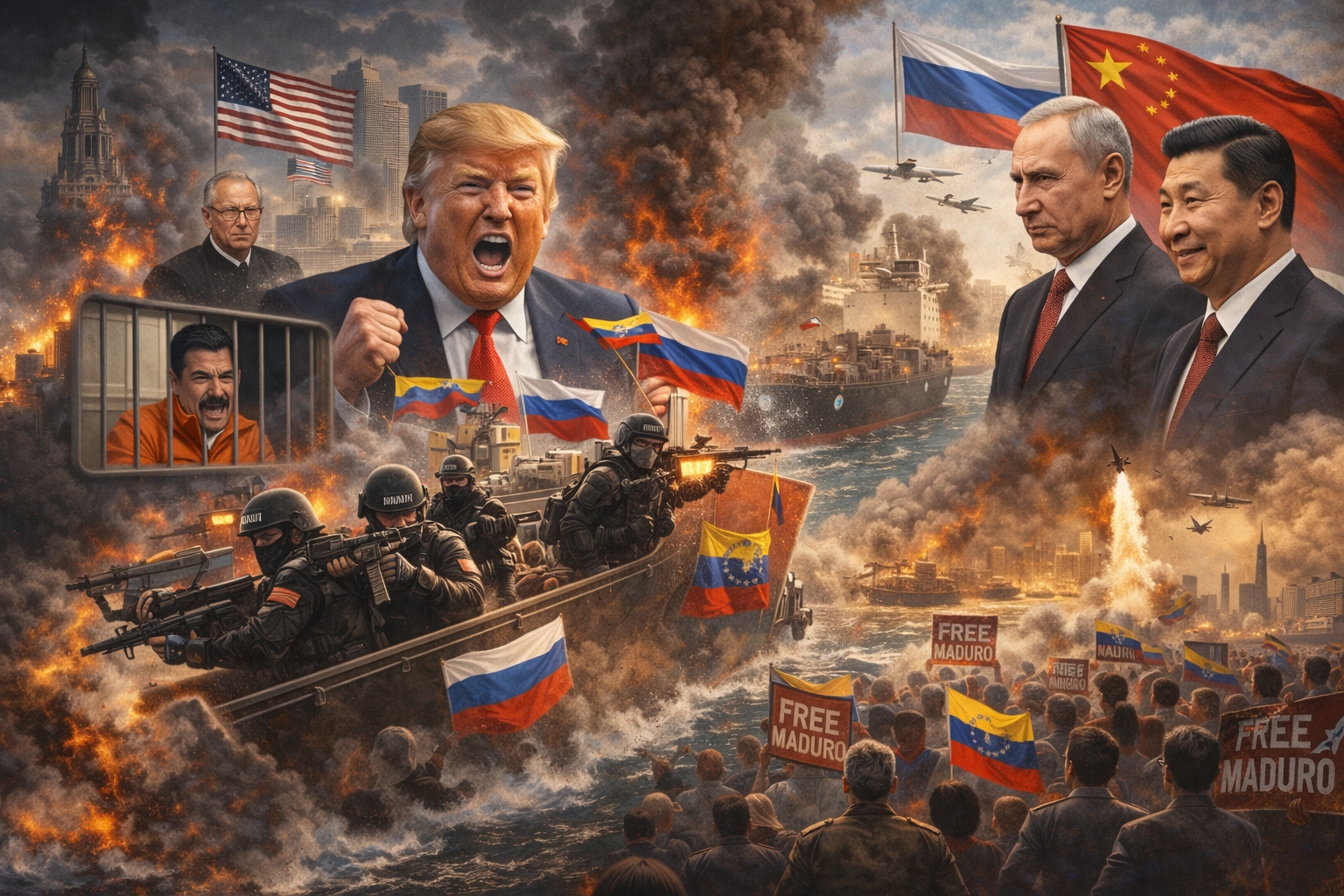
US President Donald Trump’s recent visit to China, which he, not surprisingly claimed to be a major success, was soon overshadowed by a much more fruitful visit by Russian President Vladimir Putin to Beijing.
The Russian president’s visit was planned long ahead of Trump’s decision to meet with Xi Jinping, a fact that western media seems keen to obfuscate. Rather than Putin’s visit being a hurried response to the White House, it seems more likely that the convicted felon visited China as part of a desperate plea for help from the world’s booming superpower. The plea failed ignominiously.
Let’s start with the earlier planned Sino-Russian summit. China and Russia signed an Extension of China-Russia Treaty on Good-Neighborliness and Friendly Cooperation during Putin’s visit to Beijing, continuing 25 years of the said treaty originally conceived in 2002. Furthermore, they agreed on collaboration on matters such as digital infrastructure, railroad connections and the Heihe-Blagoveshchensk cable car project. China also gave Russians guaranteed visa-free entry into China until the end of 2027.
Even more significant are the wider political proclamations agreed upon between Putin and Xi. The wording of the joint declaration of China and Russia following the meeting was particularly interesting. It marks one of the first times, and probably the most high-profile occasion so far, that the concept of a multipolar world order is mentioned in official government communication:
“Advocating a harmonious process of shaping an equal and orderly multipolar world and international relations of a new type, including a more just and rational system of global governance, Russia and China undertake and call on the international community to adhere to the following basic principles in their relations with one another:
“1. The principle of openness of the world to inclusive and mutually beneficial cooperation.
“2. The principle of indivisible and equal security.
“3. The principle of democratisation of international relations and improvement of the global governance system.
“4. The diversity of world civilisations and values.
“Russia and China will continue to develop a shared vision for shaping a multipolar world and more just international relations of a new type.”
By contrast, the results of the Sino-US summit seem insignificant, if there were even any results at all. Aside from agreeing to purchase Boeing aircraft and working towards a decrease in tariffs, there was little else. While Trump may tout the agreement on reducing tariffs in the future as a victory, this is laughable since he is responsible for the tariff build-up in the first place.
At the geopolitical level, nothing was resolved, nor likely even addressed at length. The major issue that Trump was hoping to get Chinese backing on, was of course, the matter of Iran and the Strait of Hormuz.
With worldwide economic repercussions of the Ramadan War, including indirectly for China, the White House had set its hopes on Beijing using its geopolitical weight to force the issue. It proved elusory.
While the Chinese Ministry of Foreign Affairs addressed the matter, it remained limited to calling for a “comprehensive and lasting ceasefire”. Which basically means the US and Iran have to resolve the issue among themselves. Not surprisingly, China has been allowed passage through the Strait of Hormuz as a friendly state of Iran.
Most mainstream news outlets in the west have been lukewarm about the results of Trump’s visit, a sentiment that is shared by experts. According to Amanda Hsiao of consultancy firm Eurasia Group, “despite all the ceremony and summit theatrics, (…) at the end of the day, this summit will not be that significant.”
This should come as no surprise. As Gao Zhikai, vice president of the Center for China and Globalization in Beijing, who is better known in the West as Victor Gao, said in the heat of the tariff war: “China has been here for 5,000 years. Most of the time, there was no United States and we survived. And if the United States wants to bully China, we will deal with the situation without the United States, and we expect to survive for another 5,000 years.”
In other words: China has little concern with the opinions of the United States, as the balance of power has shifted to such an extent that China doesn’t need Washington to “approve” of what it does or doesn’t do.
China has its own national interests to care about. And these interests first and foremost concern national security and securing its economic basis. The United States has little to offer China in either of these two areas, unless it were to agree to a military withdrawal from the Pacific and dismantle its military bases in Japan and South Korea.
The People’s Republic has made it clear that it remains dedicated to the One China Principle, according to which the island of Taiwan is recognised as part of a united China. Any US support for Taiwanese separatism will result in conflict with Beijing.
Regarding China’s economic interests, Russia has far more to offer. For instance, the Power of Siberia 2 Pipeline project is a direct connection stretching 2,600 km which can pump up to 50 billion cubic meters of gas per year from Russia to China.
Iran, too, is a political and economic partner of China, being a major supplier of petroleum to the Beijing and a signatory of the Sino-Iranian strategic cooperation agreement in 2021. While China has adopted a calm diplomatic approach and has not directly challenged the United States during its bombing campaign against Iran, it is clear that Beijing is opposed to any hypocritical posturing or sanctions against Tehran.
No doubt, the strategic defeat of the US regime change agenda in Iran is cause for relief in China. It shows the fundamental weakness of the US military apparatus against a resilient power, which is highly encouraging news for China at a time when Washington has often been quite aggressive in its dealings with Beijing. From the Chinese perspective, the US has been defeated by Iran, and as such would stand no chance in a war against China.
Trump’s decision to visit China was made out of weakness. It was a desperate attempt to salvage geopolitical standing in a world that is rapidly changing and moving away from US hegemony.
Trump, Marco Rubio and Pete Hegseth apparently believed they could imitate the 1970s diplomatic successes of Henry Kissinger, when he pursued rapprochement with China in order to try to isolate the Soviet Union. This proved to be a foregone quest, as China has no desire, or reason, to get dragged into animosity with either Iran or Russia.
The days of the US as the global hegemon are over. And like with every dying empire, the ruling elites are too stubborn and blinded by hubris to accept the writing on the wall.
Not that it matters in the end, as the wheels of history keep turning regardless. A multipolar, non-hegemonic world order is being shaped before our eyes. And those who seek to stop the unstoppable will be washed away by the tide of history.


The Trump regime’s policy of courting Russia is designed to de-link it from China and Iran, two countries being targeted by the US. Will i...

Donald Trump is acting like a bull in a china shop (no pun intended). His tariffs war, especially against China has caused more damage to th...