
 Archives
Multimedia
Donate
About
Sign In
Archives
Multimedia
Donate
About
Sign In



 Iqbal Jassat


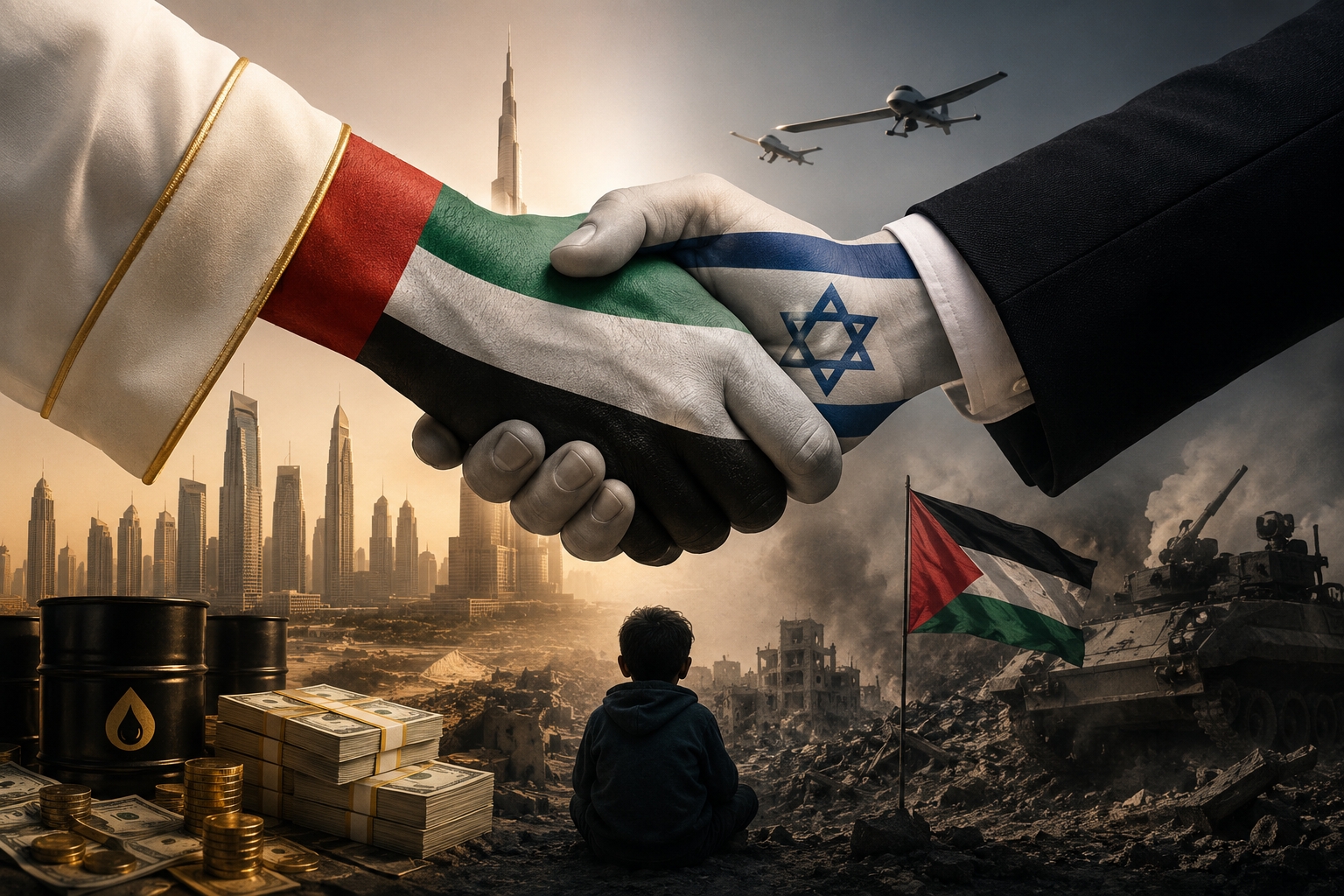
It is entirely misplaced to believe, as many political pundits do, that the United Arab Emirates (UAE) is a force for stability in West Asia and in Africa.
It would also be naive to overlook that it has built a regional network of military, political and economic influence that has reshaped conflicts from Yemen and Libya to Sudan.
Given that Palestine is central to understanding UAE strategy, the relationship Abu Dhabi has developed with zionist Israel cannot be separated from its wider regional project.
It is in this context that Abu Dhabi has identified Islamic Resistance Movements as well as popular movements demanding political change as strategic threats.
Following the Israeli playbook, to contain or crush these movements, its response has always been to ally with regimes, military factions and political forces capable of repressive criminal conduct.
Thus, it is not surprising that such a strategy intersected directly with Israel’s own security interests.
The September 2020 Abraham Accords formalised diplomatic relations between the UAE and Israel.
The agreement opened the door to rapid expansion of economic and strategic cooperation, including defence relationships, without any regard for the ongoing Genocide in Gaza.
While the UAE presented normalisation as a mechanism for peace and claimed that it had stopped Israel’s annexation of parts of the West Bank, this myth has been exposed given intense violent settlement expansion as well as the ongoing ethnic cleansing of Palestinians across the Occupied West Bank.
Having openly dumped Palestine’s freedom struggle—it never offered any real support in the past—Abu Dhabi adopted normalisation as a gateway for Israel to increasingly integrate with Arabian regimes while the occupation and massacres continued.
However, with the Palestinian cause being separated from regional diplomacy, which is what the UAE’s regional strategy is all about, the other Arabian regimes’ so-called stance on Palestinian statehood also stands exposed as fake.
The evidence speaks for itself.
Israel has gained diplomatic recognition, economic access and strategic partnerships with Arabian regimes while Palestinian statehood remains unresolved.
As participant in Trump’s unilaterally conceived Board of Peace and a member of the Gaza Executive Board, the UAE is in a position that extends far beyond humanitarian assistance.
Though it gives Abu Dhabi a role in the political architecture being constructed around postwar Gaza in cahoots with the zionist war criminals, its track record of collaboration with the settler colonial entity does not provide any hope.
After all in Yemen, the UAE supported local armed groups and developed influence in southern Yemen.
In Libya, it backed the renegade Khalifa Haftar and supplied military equipment and drones.
In Sudan, extensive evidence and reporting has connected UAE-backed networks to the Rapid Support Forces that are involved in war crimes and crimes against humanity.
And in Palestine, the UAE has established itself as one of the Arab regimes with zero interest in defending fundamental rights of Palestinians suffering decades of zionist occupation.
UAE rulers claim to provide tons of aid but as is well-known, humanitarian assistance does not erase geopolitical alignment.
It is bizarre to proclaim angelic values while simultaneously maintaining normalised relations with perpetrators of satanic evil.
Surely such contradiction deserves scrutiny and outrage.
Nearly three years of genocide in Gaza have not stopped the UAE from maintaining full diplomatic, commercial and security ties with the zionist entity.

People can easily be taken in by the propaganda that the zionist entity is too powerful. Far from it. There are deep internal divisions that...

The west’s support of Israeli-perpetrate genocide in Gaza reflects the dying gasps of a decaying empire and the realization that western h...
