
 Archives
Multimedia
Donate
About
Sign In
Archives
Multimedia
Donate
About
Sign In



 Crescent International


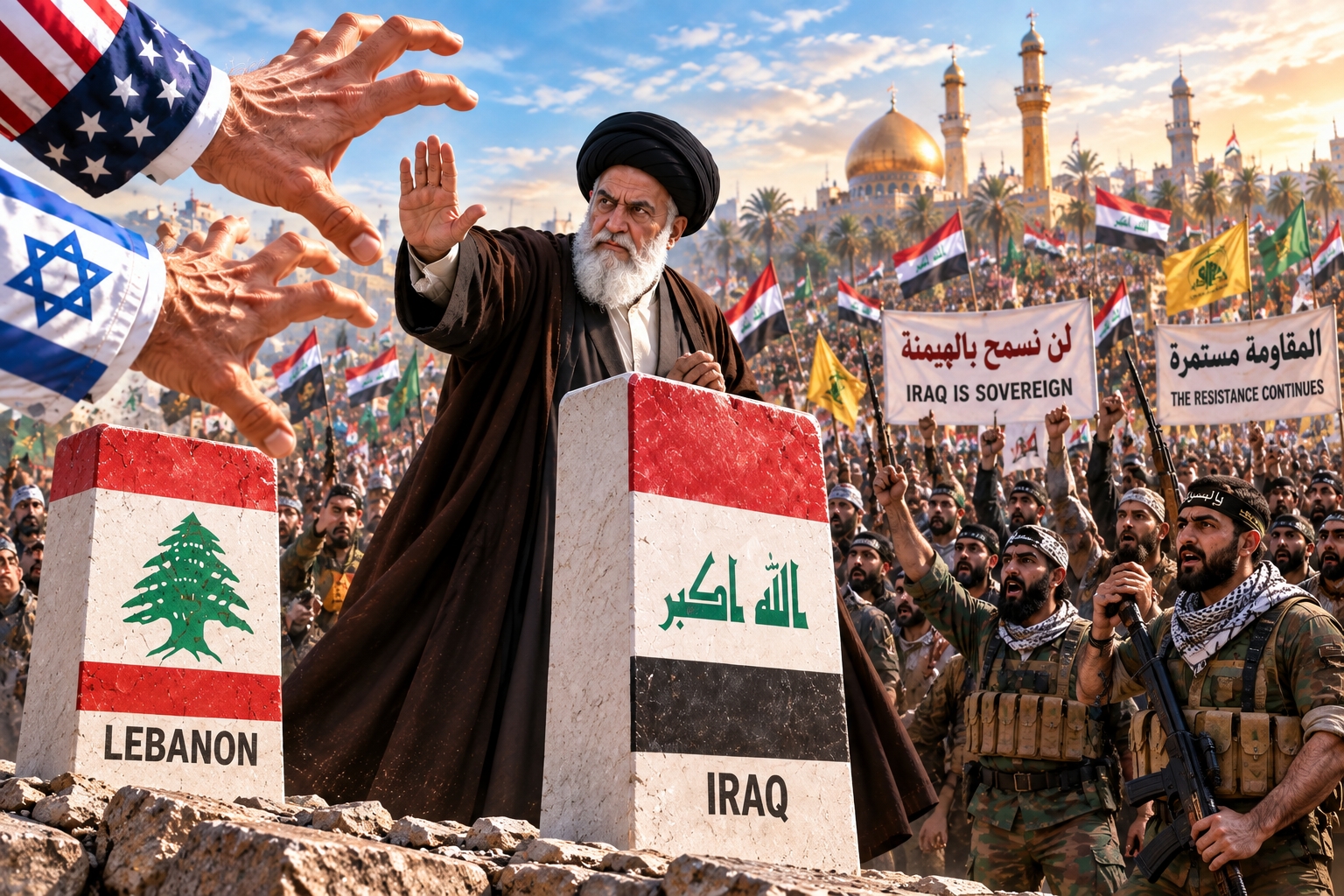
The US-zionist confrontation with Islamic Iran was never confined to one theater.
Today, this reality is simply a lot more obvious than before.
Washington and Tel Aviv are attempting to pressure Tehran across the entire regional landscape, from Palestine and Lebanon to Syria, Iraq and Yemen.
Iraq increasingly appears to be emerging as another major arena in this plot.
The US has framed the issue in Iraq as weapons.
Washington is pressing Baghdad to disarm powerful Iraqi resistance factions associated with the Hashd al-Sha‘bi (Popular Mobilization Forces).
Reuters reported on September 9 that the Iraqi government is facing US pressure to disarm Iran-aligned groups, several of which have rejected such demands.
There is an obvious parallel with Lebanon.
There, Washington has supported a political process intended to place Hizbullah’s weapons under the control of its puppet officials, while Israel applies military pressure.
Yet even after months of enormous military, political and economic pressure, Hizbullah has refused to surrender its weapons, and implementation of the US-instigated arrangement has collapsed.
Trying to transplant this failed strategy to Iraq represents a deeply flawed analogical reasoning.
Iraq is not Lebanon, and the Hashd is not simply an Iraqi version of Hizbullah.
The Hashd emerged from an extraordinary Iraqi national crisis.
The US-Israeli-backed takfiri groups captured Mosul in June 2014 when the Iraqi military apparatus was collapsing.
At that time Ayatullah Ali al-Sistani issued his famous wajib al-kifa’i—collective obligation—fatwa calling upon Iraqis capable of fighting to volunteer for the security forces and defend Iraq, its people and its sacred places.
Tens of thousands responded.
This historical origin matters enormously.
The Hashd was subsequently institutionalized by the Iraqi parliament in 2016.
Under Iraqi law, the Popular Mobilization Forces became part of Iraq’s armed forces and formally report to the commander-in-chief.
Thus, Washington faces an immediate contradiction: it is demanding that Baghdad establish state control over weapons while seeking to weaken an institution that Iraqi law already recognizes as part of the state’s security architecture.
The role of the maraj‘e (singular marja‘, meaning authoritative religious scholar) makes the American calculation even more problematic.
Najaf has consistently emphasized that weapons should ultimately operate under legitimate Iraqi state authority.
But there is a huge difference between placing weapons under the authority of a powerful, sovereign and genuinely independent Iraqi state and dismantling resistance forces under pressure from Washington while Iraq remains susceptible to US political, economic and security leverage.
For the maraj‘e, Iraqi sovereignty cannot logically mean replacing autonomous armed power with foreign-directed political power.
This is where Washington badly misread the Iraqi society.
The Najaf hawza and the maraj‘e are not peripheral institutions.
They possess enormous religious and social authority and deep historical roots within Iraqi society.
Nor is the Hashd merely a collection of Iranian groups.
It encompasses very different tendencies, including factions associated with Iran, formations connected to the maraj‘e, and forces historically associated with other Iraqi Shi‘i currents.
An Iraqi-led effort to strengthen the state and rationalize its security institutions is, therefore, one matter.
An American-Israeli campaign designed to use the slogan of “state monopoly over weapons” to dismantle organizations challenging the evil duo’s aggression is something altogether different.
The real struggle is not about weapons, but over Iraqi sovereignty.
That would produce precisely the opposite of Washington’s intended result.
Instead of isolating Iran-aligned factions, overt US and Israeli pressure could provide them with a powerful political argument: that their weapons are being targeted not because they challenge the Iraqi state, but because they obstruct foreign domination of Iraq.
This is also part of the reason why this approach has failed in Lebanon despite decades of pressure.
If the US and Israel have struggled to produce decisive strategic results through the disarmament campaign against Hizbullah in Lebanon, implementing the same formula in Iraq will be considerably more difficult.
Iraq has the maraj‘e, an institutionalized Hashd, powerful Islamic political movements, memories of US occupation and extensive religious, economic and geographical connections with neighbouring Iran.
Washington may, therefore, discover that its campaign to weaken Iran’s influence in Iraq produces the opposite outcome.
By attempting to dismantle the structures through which Iraqi resistance operates, Washington will end up mobilizing the very social forces that make American domination of Iraq impossible.


Millions of Iraqis, setting aside political differences, joined hands in a peaceful rally in Baghdad on January 17 to demand the ouster of a...
Benjamin Netanyahu is a nasty creature and a compulsive liar. In order to enhance his chances of successes at the poll, he is prepared to ki...
Syrian forces make rapid progress with Russian air support against the terrorists in eastern Aleppo. Next stop will be Raqqa.
