
 Archives
Multimedia
Donate
About
Sign In
Archives
Multimedia
Donate
About
Sign In



 Zia Sarhadi


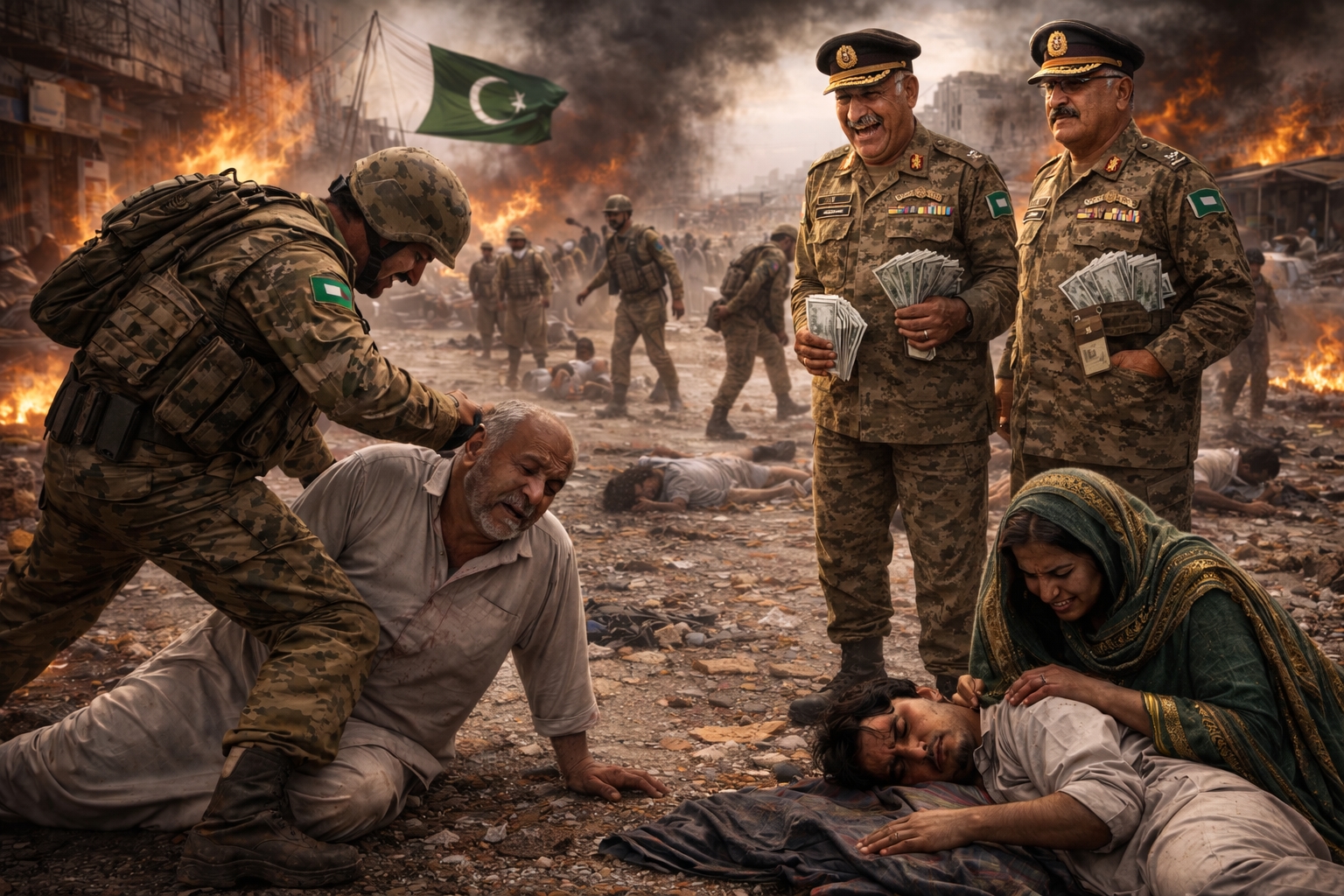
Until recently, if someone mentioned Kashmir, it automatically meant Indian occupied Kashmir. The horrors India has perpetrated against the Kashmiris are well documented.
Now, thanks to the geniuses ruling Pakistan, they have turned Azad Jammu and Kashmir (AJK), that part of the state administered by Pakistan, also into a killing field. Dozens of Kashmiris have been gunned down by the police and Rangers over the last few weeks.
The Rangers are a paramilitary force headed by a serving Pakistan army general. Killings have occurred in various parts of Azad Kashmir inculding Rawalakot, Barnala, and Kotli.
What is the reason for such killings?
The Kashmiris have for months complained about high food and fuel prices as well as lack of education and medical facilities. There are few job opportunities in the state. To get a sense of what is meant by lack of facilities, consider this.
The population of Azad Jammu and Kashmir (AJK) is around four million. There are six universities in the state. The Mirpur University of Science and Technology received significant financial help from the Kashmiri diaspora in Britain.
There ar four medical colleges and one agricultural university in the state.
Compare that to Indian occupied Kashmir. There are 12 major universities offering general course, 14 medical colleges, 17 engineering universities and two agricultural universities for a population of eight million Kashmiris. These facilities must be viewed against the backdrop of India’s policy of subjugating the Kashmiris and preventing them from making progress.
People on both sides of what is referred to as the Line of Control (LoC) are aware of these glaring differences. Winning hearts and minds means providing basic necessities of life and services to the people .
When the Kashmiris express their genuine concerns, the authorities in Azad Kashmir and Pakistan let loose the security forces to fire at them. The number of Kashmiris killed has been estimated at between 20 and as high as 150 and 200 since June 6.
Now the authorities have inserted a totally unnecessary controversy about allocating 12 reserve seats to refugees from Indian occupied Kashmir. Complicating the situation further is the fact that these refugees do not live in Azad Kashmir but have moved to cities across Pakistan.
There are a total of 45 seats in the AJK assembly. The reserve seats allocation is meant to manipulate local politics.
If the authorities are so concerned about the well-being of refugees from Indian occupied Kashmir, they should provide them better services. That, however, is not their first priority.
Some 40,000 refugees live in appalling conditions in camps dotted across Azad Kashmir. Their housing is grossly inadequate.
Schools lack basic facilities. Children are forced to sit on the floor because there are no desks available for them in classrooms. Hospitals lack proper supplies. For instance, there is no MRI in any hospital in AJK. The Kashmiris have been demanding an MRI machine for many years.
The plight of the Kashmiris in AJK has worsened over the last two years because of rising prices. This is even worse for the refugees. The authorities have not provided any funding for them.
Theoretically, an annual budget of Rs 240 million (approx $857,000) is allocated for their needs annually. Each refugee is supposed to get Rs 2,000 (approx. $7) per month. This is a the paltry sum.
What could that small amount buy amid skyrocketing prices of food, fuel and other items of daily need? Without such funding, even the little they could buy has been denied. They live an extremely precarious existence.
So, if the authorities really care about the refugees including those that have moved out of Azad Kashmir, their first step should be to provide adequate funding to assist with their daily needs and living conditions.
Neither the refugees nor the people of Azad Kashmir are against Pakistan. For them, Pakistan is their hope and dream. Unfortunately, their dream is being turned into nightmare by corrupt politicians that are being imposed on them by the military through political manipulation.
To protest these actions, the Joint Awami Action Committee (JAAC), a grassroots organization, gave a strike call for June 9. Three days before the strike, the police and rangers fired on people killing dozens of them. Some strike leaders were also injured.
Curfew was imposed on June 6 in Rawalakot, the capital of Poonch district and the centre of protest movement. Rangers took up positions on rooftops and fired on unarmed people down below. What did they want to achieve, apart from terrorising peaceful protesters?
As if such brutality was not bad enough, the authorities also blocked food and medicines being delivered to people in Azad Kashmir. Hundreds of trucks are stranded at the Kohala bridge as well as at Ajeera in Poonch district.
One could be forgiven for mistaking these stranded trucks with those lined up at the Gaza border blocked by the zionist occupiers. The Pakistan army is beginning to act like the zionist occupation army in Palestine.
Whatever happened to Kashmir being the jugular vein of Pakistan? Why are Pakistani generals behaving so recklessly?
People that ask for basic rights whether in Baluchistan, KPK or Azad Kashmir are immediately branded as terrorists. Such labels are used to justify the army’s killing its own people whether in Baluchistan or KPK. And the army has spread its terror campaign to AJK as well.
Are a handful of generals the only patriots in Pakistan? Does serving their masters in Washington DC fall under the category of patriotism?
Far from liberating Occupied Kashmir from the clutches of India, the Pakistani generals are alienting Kashmiris in Azad Kashmir. If this policy continues, there is a serious risk of losing this part of Kashmir as well.


A meeting in Toronto on November 5, 2016, commemorated the July 8 tragic killing of young resistance leader, Burhan Wani. He was 22 when sho...
3People in Occupied Kashmir and their supporters around the world observed the first anniversary of Burhan Wani’s martyrdom on July 8. Indi...