
 Archives
Multimedia
Donate
About
Sign In



 Mohamed Ousman


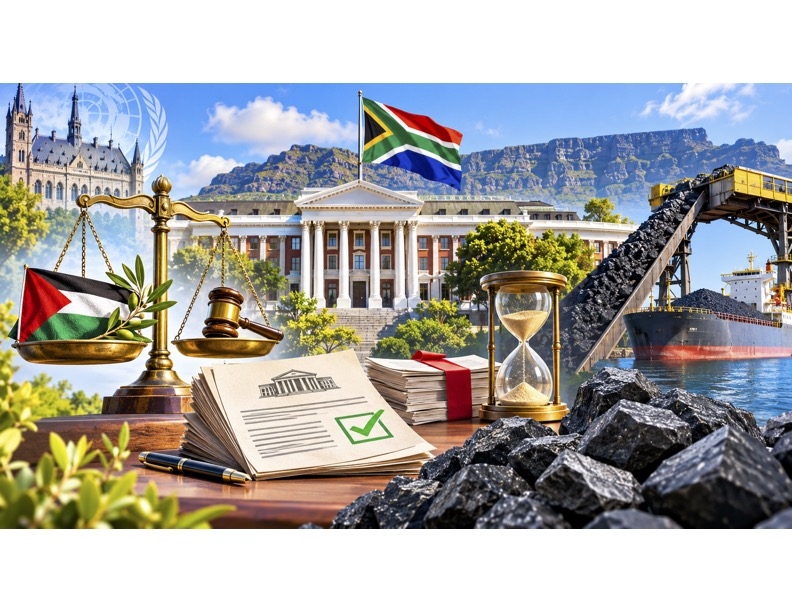
November 21 marks three years since the majority of South Africa’s parliamentarians voted to suspend relations with Israel.
The SA government presents itself as a champion of Palestinian justice internationally, pursuing Israel through the ICJ and supporting accountability through international legal mechanisms.
Yet domestically, it has failed to translate this professed commitment into decisive political, economic and legal action.
Despite parliamentary support for suspending diplomatic relations, SA’s coal exports and the continued presence of SA’s citizens serving in the Israeli military raise serious questions about enforcement and political will.
The government invokes international law when addressing the world but retreats behind bureaucratic processes when confronted with demands for domestic implementation.
Its rhetoric of solidarity consequently outpaces its actions.
Imam Muhammad Al-Asi’s Qur’anic framework Analysis
Al-Asi’s Qur’anic framework provides a particularly powerful lens through which to examine the contradiction between SA’s international advocacy for Palestinian justice and its domestic political and economic conduct (Al Asi, Muhammad: The Ascendant Qur’an, Vols 1-12, ICIT, Toronto (2008-2022).
At the heart of his framework is the distinction between a society organised around Qur’anic principles of justice and one governed by material self-interest, institutional expediency and the rationalisation of wrongdoing.
Contradiction between justice and material self-interest
Al-Asi explains how colonial powers exploited the generosity and humanitarian disposition of oppressed peoples, transforming their willingness to share into opportunities for domination and exploitation. His argument is that societies which abandon justice in favour of material acquisition become susceptible to imperial interests.
SA's position raises a comparable moral contradiction.
The government invokes the suffering of Palestinians, condemns Israeli conduct and pursues international legal proceedings, yet its economic interests continue to intersect with Israel's economy.
World Bank trade data records approximately 722,396 tons of SA’s coal exported to Israel in 2024, rising to approximately 1.86 million tons of bituminous coal in 2025.
This is not simply a question of commercial activity.
It is a question of whether economic considerations are being permitted to override the ethical and political commitments that the government publicly professes.
If solidarity with Palestine is a matter of principle, why should commercial interests be insulated from that principle?
Politics of convenience
Al-Asi contrasts the forces of kufr, represented by dominant global powers and those aligned with their interests, with committed Muslims whose determination to uphold justice transcends their apparent material and military weakness.
Applied to SA’s situation, this framework demands that political decisions be evaluated according to their contribution to justice rather than their compatibility with prevailing international power arrangements.
SA's historic anti-apartheid credentials and its ICJ proceedings demonstrate an apparent willingness to challenge powerful interests. However, the reluctance to implement corresponding domestic measures raises the question of whether the government is prepared to confront the economic and diplomatic consequences of its stated convictions.
The point is not only that every diplomatic engagement constitutes complicity and that international litigation is futile.
Rather, it is that moral independence must be demonstrated through consistent conduct.
A government cannot indefinitely present international law as its guiding principle while treating domestic implementation as an indefinitely postponable political inconvenience.
Institutional rationalisation
Perhaps Al-Asi's most penetrating contribution is his argument that rationalisations are not merely individual psychological responses; they are produced and reinforced by the social, political and institutional environment.
He distinguishes between dhikr, understood in this framework as reflection informed by divine guidance, and fusuq, the justification of conduct within a society organised around special interests.
This distinction is directly relevant to the government’s delayed response based on bureaucratic procedures, constitutional separation of powers and diplomatic considerations.
However, they become instruments of fusuq when repeatedly deployed to avoid confronting the moral substance of a political decision.
The parliamentary resolution of November 21, 2023 received 248 votes in favour and 91 against.
It called for closure of the Israeli embassy and suspension of diplomatic relations until a ceasefire and a commitment to binding UN-facilitated negotiations.
Yet, as Ntshavheni subsequently indicated, Cabinet had not even discussed the matter and was not in a hurry to do so.
The danger identified by Al-Asi is that institutional rationalisations gradually normalise contradictions.
What should provoke moral discomfort becomes administratively acceptable. The language of process replaces the language of accountability.
Institutional complicity and collective responsibility
Al-Asi further argues that perpetual wrongdoing becomes institutionalised through the participation of large numbers of people who provide administrative, managerial, promotional and economic support.
Institutions thereby acquire the capacity to sustain wrongdoing beyond the intentions of any individual.
This insight is especially important when considering coal exports, arms-related commercial relationships and the question of SA citizens serving in the Israeli military.
The SA government announced on December 18, 2023 that citizens joining the IDF without authorisation could be prosecuted under the Regulation of Foreign Military Assistance Act.
The issue, therefore, is not an absence of a legal framework but whether that framework is being enforced.
Al-Asi's argument requires us to examine not merely individual culpability but the institutional structures that permit potentially contradictory practices to continue.
Importantly, his critique should be directed at state policies, political institutions and structures of oppression, not generalised to people as an ethnic or religious community. Collective moral responsibility must never become collective ethnic blame.
Political accountability
Al-Asi's framework ultimately demands consistency between knowledge, belief and action. A government that understands the injustice, articulates the moral case and possesses relevant legal instruments must also demonstrate the political will to act.
This is a significant challenge to SA's political leadership. International legal advocacy is valuable, but it cannot substitute for an integrated programme of political, economic and legal accountability.
The distinction between the International Court of Justice (ICJ), which addresses disputes between states, and the International Criminal Court (ICC), which prosecutes individuals for international crimes, is important here.
South Africa's case against Israel is before the ICJ; it should not be confused with an ICC prosecution instituted by South Africa against Israeli officials.
The ICJ's provisional measures have imposed binding obligations concerning the prevention of acts prohibited by the Genocide Convention.
They are not, however, a final judgment that genocide has legally been established.
Justice cannot remain an international public-relations exercise.
It must become an organising principle of domestic governance. Otherwise, the language of justice risks becoming precisely the kind of institutional rationalisation that Al-Asi identifies as fusuq.
Imam Zafar Bangash’s Seerah framework and the Covenant of Madinah
Bangash’s Seerah framework, particularly his emphasis on Prophetic leadership, institution-building, consultation and collective responsibility, provides another perspective on SA's contradictory position (Bangash, Zafar: Power Manifestations of the Sirah, ICIT, Toronto 2011).
The Prophet Muhammad (ﷺ), upon establishing the Madinah community, did not limit justice to declarations of goodwill.
Through the Covenant of Madinah, he established a political and social framework that recognised mutual obligations, collective security, the protection of communities and the administration of justice.
The Covenant demonstrated that principled solidarity must be translated into institutional commitments. It brought together different communities under an agreed framework of responsibility rather than allowing political convenience to determine whose rights deserved protection.
Applied to SA, the central question is whether the government is practising principled leadership or merely expressing solidarity through rhetoric.
The parliamentary resolution of November 21, 2023 represented an important expression of collective political will.
Its 248 votes demonstrated substantial parliamentary support for action.
The Executive's subsequent failure to prioritise that resolution raises questions about consultation, accountability and the relationship between representative institutions and executive authority.
The Seerah framework also challenges Muslims and other supporters of Palestine not to confuse emotional solidarity with effective political organisation.
The Madinah model requires commitments, institutional mechanisms and accountability.
SA cannot claim the moral authority of international justice while indefinitely postponing the domestic consequences of its own political commitments.
The lesson from the Covenant of Madinah is that justice must be institutionalised.
It must protect the oppressed, impose responsibilities upon the powerful and translate collective declarations into enforceable action.
Dr. Kalim Siddiqui’s Islamic Movement Theory Analysis
Siddiqui's Islamic Movement Theory provides a framework for understanding the relationship between political power, ideological commitment and the transformation of society (Bangash, Zafar (ed): In Pursuit of the Power of Islam, Open Press, Toronto, 1996 & Siddiqui, Kalim: Stages of Islamic Revolution, Open Press, London, 1996).
His central argument is that Islam cannot be reduced to individual spirituality or moral declarations.
It is a comprehensive political and social program requiring organised collective action.
Siddiqui identifies the indivisibility of din and politics, the sovereignty of Allah and the opposition between the political forces of Islam and kufr as fundamental principles of Islamic political thought.
Applied to SA, this framework exposes the limitations of a government that professes solidarity with the oppressed but allows economic and diplomatic considerations to undermine its declared commitments.
The government’s international advocacy demonstrates that it understands the political significance of Palestine.
However, the absence of corresponding domestic measures reveals a disconnect between political pronouncements and the exercise of political power.
Siddiqui would challenge the assumption that participation in existing political institutions, parliamentary resolutions and international legal proceedings is sufficient to achieve transformation.
Political commitments must be supported by organised constituencies, independent political thinking and institutional capacity to hold governments accountable.
The Islamic Movement, therefore, should not simply applaud SA's ICJ intervention.
It must assess whether the government's domestic policies reflect the principles of justice it invokes internationally.
The responsibility of the Islamic Movement is to develop an independent political position, mobilise civil society and pursue measurable accountability: an end to complicity through trade, enforcement of existing legislation and implementation of Parliament's expressed position.
Ultimately, Siddiqui's framework demands that political authority be judged by its actual contribution to justice, not its rhetoric.
Credibility of SA's international legal intervention is weakened when its domestic conduct does not reflect the principles it advances internationally.
The fundamental contradiction is this: South Africa wants to be recognised as a champion of international justice without consistently accepting the domestic political and economic obligations that such a position entails.
There are three immediate tests of political integrity: 1. What measures will stop SA’s coal exports from sustaining Israel's economy? 2. What investigations and prosecutions have followed the government's December 2023 warning concerning South African citizens serving in the IDF? 3. Why has the Executive not transparently addressed Parliament's November 21, 2023 resolution and implemented it?
In Qur'anic terms, the challenge is to move from declarations of justice to the actual establishment of justice.
Justice cannot be selective, solidarity cannot be merely rhetorical, and political conviction cannot be indefinitely postponed.