 Archives
Multimedia
Donate
About
Sign In
Archives
Multimedia
Donate
About
Sign In



 Iqbal Jassat


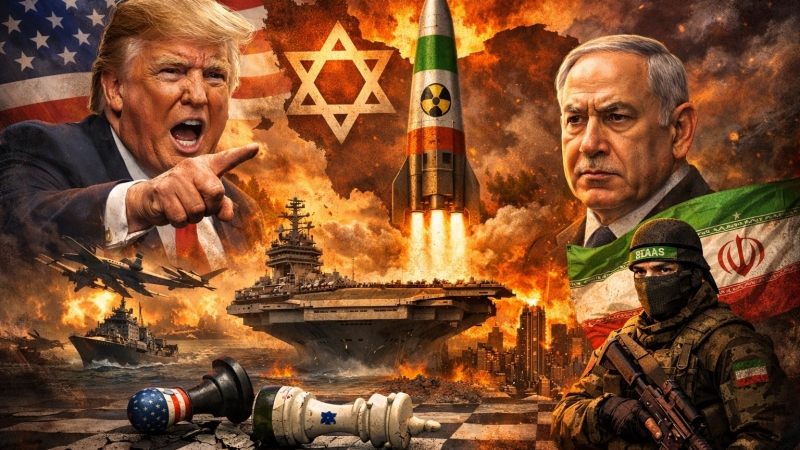
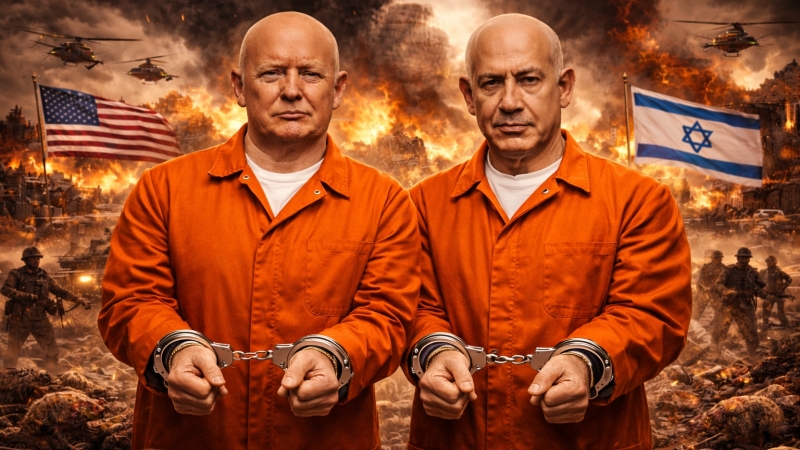
While uncertainty clouds the possibility of America launching a full-scale war on the Islamic Republic of Iran, pro-war narratives emanating from the apartheid regime of Israel, desperately seek to justify it.
The war-cries raised by Israel’s genocidaires are hardly surprising.
After all it is well known that Benjamin Netanyahu has, since the 1990s, been pressuring the United States to undertake direct military action against Tehran.
Hence it would not be incorrect to conclude that Washington’s war drums over Iran are not the product of strategy.
They are the product of imperial reflex and zionist pressure masquerading as deterrence.
Bizarrely, the spectacle of force assembled under Trump’s orders, the largest concentration of US air and naval power in the region since 2003, is being sold as strength, whereas it is, in fact, insecurity dressed up as bravado.
The indicators tell their own story.
Despite the theatrics of deployment, the expected escalation signals, mass embassy evacuations and sweeping NOTAM expansions, remain limited.
Even within the military establishment, caution seeps through the cracks.
As noted in the February 2026 analysis circulated by Larry Johnson and Douglas Macgregor, the absence of full-spectrum preparatory measures suggests hesitation, not inevitability.
Contrary to the mainstream media’s view of “weighing options”, the reality points to a deeply fractured power struggle inside Washington’s war machine.
For instance, the Washington Post report citing Chairman of the Joint Chiefs Dan Caine is particularly revealing.
Caine’s warning about depleted munitions stockpiles, exhausted by Washington’s underwriting of Israel’s war machine and its proxy entanglements in Ukraine, punctures Trump’s fantasy of an “easily won” confrontation.
Trump’s public denial of Caine’s caution is predictable.
But the leak itself is the story when senior military officials allow their reservations to reach the press, it is the Pentagon placing a marker in history: we warned him.
The pressure by Netanyahu on Trump has placed him in a huge dilemma.
Iran is not Iraq. It is not Libya. It is not a fragmented state awaiting aerial collapse.
It is a threshold nuclear state with layered air defenses, dispersed missile clusters, hardened infrastructure and strategic depth supported by Russia and China.
The fantasy that standoff air power will induce “disintegration” is recycled doctrine from Kosovo, Iraq and countless failed coercion campaigns.
Precision bombing has never delivered political submission where sovereignty is embedded in national resistance.
Yet Trump persists in the illusion that overwhelming force will produce capitulation.
Historians will remind us about the folly of imperial hubris.
What is absent from Washington’s framing is the geopolitical driver beneath the rhetoric.
The protection of Israeli supremacy remains the unspoken constant. Every escalation is filtered through Tel Aviv’s security doctrine. Every negotiation is judged by whether it secures Israel’s regional dominance.
Just as the American public is told the “reason” for US hostility is about nuclear proliferation, so too have zionist-allied agents in South Africa used similar fake arguments to justify the annihilation of Iran.
Some Israeli-based analysts who are skeptical about Netanyahu’s motives, remind us that his long-held view about a US attack on Iran would be a “masterstroke”, to attain his personal incentive to remain in power.
The reality though as cautioned by Caine, exposes a deeper truth: the United States is overextended.
Its munitions stockpiles are strained.
Its alliances are brittle. Its domestic coalition is fractured.
A war with Iran would not be a swift surgical strike. It would be attrition, retaliation and regional conflagration.
What unfolds now is not a clash of civilizations.
It is the exhaustion of empire confronting the limits of coercion.
War with Iran would not restore American dominance.
It would accelerate its unravelling and the warning has been issued from within.
Whether Trump listens is irrelevant to the structural decline already underway.
Iqbal Jassat, Executive Member, Media Review Network, Johannesburg, South Africa