
 Archives
Multimedia
Donate
About
Sign In
Archives
Multimedia
Donate
About
Sign In



 Muslim Mahmood


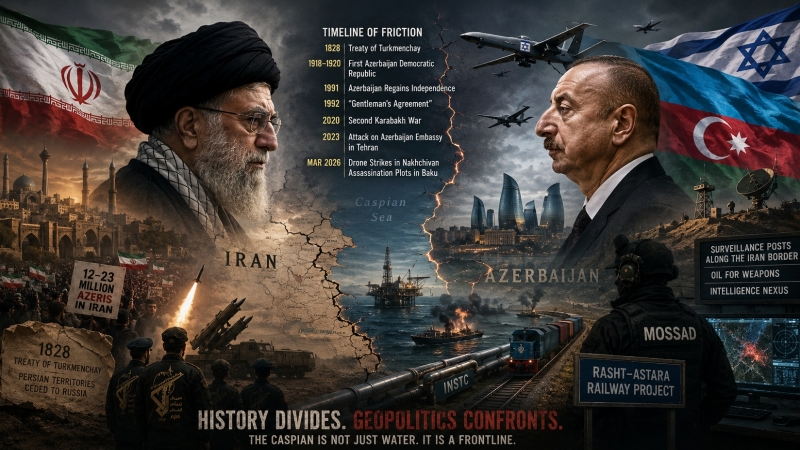
The tension simmering between Tehran and Baku is not merely a localized dispute over borders or trade.
It is a deep-seated geopolitical fracture that has been widening for two centuries, now exacerbated by a high-stakes intelligence marriage between Aliyev regime and zionist Israel.
Behind official diplomatic cables lies a story of ethnic anxiety, “gentleman’s agreements” gone sour, and a 2026 military escalation that brought the shadow war in West Asia into the waters of the Caspian Sea.
Timeline of Regional Friction
Shadow of the 19th Century and the Ethnic Fault Line
The core of the current rivalry is an unresolved historical trauma.
When the Russian Empire carved away the northern reaches of the Persian state in 1828, it split the Azeri people between two distinct political orbits.
Today, this division manifests as a demographic “time bomb” Iran.
Current estimates suggest that between 12 and 23 million ethnic Azeris live within Iran’s borders, primarily in the northwest.
This population is significantly larger than the entire population of the Republic of Azerbaijan itself.
In Tehran’s view, the existence of a secular and corrupt regime in Baku susceptible to foreign manipulation serves as a potential destabilizing tool against Islamic Iran.
The Islamic Republic has historically feared that Baku, perhaps with western backing, might one day attempt to buy into western wishful thinking and allow itself to be used as a platform against Iran.
This anxiety is not unfounded.
During the early 1990s, Baku’s rulers openly discussed the “unification” of Azeri lands, a stance that nearly severed diplomatic ties at the outset of the post-Soviet era.
To counter this, Tehran has maintained a soft, but strategic partnership with the Islamic movement in Azerbaijan and established a working relationship with Armenia.
The Israel-Azerbaijan Intelligence Nexus
While history provided the tinder, the relationship between Baku and Tel Aviv provided the spark.
The security rivalry has been fundamentally transformed by what intelligence circles describe as an “oil-for-weapons” pact.
Azerbaijan currently supplies a significant portion of zionist Israel’s energy needs.
In exchange, Israel has provided advanced military technology—specifically Unmanned Aerial Vehicles (UAVs) and satellite intelligence—that allowed Baku to dismantle Armenian defenses in 2020.
However, the partnership goes deeper than hardware sales.
Anonymous reports and regional analysts indicate that Israel has spent years installing sophisticated surveillance infrastructure along the Azerbaijan-Iran border.
This “forward intelligence platform” allows the Mossad and Israeli military intelligence to monitor Iranian communications and movements with unprecedented proximity.
Tehran has characterized these listening posts as an existential threat, viewing Azerbaijan not as a sovereign neighbor, but as a staging ground for “zionist” operations against the Islamic Republic.
The strategic incentive for Israel is clear: by embedding itself in Baku, it forces Tehran to look over its shoulder at its own northern border, complicating any Iranian military planning in the broader West Asia region.
The 2026 Escalation: Drones and Assassination Plots
The long-running cold war turned hot in the spring of 2026. Following the assassination of high-ranking Iranian officials by the zionist war criminals, the regional landscape shifted into a cycle of direct confrontation.
On March 5, 2026, four drones—alleged to be of Iranian origin—violated Azerbaijan airspace and struck the Nakhchivan exclave, resulting in civilian injuries.
Baku responded with uncharacteristic bluntness, labeling the incident an unprovoked act of terror and immediately recalled its diplomatic staff from Tehran.
Simultaneously, the Azerbaijani State Security Service announced the dismantling of an alleged IRGC-orchestrated cell that had been planning a series of high-profile assassinations.
The targets reportedly included the Israeli embassy in Baku, a prominent leader of the local Jewish community, and the Baku-Tbilisi-Ceyhan pipeline—a critical piece of energy infrastructure that links the Caspian to western markets.
This escalation revealed the fragility of the “gentleman’s agreement” that had supposedly governed the relationship since the 1990s.
The discovery of these plots suggests that Tehran has moved toward a policy of irregular warfare to punish Baku for its deepening ties with Israel.
Economic Interdependency as a Stabilizing Force
Despite the military theater and the rhetoric of “unbreakable friendship” that occasionally masks deep suspicion, both states are tethered by a cold, hard economic reality.
Azerbaijan is Iran’s most significant trade partner in the Caucasus, accounting for over 50% of Tehran’s total trade volume in the region—surpassing the combined trade with Armenia and Georgia.
The geography of the South Caucasus makes cooperation a necessity rather than a choice.
Iran provides the primary transit route for Azerbaijan to reach its landlocked Nakhchivan exclave, while Azerbaijan is a critical link in the International North-South Transport Corridor (INSTC).
This corridor is essential for Iran’s efforts to bypass western sanctions, providing a trade route that connects the Persian Gulf to Russian and European markets.
Even as drones were being launched and spies were being arrested, officials from both countries were finalizing plans for the Rasht-Astara railway, a project intended to modernize transit links that neither side can afford to lose.
Political Survival of Regional Actors
The volatility of the Azerbaijan-Iran relationship is also a reflection of internal political pressures.
In Israel, Benjamin Netanyahu has built a decades-long political brand around containment of Iran, often seeking to build coalitions that could provide a platform for a direct strike on Iranian assets.
The partnership with Azerbaijan is a crowning achievement of this doctrine, though it has come with significant risks, as seen when Israeli actions in the region have occasionally derailed broader ceasefire negotiations in West Asia.
For rulers in Baku, the rivalry is a balancing act.
President Ilham Aliyev must maintain enough military strength to deter Iranian meddling while ensuring that the transit corridors—the lifeblood of Azerbaijan’s economy—remain open.
For the Islamic Republic, the goal remains preservation of the status quo: preventing the Aliyev regime from allowing the US and Israel to use Azerbaijan as a base to instigate unrest inside Iran and limit Israel’s footprint on its doorstep.
As the 2026 US-Israel war on Iran illustrates, the South Caucasus has become a primary theater where the “Persian-Azerbaijan” roots of the past have been completely overshadowed by contemporary military realities.
While full-scale war remains unlikely due to the mutual economic costs, the era of “gentleman’s agreements” is over, replaced by a permanent state of high-alert confrontation.


Last month’s massive protests in Azerbaijan were sparked by its humiliation in clashes with Armenian forces. A leading Azeri general was k...