
 Archives
Multimedia
Donate
About
Sign In
Archives
Multimedia
Donate
About
Sign In



 Crescent International


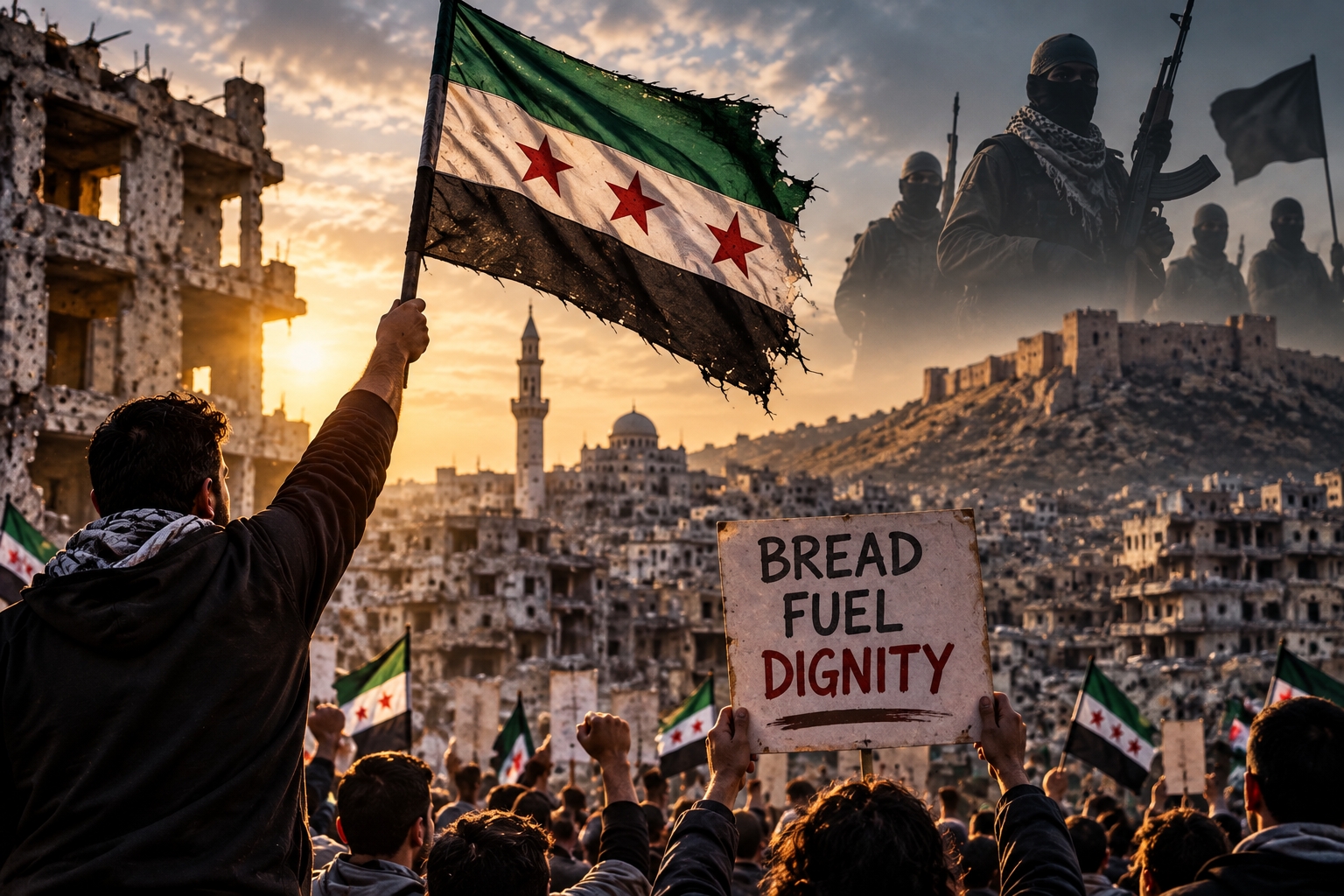
The latest wave of mass protests sweeping Syria should surprise no one.
What is surprising and politically significant is where they gained a mass following: Idlib, the very territory repeatedly portrayed in western media as the historic stronghold and political base of the takfiris now ruling Damascus.
Syria Direct reported protests in Maarat al-Numan in Idlib after the regime increased fuel prices sharply.
This matters because Idlib was the principal territorial base of takfiri groups from which Syria’s current leadership emerged.
Protests erupting there challenge any simplistic picture of Idlib as a secure reservoir of support for the militias in Damascus.
The significance goes beyond geography.
If serious public anger is emerging within the former heartland of the forces now controlling Damascus, the problem cannot easily be dismissed as agitation by remnants of the Asad government, hostile minorities or outside actors.
It suggests that dissatisfaction has reached into constituencies and territories central to the new political order itself.
The immediate catalyst is economic.
Damascus raised diesel prices by 40%, alongside increases in gasoline and cooking gas.
Protesters burned tyres, blocked roads and disrupted oil-tanker movements.
With roughly 90% of Syrians estimated to live below the poverty line, another sharp increase in basic living costs was always likely to produce anger.
But fuel prices are merely the trigger.
The deeper crisis concerns the capacity of the new authorities to transform military victory into functioning government.
Foreign backed armed groups can capture territory, but governing and reconstructing a modern state is much harder and require diferent skill sets.
This distinction has historically posed serious problems for Salafi groups.
Such organizations have often proved capable of mobilizing fighters, exploiting institutional weaknesses and destroying existing political structures.
Their record of constructing durable, independent and broadly legitimate states is much thinner.
Where “Islamic” oriented monarchies have enjoyed stability, they have generally possessed powerful external patrons.
Afghanistan in the 1990s, Libya after 2011 and Syria’s long war illustrate another problem.
Armed salafi-minded groups can become highly effective instruments for breaking existing political orders without possessing either the political vision or institutional machinery required to replace them.
In the process, indigenous Islamic movements with deeper social and political traditions are marginalized by actors whose principal political language is armed coercion based on American and Israeli backing.
Seen from this perspective, Idlib is not a peripheral detail; it is a warning sign.
If the authorities are struggling to contain economic anger in the territory from which their own movement emerged, western recognition, sanctions relief and diplomatic rehabilitation cannot by themselves manufacture domestic legitimacy or state capacity.


After more than eight years of bloodletting, the grand conspiracy of regime change in Syria is finally seeing its end with the last remnants...
