 Archives
Multimedia
Donate
About
Sign In
Archives
Multimedia
Donate
About
Sign In



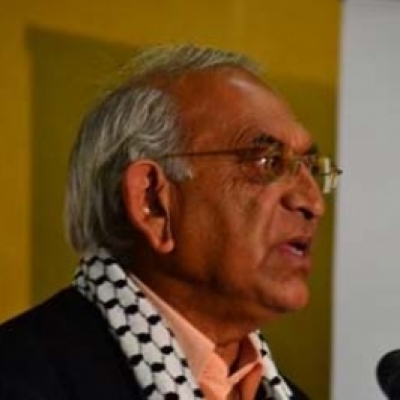 Iqbal Jassat


For decades, unconditional loyalty, attachment and support for Israel featured as one of the few issues that united both major American political parties.
Democrats and Republicans differed on healthcare, taxation and immigration, but Israel remained politically protected and untouchable.
Candidates who independently sought to change course by daring to challenge military aid or question Israeli policy risked being overwhelmed by well financed campaigns backed by powerful lobbying networks, led by AIPAC.
The good news is that the political architecture is beginning to fracture.
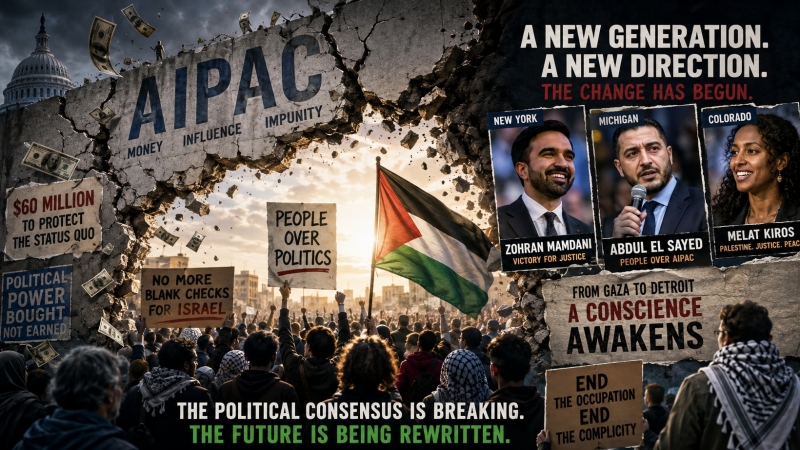
The Democratic primary victory of Abdul El Sayed in Michigan is the latest indication that a profound political realignment is underway.
Following the victories of Zohran Mamdani’s allies in New York and the election of pro- Palestine progressive Melat Kiros in Colorado, Michigan has now delivered another unmistakable message.
Democratic voters are increasingly rejecting candidates associated with AIPAC and embracing those prepared to openly challenge Washington’s unconditional support for Israel.
From our analysis it is encouraging to note that this is no longer an isolated trend.
One hopes that mainstream coverage will begin to pay more attention to the cumulative significance of these elections.
If viewed individually, each race unfairly appears to be a local contest shaped by local issues.
Viewed together however, they reveal something far more consequential.
America is witnessing a new generation of Democratic politicians whose position on Palestine differ fundamentally from those of the party establishment.
Abdul El Sayed made opposition to AIPAC’s influence a central feature of his campaign.
Rejecting corporate PAC money, condemning what he described as the genocide in Gaza and calling for an end to unconditional military aid to Israel, he confronted one of Washington’s most influential lobbying networks directly.
Despite unprecedented outside spending designed to defeat him, Democratic primary voters chose the candidate who challenged the system rather than the one backed by it.
AIPAC and other PAC groups spent more than $60 million to support Haley Stevens against El Sayed.
She was still trounced despite massive AIPAC dollars poured into her campaign.
That outcome should be a wakeup call for those who have long relied on financial power to shape American foreign policy.
For decades, AIPAC’s influence rested on a simple calculation: Throw unlimited money at politicians; mobilise zionist donors to fund campaigns; and gain favourable media coverage.
The vindictive campaigns deployed would warn politicians that criticism of Israel carried unacceptable destructive consequences.
That strategy is failing as the current trend signifies.
For a generation of voters Gaza has become the defining moral issue rather than a distant geopolitical conflict.
The beneficiaries of this shift extend well beyond individual candidates.
Arab American communities, progressive Jewish organisations, labour movements, student activists and younger Democratic voters have increasingly united around a demand that American foreign policy be measured by the same standards of international law applied elsewhere.
Social media has accelerated this transformation by exposing millions of Americans to images and testimony that bypass traditional media gatekeepers and official narratives.
The pattern now stretches across multiple states.
In New York, Mamdani demonstrated that candidates openly describing Israeli actions as genocide could defeat establishment Democrats despite overwhelming financial disadvantages.
In Colorado, Melat Kiros unseated a 30-year incumbent after making Palestine one of the defining issues of her campaign.
Now Michigan, one of America’s most strategically important swing states, has delivered another victory for a candidate who explicitly rejected AIPAC’s political influence.
Taken together, these victories expose the limits of money when confronted by organised grassroots movements driven by moral conviction.
This does not mean American support for Israel will disappear overnight.
Congress remains broadly supportive of military assistance, and the institutional relationship between Washington and Tel Aviv remains deeply entrenched.
What has changed is the political cost of maintaining that relationship without question.
The Democratic Party is no longer speaking with one voice on Israel.
The generation shaped by Gaza has begun replacing the generation shaped by Cold War alliances and post-September 11 security doctrine.
Each primary election makes that transition more visible.
For Palestine, these elections represent more than symbolic victories.
They suggest that one of the central pillars protecting Israeli impunity inside Washington is beginning to weaken from within.
The political consensus that once appeared permanent is steadily giving way to open contestation.
The machinery that sustained unconditional US support for Israel is no longer operating without resistance.
Iqbal Jassat, Executive Member, Media Review Network, Johannesburg, South Africa