 Archives
Multimedia
Donate
About
Sign In
Archives
Multimedia
Donate
About
Sign In



 Waseem Shehzad


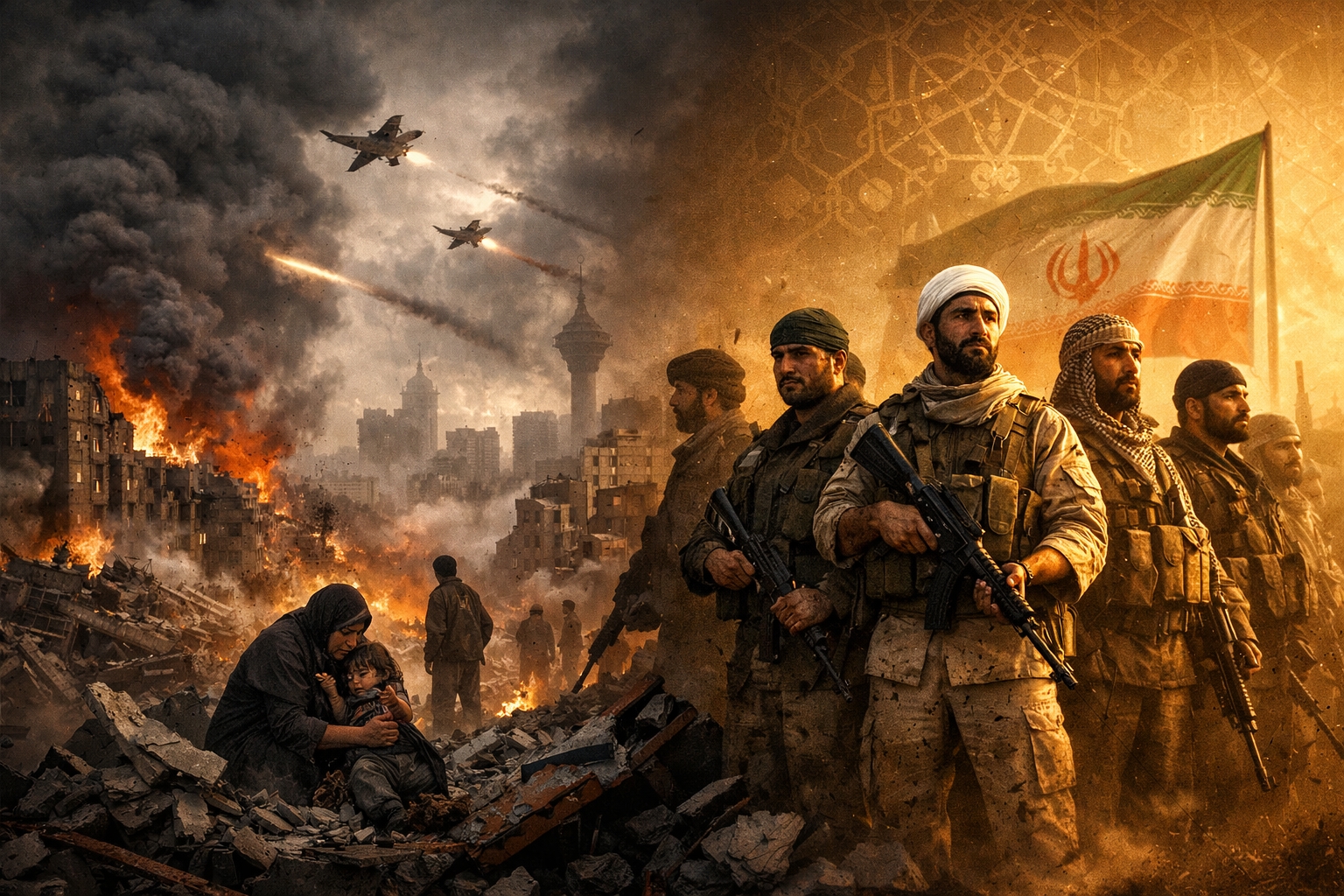
For much of its post-1979 history, the Islamic Republic of Iran has framed its foreign policy through the dual necessities of Islamic commitment and strategic survival. This approach was recognized by the notorious American war criminal Henry Kissinger, who once accurately pointed out, Iran is not just a state; it is also a cause. Just like the US itself is not simply a nation-state, but a global driver of militant liberalism and cut-throat capitalism.
Central to Iran’s framework of balancing ideals and pragmatism was the concept of exporting the Islamic Revolution—an approach that sought to empower mustad‘afin (the oppressed) and challenge western-imposed despotic regimes across the Muslim world.
Yet over the past 25 years, Tehran effectively placed this policy on pause, adopting instead a posture of strategic pragmatism. This recalibration prioritized engagement with existing regimes, including those structurally aligned with the United States, in the belief that coexistence, co-option, and gradual influence would yield greater long-term prosperity for the Muslim Ummah.
While this strategic pause was based on the Islamic principle of Husnu Zann, it rested on a flawed assumption: that western-backed regimes in the Arab and broader Muslim world could be politically reformed or even brought into a more balanced relationship with Iran.
It should also be noted that despite what the western propaganda claims, the Islamic leadership of Iran does not impose its vision on other societies. Tehran opted for exporting the Islamic model of governance only to those willing to import it. Unfortunately, because most Muslim societies understand Islam only through a ritualistic lens, they were not ready to import Islam in its totality.
The US-Israeli aggression against Iran exposed the limits of Iran’s pause approach. When push came to shove, the western-backed despotic regimes demonstrated their structural dependency on western security architectures, directly and indirectly aligning against Iran. Thus, this outcome is a moment of strategic clarity for Tehran—one that necessitates a fundamental recalibration of how it understands and operationalizes the export of its Islamic revolutionary ethos. The ongoing phase of the regional war provides a unique opportunity for Iran to rally the Muslim street behind it.
From Revolutionary Zeal to Strategic Restraint
In the immediate aftermath of the Islamic Revolution, Iran’s leadership articulated a foreign policy rooted in ideological expansion. Exporting the revolution was not merely rhetorical; it involved support for Islamic movements, cultivation of transnational networks, and an explicit rejection of western hegemony in the Muslim world. This posture positioned Iran as both a state actor and an Islamic civilizational project, seeking to reshape political consciousness across the Muslim Ummah.
By the mid-2000s, a combination of internal and external pressures led to a gradual pause. The US invasions of Afghanistan (2001) and Iraq (2003) placed American military forces on Iran’s eastern and western borders. Simultaneously, tightening sanctions regimes—particularly after 2010—exerted economic pressure. However, these were not the key factors in pausing the export of the revolution. The primary issue was the successful use of the sectarian card against Iran by the US and Israel.
These constraints incentivized a more cautious approach. Rather than actively promoting revolutionary change, Tehran pursued what can be described as strategic patience—engaging diplomatically with regional governments, avoiding direct confrontation, and seeking to stabilize its immediate environment. This was evident in Iran’s outreach to Gulf states at various points, as well as its participation in multilateral negotiations culminating in the 2015 nuclear agreement.
The Logic of Co-option and Strategic Miscalculation
At the heart of Iran’s strategic pause was a belief in the possibility of co-opting adversarial regimes. The logic was straightforward: sustained engagement, economic interdependence, and regional dialogue could gradually reduce hostility and create space for a more balanced regional order. This approach implicitly assumed that Arabian regimes, even if aligned with the US, retained a degree of strategic autonomy that could be leveraged.
Yet this assumption underestimated the depth of structural alignment between these regimes and western powers. Many Arab regimes are deeply embedded within US-led security architectures, relying on American military aid, intelligence cooperation, and political backing for survival.
By extending the benefit of the doubt to these regimes, Iran engaged in what can now be seen as a miscalculation. It overestimated its ability to reshape regional dynamics through diplomacy while underestimated the lack of agency and corrupt nature of the western backed dictatorships in the Arab world.
The Stress Test: Regional Confrontation and Alignment
The recent phase of confrontation involving Iran, the US and Israel has functioned as a decisive stress test for Tehran’s pragmatic approach. Faced with direct and indirect aggression, Iran was compelled to activate its regional deterrence networks, engaging in calibrated responses designed to impose significant costs to western backed regional dictatorships.
Crucially, this confrontation revealed the true positioning of Arab regimes. Despite years of diplomatic outreach and attempts at de-escalation, these regimes either supported or facilitated US-Israeli aggression—whether through intelligence sharing, logistical cooperation, or political alignment in international forums.
This outcome underscores a key reality: regime interests in these states are structurally tied to the preservation of a western-dominated regional order. Their primary concern is regime survival, which is underwritten by external support rather than domestic legitimacy. As such, expecting them to adopt a neutral or balanced stance in a confrontation involving Iran was unrealistic.
Strategic Failure and the Limits of Pragmatism
The failure of Iran’s strategic pause can be traced to three interrelated factors:
The net result is a strategic contradiction: Iran exercised restraint and pursued engagement yet faced the same adversarial alignment when the US and Israel attacked it. This suggests that pragmatism, in this context, did not produce the intended strategic dividends.
Toward Strategic Recalibration: Returning to the People
The current moment demands a reassessment of Iran’s approach to exporting its revolutionary ethos. However, this does not imply copying the Lebanese or Iraqi models Iran implemented there. Each locality requires a specific approach.
The current situation calls for an updated strategy that prioritizes organic societal movements over regime-level engagement.
Such an approach will likely involve:
This bottom-up strategy offers several advantages. First, it aligns with the original spirit of the Islamic Revolution, which emphasized empowerment of the oppressed rather than accommodation with ruling elites. Second, it creates a more resilient network of influence that is less susceptible to sudden shifts in regime policy. Third, it enhances Iran’s ability to withstand future confrontations by ensuring broader regional support at the societal level.
Insulating Against Future Schemes
It is increasingly evident that the current round of hostilities is unlikely to be the last. The structural drivers of conflict between Iran, the US, and Israel remain firmly in place, including competing visions of regional order.
In this context, Iran’s long-term security will depend on its ability to build a multi-layered offensive deterrence architecture that extends beyond military capabilities. While its advancements in missile technology and asymmetric warfare have enhanced its defensive posture, these tools must be complemented by a robust network of societal alliances.
By actively investing in relationships with the people rather than regimes, Iran can create a form of strategic depth that complicates adversarial planning and reduces the effectiveness of external pressure. This approach does not eliminate the risk of conflict, but it does reshape the battlefield in Iran’s favor on a much deeper level.
Conclusion: From Illusion to Clarity
The past two decades of Iranian foreign policy reflect a balance between ideological aspiration and strategic pragmatism. The decision to pause the export of the Islamic Revolution was rooted in a rational assessment of immediate constraints. However, it was also predicated on assumptions that have now been decisively challenged.
The recent alignment of Arab regimes with US-Israeli aggression has stripped away any remaining illusions about the potential for regime-level co-option. What remains is a stark reality: Iran’s security cannot be entrusted to the goodwill or neutrality of regimes whose survival depends on its adversaries.
Strategic recalibration is therefore not a choice but a necessity. By returning to a people-centered approach—one that engages with the organic forces of change within Muslim societies—Iran can realign its foreign policy with both its ideological foundations and geopolitical realities.
In doing so, it may not only insulate itself from future conflicts but also revive the transformative potential that once defined its revolutionary project.


Imam Khomeini (ra) whose death anniversary falls this month (June 3) was an outstanding leader whose courage and convictions brought about m...
This month 23 years ago, the oppressed Muslims as well as the toiling masses worldwide lost one of their own: Imam Khomeini.
US enmity towards Iran has nothing to do with Iran’s peaceful nuclear program. It is merely a pretext used by Washington for Iran’s refu...
One of the first messages to have been proclaimed by the Islamic Revolution and the line of the Imam was that the Islamic Revolution in Iran...
1