
 Archives
Multimedia
Donate
About
Sign In
Archives
Multimedia
Donate
About
Sign In



 Crescent International


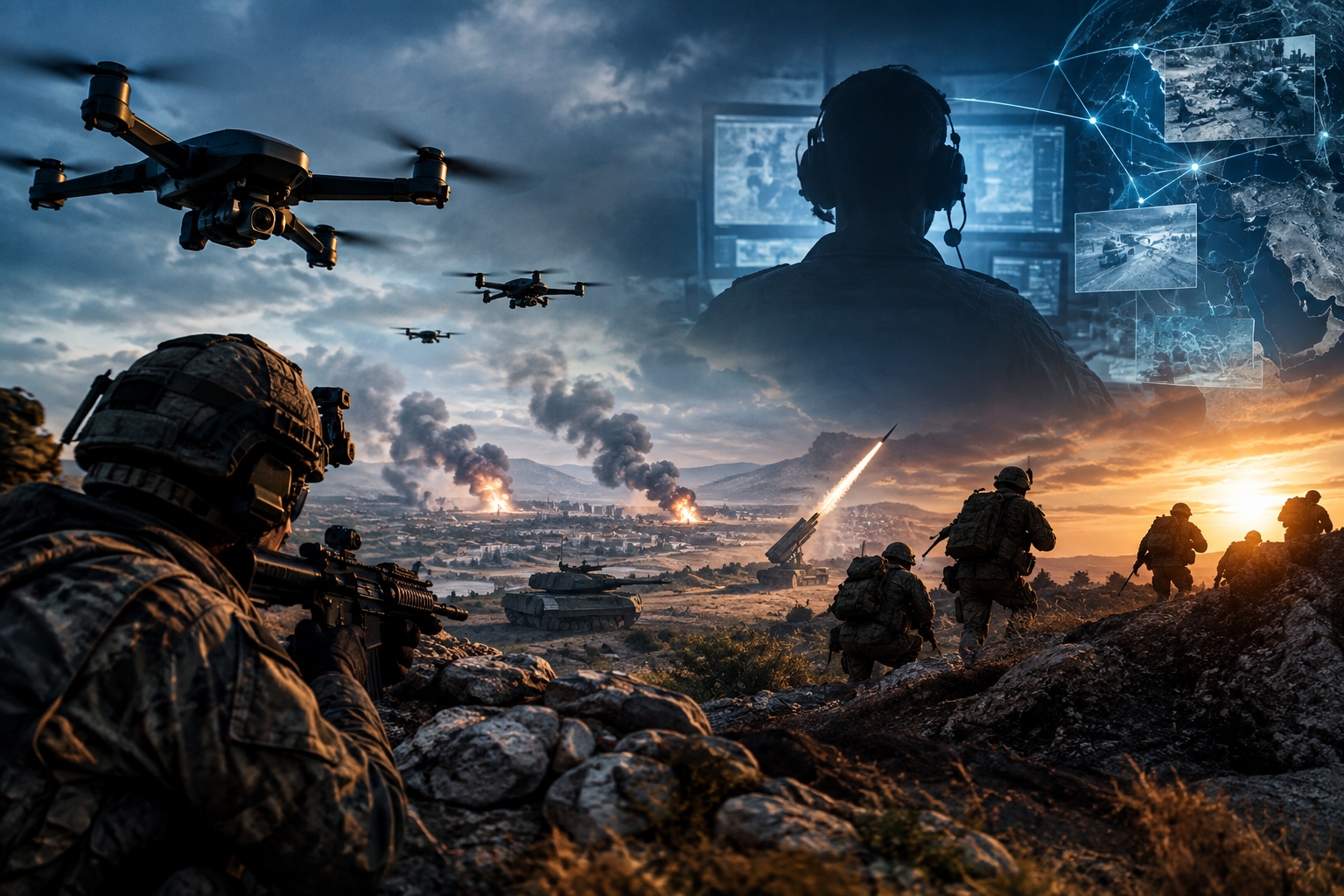
The spectacular use of drones has produced one of the most misleading clichés about modern warfare: that drones are transforming, or even deciding, wars.
Ukraine, Lebanon, Yemen and the ongoing US-Israeli war on Islamic Iran suggest something more complicated.
Drones matter greatly, but only when embedded inside a larger military system.
A drone is ultimately a platform.
Its effectiveness depends upon reconnaissance, intelligence, electronic warfare, communications, missiles, artillery, infantry, logistics and, above all, commanders capable of integrating these elements.
Ukraine provides perhaps the clearest laboratory.
The Royal United Services Institute (RUSI) analyst Jack Watling observed that improved Ukrainian battlefield performance was not simply the result of better drone employment but, more importantly, the “integration of drones, infantry, artillery and other tools.”
The Center for Strategic and International Studies (CSIS) reaches essentially the same conclusion: drones have neither replaced artillery nor tanks, engineers and infantry. They extend their capabilities. Most importantly, a drone cannot occupy and hold territory.
Russia’s experience in Ukraine offers another important corrective to the drone-centric view of modern warfare.
Some of the Russian Army’s most consequential tactical advances have increasingly relied on small-group infantry infiltration, exploiting gaps, terrain, concealment and surprise to penetrate Ukrainian defensive positions rather than simply destroying them from the air.
The dramatic March 2025 operation around Sudzha in the Kursk region became a striking illustration: Russian assault troops used a disused gas pipeline to move roughly 15 kms behind Ukrainian lines, emerging in the rear and creating operational surprise while largely avoiding aerial observation.
A US Army assessment subsequently described the operation as an example of how the growing transparency created by drones is driving armies to experiment with subterranean and other concealed forms of manoeuvre.
The lesson is significant: as the battlefield becomes saturated with sensors and drones, the ability of small infantry groups to move unpredictably, conceal themselves and penetrate an enemy’s rear can become more, not less, important.
Drones can identify the battlefield, but ultimately, it is soldiers on the ground who exploit a breach, seize terrain and impose a military reality on the enemy.
There are physical limitations as well.
Small drones carry limited explosive payloads.
They are vulnerable to interception and weather.
RUSI notes that artillery remains superior for destroying hardened positions, delivering heavy explosive effects and operating through weather or electronic conditions that can substantially degrade UAV operations.
The lesson is simple: the decisive weapon is not the drone but the kill chain surrounding it.
This helps explain developments in West Asia.
In Lebanon, Hizbullah’s drone capability cannot sensibly be separated from its broader battlefield architecture.
Its arsenal combines UAVs with anti-tank guided missiles, rockets, missiles, surveillance, prepared positions and experienced ground formations.
Yemen demonstrates the principle even more dramatically.
Ansar-Allah’s drones attract international headlines, but reducing its military success to UAV technology misses the movement’s more important strengths: political organization, intelligence penetration, knowledge of terrain, tribal relationships and experienced infantry.
Its sophisticated political-intelligence network predates its seizure of Sana‘a.
Research from West Point describes how the movement cultivated tribal relationships, absorbed state intelligence structures and accumulated detailed information about Yemen’s political and tribal networks.
On the battlefield, drones became another layer of this architecture.
The Armed Conflict Location and Event Data (ACLED) found, revealingly, that combined Ansar-Allah missile and drone attacks on military camps produced roughly three times the lethality of drone attacks alone.
Technology multiplied organizational capability; it did not substitute for it.
The Ramadan War reinforces the point at a much larger scale.
Iran’s drones operate alongside ballistic missiles, intelligence, dispersed launch infrastructure and a wider regional strategy.
CSIS concluded that Iranian drone effectiveness depends not merely upon the aircraft but upon an entire “ecosystem” encompassing production, doctrine, targeting and integration with other strike systems.
Perhaps nothing illustrated the strategic predicament more starkly than the reported email circulated by US Central Command during the Ramadan War, asking military analysts for “new creative and unconventional ways” to fight Iran.
The spectacle of the world’s most “powerful” military effectively crowdsourcing ideas in the midst of a major war was deeply revealing.
It suggested that the problem was not shortage of weapons, drones or technological sophistication, but the absence of a strategy capable of converting technological superiority into decisive political and military results.
Military history repeatedly punishes armies that mistake a new weapon for a new strategy.
Tanks without infantry support become targets.
Artillery without reconnaissance wastes ammunition.
Missiles without intelligence strike empty buildings.
Drones without strategy and competent command become expensive flying cameras or wreckage.
If you don’t believe us, just ask the US military.
The revolution, therefore, is not the drone.
It is the entire military system capable of making the drone a part of creative military strategy and tactics.


Not only the US military but even the media including European have resorted to using drones. If the military drones incinerate people with ...
The US has become addicted to killing innocents with drones but ultimately, it is the responsibility of the Pakistani government to protect ...
