 Archives
Multimedia
Donate
About
Sign In
Archives
Multimedia
Donate
About
Sign In



 Muslim Mahmood


❝Empires are born,
they grow up,
they get old,
and they die.
No exceptions.❞ — Ibn Khaldun
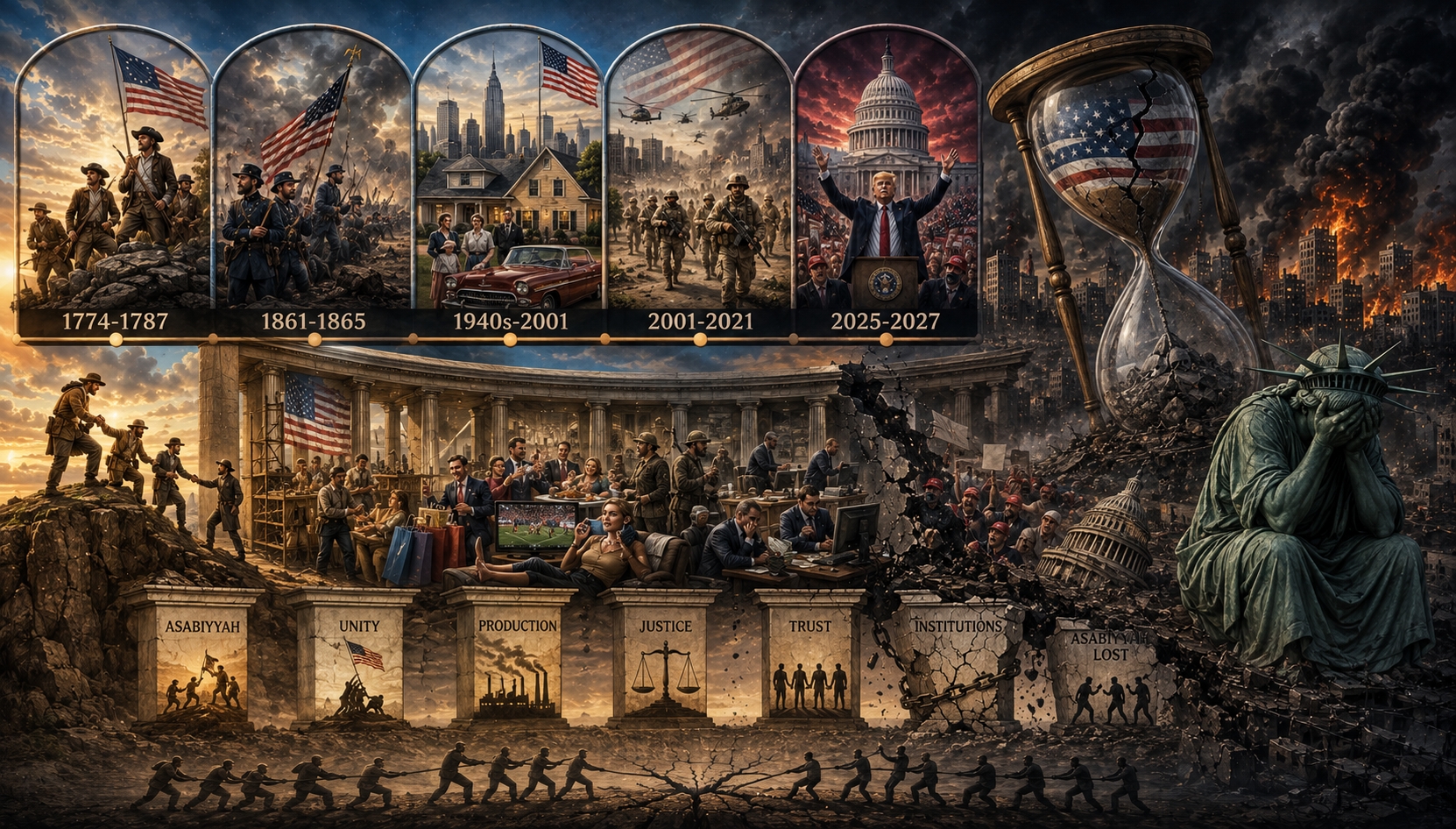
Timeline of the American Lifecycle
1774–1787: The Foundation Phase
A rugged frontier spirit and intense group solidarity, or asabiyyah, forge a new state-building identity through the American Revolution.
1861–1865: Personalization of Power The American Civil War serves as a centralizing force, shifting the country from a rural, tribal culture toward an urbanized, state-centered system.
1940s–2001: The Growth and Expansion Phase
Victory in global conflict establishes the dollar as the world’s reserve currency and ushers an era of unprecedented consumerism and luxury.
2001–2021: The Stagnation Phase
Military overextension in West Asia and the 2008 financial crash signal the erosion of social trust and the beginning of institutional complacency.
2025–2027: The Terminal Decay Phase
The rapid centralization of executive power, the imposition of reciprocal tariffs, and the fracturing of internal solidarity lead the state toward a systemic collapse.
The Science of Civilizational Biology
History is not a mere collection of battles and kings but a biological organism with a predictable lifespan. A state, like a human body, grows, matures, and eventually decays over a natural cycle often spanning three generations, or approximately 120 years.
This progression is driven by the rise and fall of asabiyyah, or social cohesion—the shared group feeling that allows individuals to overcome challenges as a single, unbreakable fist.
In the first generation, the builders live in a “desert state,” unpolished and used to deprivation.
They rely on each other for survival because no government safety net exists to catch them.
However, the very success of these founders plants the seeds of destruction.
By the second generation, the leaders move from the tent to the palace, trading their roughness for comfort.
By the third generation, the spirit of sacrifice is dead; the citizens have never known hunger or fear and assume their luxury is a natural fact of life.
This “senile” civilization eventually hollows itself out, waiting for a new, hungrier group with higher asabiyyah to come over the hill and claim the meal.
Dissolution of Asabiyyah and the Loneliness of the Domesticated Citizen
The true strength of the American state was once measured not in wealth, but in its shared group feeling.
In the beginning, a rugged frontier spirit fueled a collective destiny.
However, since the 1950s, this cohesion has plummeted, replaced by a society where individuals are increasingly isolated and disconnected.
Modern technology and cultural shifts have created a “loneliness epidemic,” where citizens of the state find themselves openly hostile to one another.
When asabiyyah weakens, people no longer follow laws out of voluntary commitment; they do so out of habit, fear, or coercion.
The citizen becomes “domesticated,” like a well-fed but helpless gazelle, relying entirely on the state for protection rather than on their own fortitude or the bonds of their tribe.
This loss of martial spirit is a terminal signal.
As one veteran observed, the lack of strong community makes civilian life alien; the social glue has dissolved into superficial pursuits, leaving the state with “negative asabiyyah” where men refuse to fight for a leadership they no longer believe in.
The Fiscal Mirage: Extraction and the Destruction of Incentives
A state’s decline is often administrative and quiet, occurring when the economic engine weakens year-by-year.
The American state currently faces a $39 trillion debt, a figure so vast it exceeds the cost of the actual military.
According to the patterns of history, states do not fall because people stop working; they fall because incentives stop working.
In the beginning of a dynasty, taxes are low and revenue is high because people are motivated to create.
As the state ages, however, rulers grow comfortable and bureaucracies multiply, requiring ever-increasing sums of money to fund luxuries and military costs.
When the state treats wealth as something it can endlessly extract, it consumes its own foundation.
Higher taxes do not increase revenue for long; instead, they change behavior, discouraging risk and pushing economic activity into the shadows.
In this late stage, the ruler stops seeing citizens as allies and begins seeing them as a revenue stream to be mined.
This fiscal death spiral—where the state squeezes a shrinking economy harder to pay for its expanding appetites—leads to the death of innovation and hope.
The dynasty eventually taxes itself to death, eating its own muscle to feed a hunger that can never be satisfied.
The Autocratic Turn: Dismantling the Referees of Justice
Recent investigative findings from international institutes like V-Dem reveal that the American state is retreating toward autocracy at an “unprecedented” speed.
Between 2025 and 2026, the country’s democracy ranking plummeted from 20th to 51st as the regime began concentrating executive power and overstepping existing laws.
This process involves the systematic dismantling of “referees”—independent institutions such as courts and inspectors general that once served as guardrails against despotism.
The loss of justice is the “real cancer” of a dying empire.
Justice, in this context, refers to the predictable security of property and the right to keep what one earns.
When the state becomes a predator, inventing crimes to seize assets or creating monopolies that crush the small producer, the fundamental contract between the ruler and the ruled is broken.
Injustice does not merely hurt the economy; it ruins the soul of the state, inviting outsiders to kick the door down.
The US regime’s use of non-stop executive orders to bewilder citizens and the dismissal of those who expose malfeasance are classic markers of a dynasty entering its final, paranoid phase.
Retreat from Hegemony and the Rise of Multi-Polarity
The external symptoms of this internal rot are visible in the state’s strained global alliances and its increasingly unilateral foreign policy.
The “America First” stance has led to a withdrawal from international agreements like the Paris Climate Accord and the World Health Organization, signaling a shift toward a walled-off, isolationist posture.
In West Asia, the limits of American power were revealed when the regime proved unable to bring regional actors to heel, with reports suggesting that major military decisions were made at the request of allies rather than out of the state’s own strategic interest.
As the state’s global influence shrinks, rivals like China have begun to outpace and outflank it in technological innovation, trade, and infrastructure.
The decline of “dollar dominance” is no longer a theoretical threat but a quiet reality as countries look for alternative reserve currencies.
This retreat is marked by “spits-and-splutters” of regrouping and revenge, yet the writing remains on the wall: the world is transitioning to a multipolar order where the former hegemon is forced to eat “humble pie”.
The reliance on mercenaries and client states, rather than on a defense based on blood and belief, confirms that the state has already lost its soul.
The Persistence of the Cycle
By early 2027, the internal and external pressures would converge to create a state on the brink of failure.
Mass protests and economic instability are not accidents; they are the inevitable outcomes of a system that has forgotten what creates wealth and unity.
The transition from a civilization of builders to a civilization of extractors is a biological progression that no state has ever successfully cheated.
Once luxury replaces purpose and extraction has replaces encouragement, the final phase is merely a matter of time.
❝Empires Don’t Just Die by Accident
They Die on Schedule.❞ — Ibn Khaldun