 Archives
Multimedia
Donate
About
Sign In
Archives
Multimedia
Donate
About
Sign In



The threat to Muslims from an imperialistic American-Israeli power will not go away even if “Islamic terrorism” ends. The war-elites in Washington and Tel Aviv spent most of the last century sapping the resources of the world in what was supposedly a life-and-death struggle with communism. When communism collapsed, the politicians went looking for a new enemy to justify continuing their aggressive policies. Unable to find any convincing enemies to promote, they set about creating one from the movements of resistance created by their own policies; and so we now have “Islamic terrorism” or “Islamo-fascism”.
Some three months after US and Iraqi forces launched their much-trumpeted security plan, code-named “Operation Imposing Law” (Fardh al-Qanun), designed primarily to secure the Iraqi capital, Baghdad, and the restive al-Anbar province, the Iraqi insurgency has shown no significant sign of waning.
For years the Arab League has been a symbol of the incompetence and impotence of the Arab states. Every time there has been a major issue in the Muslim world, the League has met and done absolutely nothing of note. Yet now, for some reason, the summit that is taking place in Riyadh at the end of March (as this issue of Crescent goes to press) is being hailed around the world as crucial for the future of the region
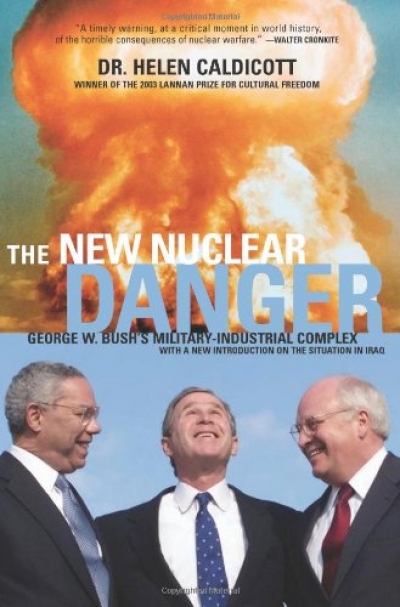
The New Nuclear Danger: George W. Bush’s Military-Industrial Complex by Dr Helen Caldicott. Pub: The New Press, New York, 2004. Pp: 304. Pbk: US$17.95.
One has to look to Dr Mahathir Mohamad, former prime minister of Malaysia, for a slap to the Americans once in a while. Many have dismissed him as suffering from “former president syndrome”: ex-rulers indulge in rhetoric and tell others what they themselves should do were they still in power. But in the case of Mahathir, one thing many of his enemies and friends agree on is that the man has a lot of stamina for putting up a good fight.
Some clear truths are too serious for diplomatic dissemblers to acknowledge. One of these it the clear reality of the nature of theWashington regime's foreign policy. For at least half a century, American foreign policy has matched Israel's in its hostility to the self-determination of Muslims.
Why is US President George Bush threatening to go to war against Iran over its civilian nuclear program at a time when American forces are bogged down in Iraq and US defence secretary Donald Rumsfeld is facing a virtual insurrection against his disastrous handling of the war by retired American military generals?
There is an old saying about Afghanistan that goes something like this: when God wishes to punish someone, He sends them to attack the Afghans. The US and its ally, Britain, have blundered into Afghanistan on the pretext of fighting terrorism, but in reality to advance Western interests.
Last month marked the third anniversary of the US invasion of Iraq and the toppling of Saddam Hussain. Few now doubt that the invasion was the culmination of a long-held plan on the Americans’ part, and that the intense international politicking of the months leading up to the war, with the talk of Iraqi weapons of mass destruction and links between Saddam Hussainand al-Qa’ida, UN resolutions and weapons inspectors, was no more than a process designed to justify the invasion.
Egypt, under president Husni Mubarak, receives the second largest amount of US foreign aid per annum after Israel, but unlike Israel pays a very high price for it. Not only does it openly and loyally back US foreign policy in the Middle East and the rest of the Muslim world, but it is also publicly committed to the US government's ‘war or terrorism', which is really an ill-disguised assault on Islamic activists and Islamic groups.
Since the conflict in Darfur began three years ago, about 180,000 people have died, mainly because of hunger and disease; about 2 million have been displaced. Clearly, the conflict is too vicious and costly to be allowed to continue, but the current efforts of the African Union (AU) to resolve it are not equal to the task. But the so-called international community cannot seriously be concerned about the fate of the people of Darfur or of Sudan as a whole.
The subservience of Pakistan’s rulers was again displayed on January 13: the US bombed a border village in Pakistan's Bajaur Agency, killing 18 civilians, six of them children. Far from confronting America's state terrorism, Pakistani officials from general Pervez Musharraf down proffered lame excuses: "foreign terrorists" were the intended target, for instance. In particular, they claimed that Ayman al-Zawahiri was a guest at one of the houses for an Eid al-Adha celebration in Damadola village.
By taking a firm and principled stand over its right to enrich uranium under the Nuclear Non-Proliferation Treaty (NPT), Iran has forced the US to blink. The meeting on November 24 of the Board of Governors of the International Atomic Energy Agency (IAEA) in Vienna was a far more civilized affair than the bellicose threats issued by the same body two months earlier.
The US occupation of Iraq, which has destabilised the country, driving it into effective civil war, may have unsettling consequences for neighbouring Syria. US president George W. Bush is exerting strong pressure on Damascus to cooperate with Washington's colonial schemes, to end its links with Lebanon, and to help the UN's enquiry into the murder of Lebanon's late ex-prime minister, Rafique Hariri.
In recent months the world's richest countries, led by the US and Britain, have been claiming noisily that they plan to have the world's poorest regions, particularly Africa, lifted out of poverty; they also intend to improve human rights there, they say.
1Iran won what may be regarded as a partial and temporary victory at the International Atomic Energy Commission (IAEA) on September 24, when the UN nuclear agency’s board refrained from acceding to American demands that it immediately refer Iran to the UN Security Council for alleged breaches of the nuclear Non-Proliferation treaty (NPT).
That Pakistan's president, General Pervez Musharraf, shook hands with a war criminal like Ariel Sharon of Israel—better known as the Butcher of Beirut—was bad enough; it was even worse that he chose to do so on the twenty-third anniversary of the Sabra and Shatilla massacres (September 14-16).
As if Hurricane Katrina had not caused quite enough damage, Rita came roaring in and swept across Louisiana and Texas, putting out of action more than 25 percent of the US's oil-refining capacity.
Nothing illustrates the West’s hypocrisy better than its attitude to the issue of nuclear technology and its use for the generation of energy. There are several layers of hypocritical behaviour: countries that do not possess nuclear know-how must be denied its use because it is alleged that this would lead to their making nuclear weapons.
Even the elaborate Independence Day celebrations on August 14 could not conceal the panic that has gripped Pakistan’s ruling elites since America’s military and nuclear agreements withIndia in June and July respectively.