
 Archives
Multimedia
Donate
About
Sign In
Archives
Multimedia
Donate
About
Sign In



 Crescent International


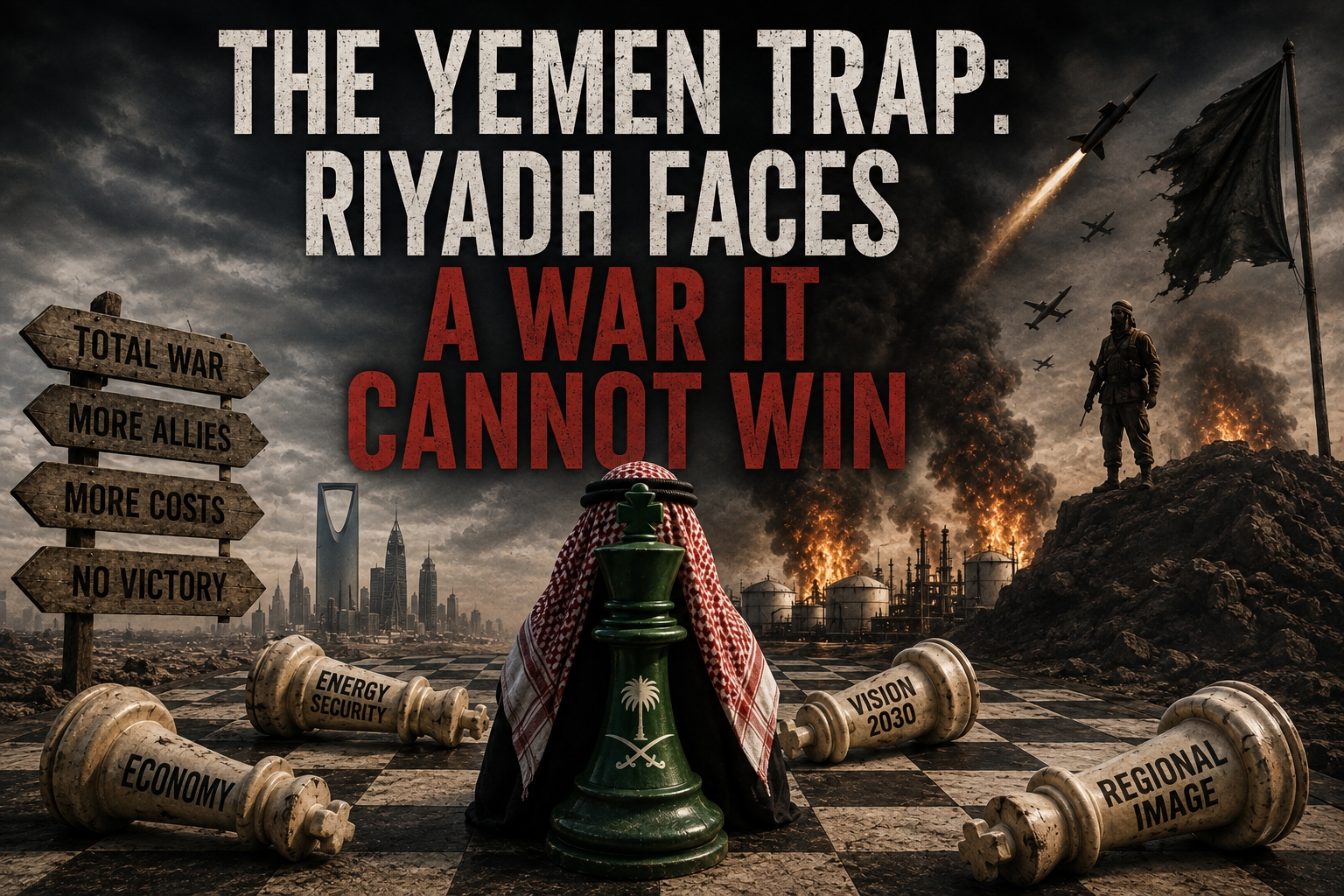
As Yemen continues its determined pursuit of breaking the western-backed Saudi blockade, Riyadh appears to be left with only two options: total war or a fair sustainable peace.
The problem is that Riyadh does not make such decisions independently.
Recent developments in the region show that in order to achieve a reasonable settlement, force and power are the only tools that can make the US, Israel, and their surrogates understand.
In this framework, what are Bani Saud’s options on the Yemeni front?
Considering the Saudi regime’s extreme arrogance, its rulers will view a reasonable political settlement as defeat.
This, combined with the fact that Israel and the US demand unrelenting Saudi military pressure on Yemen, makes it more likely that Riyadh will pursue the option of total war.
A political settlement will mean Ansar-Allah’s continued rule over Yemen.
That in turn will mean Tehran gaining another state actor as an ally.
This would be a major geopolitical blow for the US, Israel, and their surrogates.
It will be an even bigger challenge than was the case with Iran-allied Syria because unlike Ba‘athist Syria, Ansar-Allah are ideologically allied with Iran.
They enjoy widespread support in the Muslim world because of their Islamic credentials and their principled stance against the zionist-led genocide in Palestine.
From the US-zionist perspective, a political settlement in Yemen will produce something considerably more consequential than simply an end to the Saudi-led war on Yemen.
It will consolidate an Iran-aligned government that enjoys the support of much of Yemen’s population.
Further, the Ansar-Allah movement has demonstrated clear military capabilities.
It controls one of the world’s most strategically important maritime chokepoints.
And, it enjoys huge popular legitimacy across the Muslim world because of it unambiguous support for Palestinian resistance.
This combination makes a negotiated settlement far more difficult for Washington, Tel Aviv, and their regional surrogates to accept.
Considering that Riyadh and its US-zionist patrons desire total war, their wishes are colliding with hard, on-the-ground realities.
The Ansar-Allah have shown clear ability to strike key Saudi economic infrastructure, as well as a determined conviction that it must escalate.
In an escalation scenario, the Ansar-Allah have relatively little to lose beyond the western-backed Saudi blockade itself.
The movement has already endured years of war, bombardment, economic pressure, and diplomatic isolation, while maintaining control over large parts of northern and western Yemen.
A renewed Saudi offensive would, therefore, carry a fundamentally different risk for Ansar-Allah than it would for Riyadh.
For Ansar-Allah, escalation could be framed as continuation of a conflict that had never really ended.
Rather than accepting a political arrangement that leaves the Saudi blockade and other forms of economic pressure largely in place, the movement could calculate that greater military pressure is preferable to remaining under an indefinite siege.
Its military capabilities also give it tools to impose costs on Saudi Arabia, particularly by threatening its critical infrastructure and US-Israeli military and economic interests in the region.
This creates an important asymmetry.
Riyadh has far more to protect: oil infrastructure, ports, airports, investment projects, economic diversification plans, and the broader image of Saudi Arabia as a stable destination for international capital.
The Ansar-Allah, on the other hand, can present themselves as a movement that has already survived years of devastating conflict and, therefore, has fewer vulnerable assets.
In these circumstances, the Saudis face a difficult choice: the longer and more intense the war becomes, the greater the potential cost to Riyadh.
Ansar-Allah can argue that they have already paid much of the price of the conflict.
Consequently, an escalation scenario could produce a dangerous strategic paradox for Riyadh.
The very military pressure intended to force Ansar-Allah into submission will likely strengthen the latter’s argument that there is no alternative to escalation.
It gives them greater justification to target the economic interests that Saudi Arabia considers vital.
Even if Riyadh were to convince its so-called regional allies—Pakistan, Turkiye and Egypt—to join the fight against Ansar-Allah, the cost for the Saudi regime would remain high.
Ansar-Allah will retaliate directly against critical Saudi economic and strategic infrastructure.
In other words, regardless of how many regional allies Riyadh mobilizes, the cost of escalation will ultimately be borne by Riyadh itself.



The Yemeni resistance has shown remarkable resilience in the face of overwhelming odds and while the aggressors, led by Saudi Arabia and the...
