 Archives
Multimedia
Donate
About
Sign In
Archives
Multimedia
Donate
About
Sign In



 Khurshid Alam


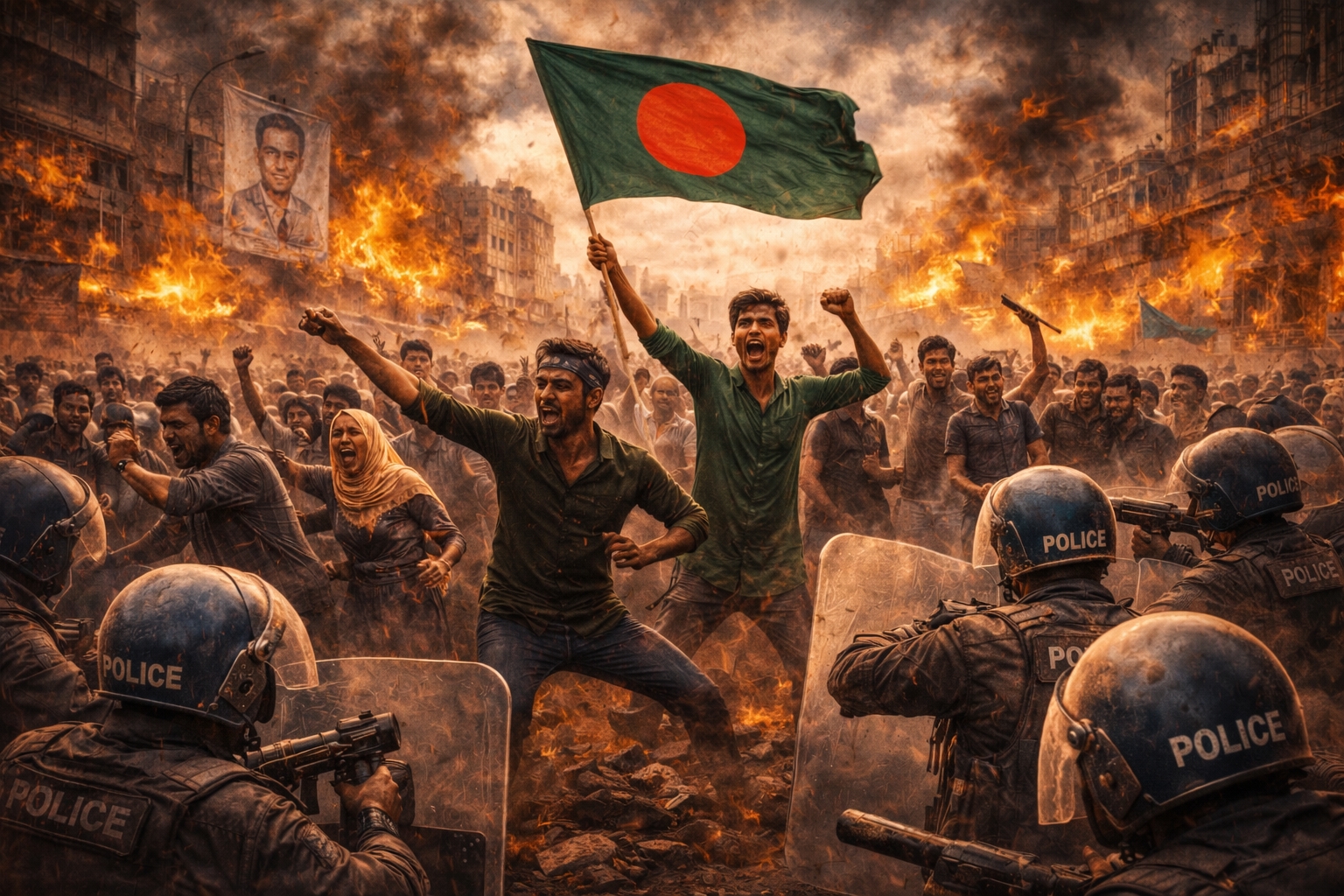
Bangladesh is gripped by turmoil following the assassination of Osman Hadi, a prominent student leader of the July 2024 uprising against Sheikh Hasina’s regime. He was shot in the head on December 12 as he was riding in a rickshaw after Friday prayers in Dhaka.
Rushed to hospital in Dhaka and then flown to Singapore for treatment, he died on December 18. There was a mass funeral for him in Dhaka on December 20 attended by the chief advisor to the Interim government Muhammad Yunus as well as senior military and civilian officials. Flags were flown at half mast.
The assailants, among them the prime suspect Faisal Kareem Masud are believed to have fled to India. This has heightened anti-Indian sentiment which was already high because Delhi is harbouring the fugitive former primer minister Sheikh Hasina.
Hadi’s party, Inqilab Moncho has demanded that the assailants be apprehended quickly to face trial. Following Hadi’s funeral, Inqilab Moncho gave a 24-hour ultimatum to the interior minister and his advisor to provide a progress report about arresting the assailants or resign.
The interim government in Bangladesh has also demanded that India hand over Sheikh Hasina. She was sentenced to death in November for crimes against humanity by Bangladesh’s International Crimes Tribunal. She and her party members also face other charges including killings, torture and disappearances of political opponents.
Hadi’s killing has come at a critical time for Bangladesh as parliamentary elections are slated for February 12, 2026. In addition to electing 300 members of parliament, there will also be a referendum on what is referred to as the “July National Charter”. This was signed by 22 political parties on October 17. It charts a new democratic course for Bangladesh wracked by decades of political violence.
Two leading political parties—the Bangladesh Nationalist Party (BNP) and the Jama‘at-e Islami—signed the July National Charter. The former ruling party, the Awami League did not. It has been banned from contesting the elections.
It is widely believed that both India and the Awami League are behind Hadi’s killing. Both want to destabilize Bangladesh and would like to see the elections derailed. So far, that does not appear to be the case although there have been violent protests including arson attacks on two leading newspapers, the Daily Star and Prothom Alo, viewed as pro-Awami League. Protests have also been held outside Indian diplomatic missions in Bangladesh.
Hadi was a vocal critic of India and wanted its influence on Bangladeshi politics eliminated. A day before his assassination, he had published a map of Greater Bangladesh that included the “Seven Sisters”—the seven eastern Indian states linked by a narrow corridor along Bangladesh’s border.
In Bangladesh, the last elections were held in January 2024. Sheikh Hasina was returned to office for a fourth consecutive term because her main rivals boycotted the polls. They accused her regime of rigging the polls.
That Sheikh Hasina had little support among the teeming masses of Bangladesh became apparent when student-led protests erupted in July 2024. Her autocratic rule benefited a small coterie of hangers-on and party faithfuls.
The spark for protests was provided by the quota system that mandated 30% of all government jobs for families of those who fought for the country’s independence from Pakistan in 1971. It included not only the “freedom fighters” but also their children and grandchildren. Not surprisingly, most people saw this as a gateway to corruption that entrenched Hasina’s power.
With few jobs available in the private sector, government jobs are the main source of employment for university graduates. More than 18 million young Bangladeshis are looking for work. Shut out of government jobs, the students’ frustration boiled over.
The quota system was scrapped in 2018 following student protests. It was, however, reinstated by a high court verdict in June 2024 when relatives of the 1971 veterans filed petitions.
Students saw the court’s reversal of the withdrawal six years earlier as a betrayal. Protests erupted at university campuses. The Hasina regime responded with customary brutality believing it could crush the protests.
Police and paramilitary forces including a counter-terrorism unit attacked students at university campuses. Far from subduing them, protests spread to other campuses across the country in solidarity with fellow students. They also spilled over into the streets of major cities, especially Dhaka where people were already reeling from high unemployment and inflation.
What added fuel to the fire was Hasina’s branding of the students as “razakars”, a derogatory term used for people who had collaborated with the Pakistan army during the 1971 uprising. If she thought she could discredit the students by such labels, it backfired.
Student protests escalated, demanding a public apology from Hasina and the resignation of government ministers, especially the interior minister and university chancellors. They also brought to the fore accusations of forced disappearances, extrajudicial killings and the suppression of opposition figures and Hasina’s critics. Demands for Hasina’s resignation quickly followed.
According to a United Nations report, up to 1,400 people may have been killed during the protests between July 15 and August 5, 2024. Thousands of others were injured. The Awami League spokesman, Mohammad Ali Arafat, who has also fled to India, rejected the figures calling them “unverified”.
He also denied the disappearances and torture of political opponents saying it was the work of the military-linked intelligence agencies over which the civilian government had “little control”. He flatly denied the presence of a secret prison called “Ayna-ghar,” (The house of mirrors). “We unequivocally deny its existence,” Arafat said.
Sheikh Hasina’s confidence in riding out the protests was based on her belief that the army chief, General Waker-uz-Zaman would carry out her orders. He is related to her by marriage. To his credit, the general refused to do so, thus saving Bangladesh from another bloodbath.
When Hasina realized that the army would not support her, she and her sister Rehana fled to India to seek refuge. So much for her heavy mandate, not once but in four successive “elections” since 2008, that the opposition parties had boycotted.
In the February elections, the parties that seem to have an edge over others include the Bangladesh Nationalist Party (BNP) led by the 80-year-old Khaleda Zia. She died in hospital on December 30 from multiple ailments. Her funeral was held in front of parliament the same day.
The other major party is the Jama‘at-e Islami. Several leaders of the Jama‘at were hanged by the Hasina regime after kangaroo trials.
Khaleda Zia’s son, Tarique Rehman announced that he would return to Bangladesh after spending 17 years in exile in Britain. His return to Dhaka on December 25 has paved the way for him to lead the BNP into elections. H is already been referred to as the "future prime minister of Bangladesh".
Two student-led parties, the Jatiya Nagarik Party (the National Citizens’ Party) headed by the sociology graduate Nahid Islam, and Inquilab Moncho whose leader Hadi was assassinated are also in the running. Despite being new parties, the students’ enthusiasm might see them gain a large number of seats in parliament.
The people of Bangladesh deserve a better fate than what has befallen the people of Pakistan. Brutish generals continue to terrorize the people, as they had done 54 years ago in what is today Bangladesh. Their massacre of Bengalis led to the humiliating surrender of tens of thousands of Pakistani troops to the invading Indian army.


As Bangladesh aid donors met in Dhaka on November 4, they got a glimpse of the problems confronting the country. The opposition Bangladesh N...
Elections due to take place in Bangladesh on January 22 were cancelled abruptly on January 11. The country’s caretaker government, headed...

Most people in Pakistan would rather not remember the humiliating surrender of 90,000 Pakistani troops to the invading Indian army in Decemb...