
 Archives
Multimedia
Donate
About
Sign In



 Crescent International


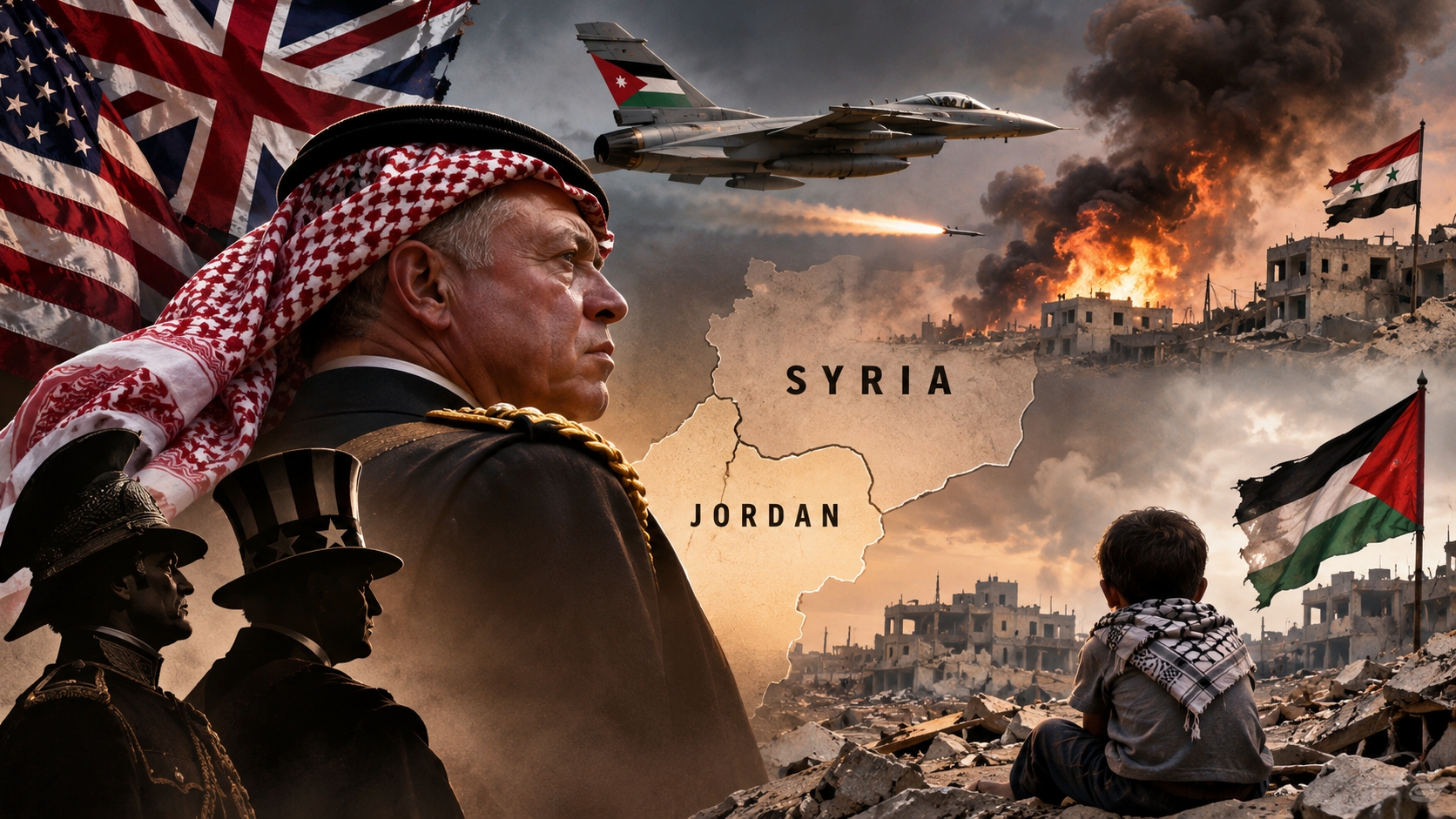
The western-backed Jordanian regime’s airstrikes inside southern Syria on October 26 were not simply a security operation.
They exposed the political bankruptcy and strategic short-sightedness of the British-installed regime governed by a Second Lieutenant of the British army, Abdullah II ibn al-Hussein.
It manifested the regime’s complete detachment from the realities of the region and the people it governs.
The immediate chronology is revealing.
On October 23, an attack during a funeral at a Greek Orthodox church in Jordan’s Karak governorate killed nine people.
The Abdullah regime subsequently arrested three suspects.
On the evening of October 26, the Jordanian regime struck several locations in Syria’s Daraa and Suwayda provinces.
Amman said the operation targeted Daesh militants linked to the attack and claimed around 20 militants were killed.
The Israeli installed proxies in Damascus, however, reported seven civilian deaths, including women and children.
The takfiri-led Syrian regime said the strikes had taken place without prior coordination, summoned Jordan’s ambassador and delivered a formal protest.
The two regimes later agreed to establish a joint security committee to examine the incident and its consequences.
The regime in Amman may present this as an exercise in defending national security.
In the post-2023 regional environment, however, the political consequences of such actions cannot be separated from the ongoing genocide in Palestine.
A ruler who uses military force against another Muslim country but refuses to lift even a finger to stop the slaughter of Palestinians, only deepens the legitimacy crisis confronting his regime.
The question is not whether Jordan has legitimate security concerns.
The real issue is why its response takes the form of unilateral military action inside a neighbouring Muslim country, with civilians paying the price.
This is the behaviour of a feudal clan, not that of a political system capable of understanding or responding to regional realities.
Such a system subordinates state interests entirely to regime’s survivability.
The Jordanian regime has once again demonstrated that its calculations are shaped more by its external allegiances than by the sentiments and concerns of the people it governs.
The strikes also reveal the long-term consequences of the proxy war imposed on Syria.
Fifteen or 25 years ago, it would have been difficult to imagine Jordan bombing Syrian territory and Damascus refraining from a military response.
Syria’s capacity and strategic posture have been greatly weakened by years of externally sponsored war and internal devastation.
Consider February 10, 2018: Even while fighting that war, Syrian air defences shot down an Israeli F-16 during an Israeli raid.
Jordan, by contrast, has never shown comparable willingness to confront Israel.
The episode should therefore be understood as more than a border incident.
It exposes the asymmetry of a regional order in which regimes backed by Washington and its surrogates can direct force against neighbouring Muslim countries while remaining subservient to apartheid Israel.
It also extinguishes any remaining hope that these foreign-imposed regimes can meaningfully reform themselves.
By choosing confrontation over political legitimacy and regional solidarity, Jordan’s rulers are setting themselves on a collision course with the people of the region.
Their action reflects a profound detachment from the region’s realities and concerns of the wider Muslim Ummah.
In the emerging multipolar world order, where western powers are experiencing a significant decline, it is quite reckless for the Jordanian regime to remain so thoroughly aligned with western geopolitical interests while adopting a confrontational posture towards its Muslim neighbours.
A regime whose survival depends so heavily on external patrons is particularly vulnerable in this changing security environment.
Its western masters are becoming increasingly incapable of protecting their own regional military bases or safeguarding their vassals in West Asia with the same degree of impunity they enjoyed 15 or 20 years ago.


The first shots in the war on Iraq were fired in Jordan when King Abdullah II sent tanks into the city of Ma’an, 215 kilometres (135 miles...
Jordan’s parliamentary elections finally took place on June 17, almost two years after the dissolution of the previous parliament at the e...

Jordan is an artificial entity. The British carved it out of a part of Palestine and handed it over to Hussain ibn Ali, who was the Sharif (...
