
 Archives
Multimedia
Donate
About
Sign In



 Crescent International


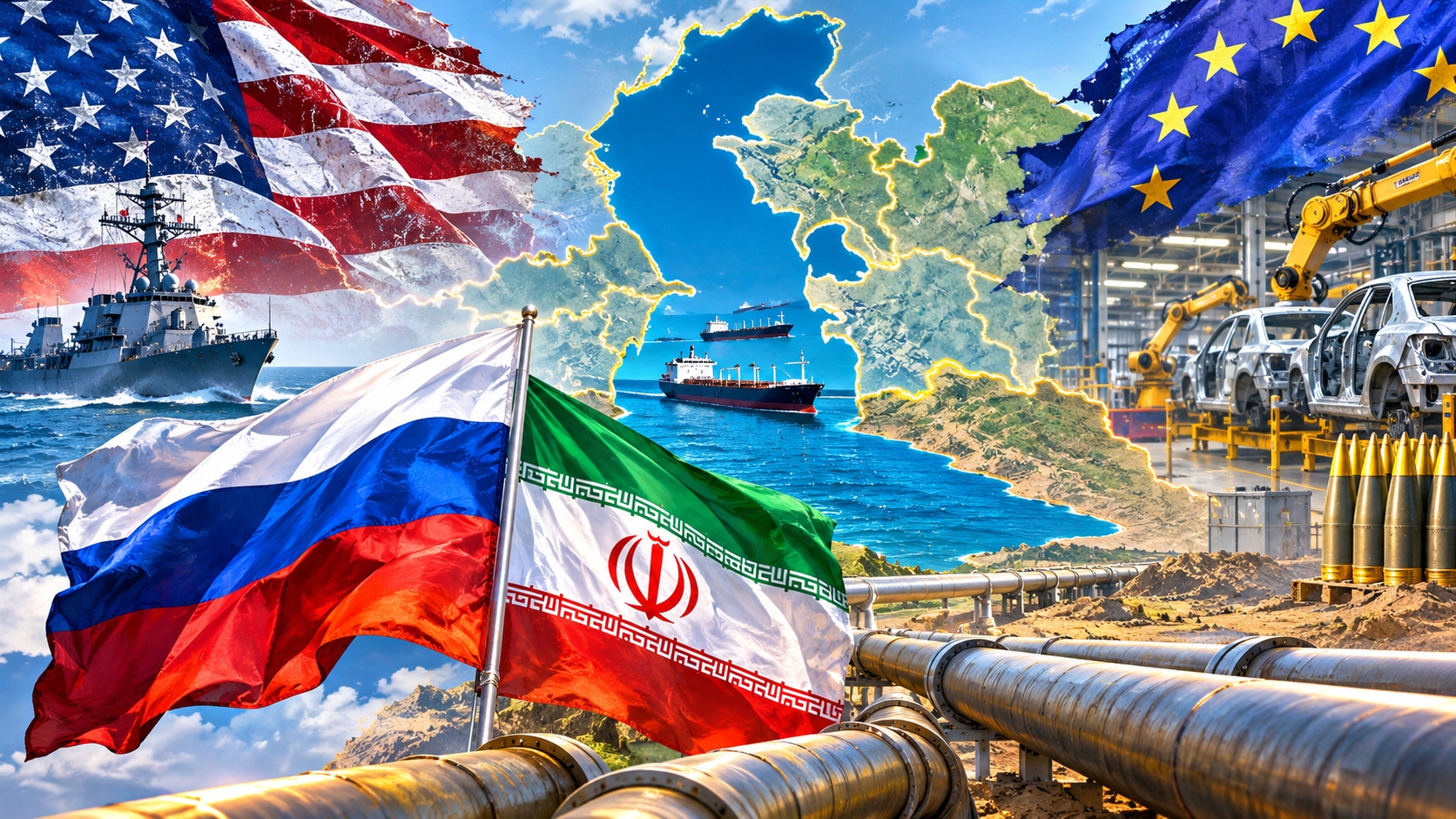
The Islamic Revolutionary Guard Corps (IRGC) of Iran is right to dismiss Washington’s newly announced Iron Gate initiative as little more than political wordplay.
But there is a much bigger problem with this plan than its questionable ability to achieve its stated objectives: it will stretch US imperialism’s military, economic and political resources even further.
It will also accelerate the emergence of geopolitical arrangements that Washington has spent decades trying to prevent.
Iron Gate, which seeks to extend the US blockade of Iran to its land borders and the Caspian Sea, should not be viewed merely as another instrument of economic pressure against Tehran.
It must also be understood within the broader geopolitical confrontation between western regimes and Russia.
The western regimes spent years attempting to weaken Russia through the indirect war in Ukraine, backed by sanctions, military assistance and economic isolation.
Yet the conflict has exposed this strategy’s limitations.
Russia has not been defeated, and the prospect of a military resolution on terms dictated by Washington and its European vassals remains elusive.
But even if the Ukrainian battlefield eventually falls silent, the strategic ambitions behind western containment will not necessarily disappear.
Washington and the EU will still seek mechanisms to weaken Russia’s economic, technological and geopolitical reach.
In this context, Iran and the Caspian region offer another potential pressure point.
This is where Iron Gate becomes particularly significant.
By targeting Iranian land connections and Caspian shipping routes, Washington is effectively extending its confrontation into a geographical space of considerable importance to Russian strategic and economic interests.
The Caspian is not simply an alternative trading route for Iran; it is also a shared strategic environment in which Russia has substantial interests.
American attempt to impose restrictions there inevitably brings Moscow into the equation.
In other words, what is presented as another initiative against Iran can also function as a continuation of the broader containment strategy against Russia.
It amounts to a potential Plan B: if Russia cannot be strategically defeated in Ukraine, pressure can be maintained through other theatres and instruments.
There is another dimension worth considering.
Europe’s growing militarisation is increasingly being presented not merely as a security necessity but also as an industrial and economic opportunity.
Germany’s defence industry association has proposed redirecting the country’s struggling automotive manufacturing capacity towards weapons production.
In March 2025, Defense News reported the proposal, while documenting the conversion of former automotive facilities to military manufacturing.
In March 2026, Deutsche Welle also reported discussions involving Volkswagen’s Osnabrück plant and the potential production of components for Israel’s Iron Dome system.
This is an extraordinary illustration of the direction in which European economic priorities are moving: industrial capacity that once served civilian prosperity is increasingly being considered for military production.
Yet there is a fundamental contradiction in this strategy.
Extending confrontation across additional geographical theatres does not eliminate the costs of containment.
It multiplies them.
Trying to create military pressure around Iran, policing maritime routes and attempting to disrupt trade across the Caspian requires resources sustained political commitment.
It also creates additional opportunities for escalation, as it will provide Islamic Iran and Russia with additional political, economic and military leverage.
Russia was able to bring the entire cabal of western regimes to a standstill within their own geopolitical sphere, namely Europe and Ukraine.
There is no doubt that the costs for western regimes in the Caucasus and Central Asia will be even greater, as these are regions where both Iran and Russia command greater local appeal.
More importantly, this approach risks producing the opposite of its intended geopolitical outcome.
Russia and Iran already have a 20-year strategic partnership agreement, signed in January 2025, covering defence, security, energy, trade and coordination against common threats.
Iron Gate provides another incentive for both countries to strengthen alternative transport corridors, financial arrangements and economic cooperation.
Washington may believe it is building another instrument of containment.
Instead, it could be helping to consolidate the very Eurasian cooperation it seeks to undermine.
The fundamental problem with western geopolitical thinking is that it continues to treat pressure as an instrument that can be expanded indefinitely without generating counterpressure.
Western regimes have failed to grasp the reality that they are no longer the domineering geopolitical bloc.
But reality is unforgiving: it does not care whether one chooses to acknowledge or deny it.
Eventually, it boomerangs against those who refuse to accept it and smashes them in the face.


The Caucasus region has never had peace or stability for more than 200 years. Despite a brutal Russian crackdown on Chechnya, the Muslim rep...
Aware that their survival depends on unity, the Mountain Peoples of the Caucasus have frequently attempted to achieve this goal in the face ...
