 Archives
Multimedia
Donate
About
Sign In
Archives
Multimedia
Donate
About
Sign In



 Muslim Mahmood


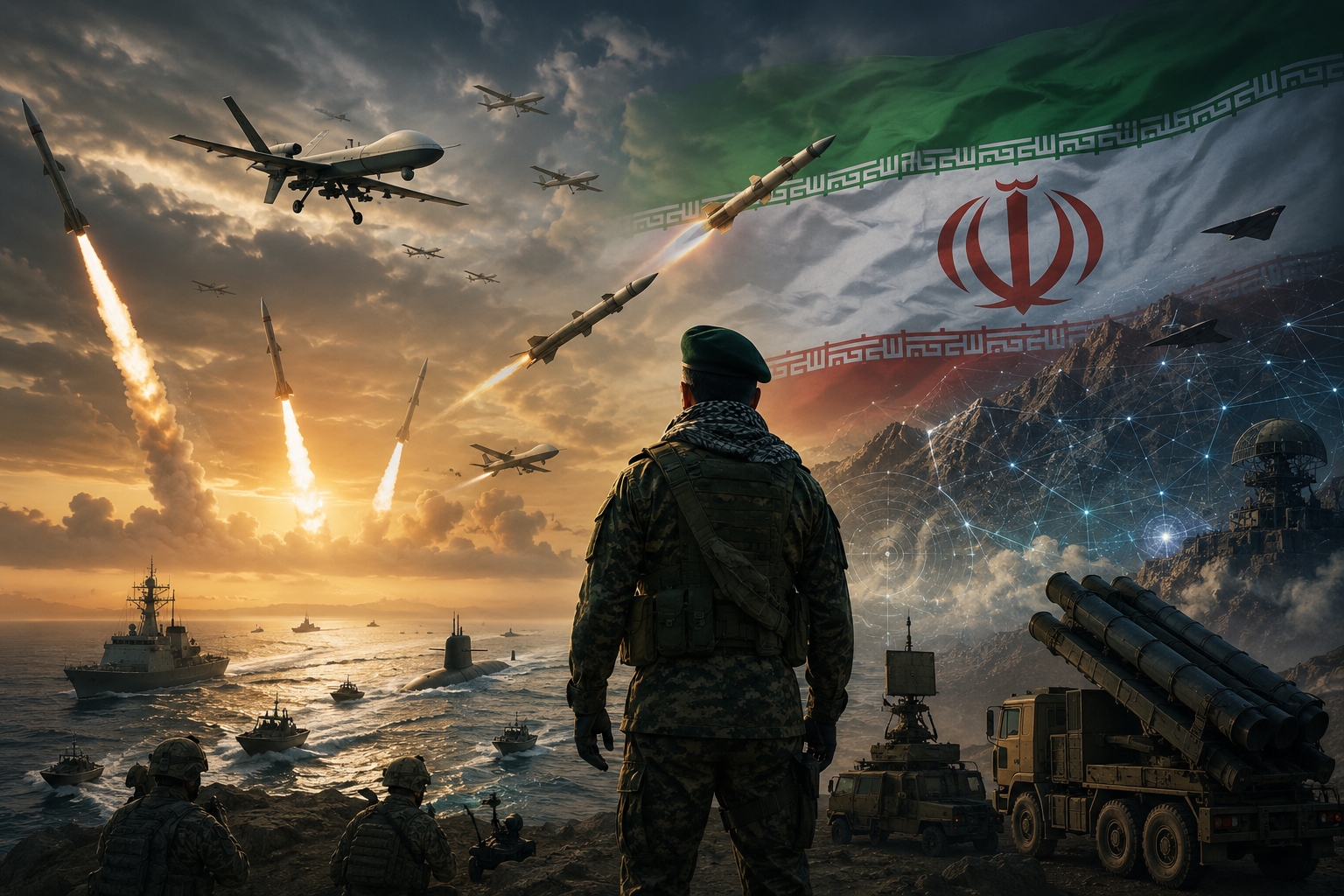
In the modern landscape of global conflict, the Islamic Republic of Iran has moved beyond traditional defensive postures to implement an offensive deterrent strategy that challenges the conventional military supremacy of America and zionist Israel.
While Asymmetric Warfare is traditionally defined as a conflict where a weaker power leverages unconventional tactics to level the playing field against a superior force, Iran’s current model has evolved into a sophisticated, decentralized system designed to absorb pressure and redistribute it outward.
This report investigates how technological indigenization, intricate networks across Lebanon and Gaza through local allies, and economic chokepoints have collectively redefined the cost-benefit analysis of modern war in West Asia.
Timeline of Strategic Evolution
The Deadly Triangle: Allies, Missiles, and Drones
Iran’s redefinition of asymmetry rests on a deadly triangle consisting of a vast human network, diverse missile programs, and low-cost drone technology. This strategy allows the state to strike without engaging in direct, head-to-head military confrontation, effectively pushing the battlefield away from its own borders.
The first pillar involves allied forces, referred to as the Axis of Resistance, extending from Hizbullah in Lebanon to groups in Iraq, Syria, and Yemen. This network provides “strategic depth,” forcing opponents to fight on multiple fronts before ever reaching Iranian territory.
Furthermore, these groups allow for plausible deniability, as Iran can claim, quite rightly, that they act independently, complicating the legal grounds for direct retaliation.
The second and third pillars involve technological proliferation. Lacking a modern air force, Iran has developed the largest and most precise missile arsenal in West Asia, utilizing underground missile cities to ensure a second-strike capability. Most notably, the rise of suicide drones, such as the Shahed series, has shifted the war economy.
A drone costing roughly $20,000 can successfully destroy a multi-million dollar tank or aircraft, creating a massive cost imbalance. Reports from the 2026 war on Iran indicate that US forces lost 42 military planes in just 40 days, including 24 MQ-9 Reaper drones and an F-35A Lightning II, damaged by ground fire.
Mosaic Defense and Decentralized Power
Traditional military doctrine suggests that removing the central leadership of any state will cause the system to collapse. The Iranian military, however, is built on a distributed power model known as the Mosaic Defense.
This strategy envisions the country as a spider web where each local unit or “node” is responsible for its own defense. If the central command is disrupted, the local units continue to operate independently.
This decentralized structure makes “shock and awe” or decapitation strikes largely ineffective. Because the system does not depend on a single center or even on winning in the traditional sense, it is significantly harder to neutralize.
This resilience is coupled with the indigenization of military knowledge. Unlike many of its neighbors, Iran does not rely on western states for military equipment, parts or repairs. If the borders are closed, the domestic production lines continue to function, allowing for sustainability in prolonged, exhausting conflicts.
Economic Leverage and Global Chokepoints
A critical component of Iran’s redefined asymmetric strategy is the use of geographic leverage to exert global economic pressure. The Strait of Hormuz serves as the world’s energy artery, and Iran has demonstrated the ability to threaten or close this waterway. During the US-zionist war of aggression, closure of the Strait led to a global energy crisis, with US gas prices spiking above $4 to $5 per gallon.
Iranian officials maintain that they are the guardians of this passage but reserve the right under international law to restrict access to belligerent parties or aggressors during a state of war. By holding a gas nozzle to the heads of the global population, Iran forces international actors to weigh the high economic costs of escalation.
This form of warfare moves beyond the physical battlefield. It impacts global markets causing financial pressure that can undermine the political will of states with democratic pretensions.
Institutional Failures and the Limits of Conventional Might
The ongoing conflicts involving major powers like America, Israel and Russia suggest a pattern where military superiority fails to convert into political victory. In the specific case of the US-zionist war on Iran, critics in US Congress, such as Representative Thomas Massie, have questioned the lack of a clear mission and the legal basis for preemptive war. Massie noted that the Department of War conceded there was no evidence of an “imminent” Iranian strike prior to the commencement of hostilities.
Furthermore, the alleged invincibility of advanced platforms like the F-35s has been challenged by Iranian ground fire and drone saturation. The high cost of the 40-day war—estimated at $29 billion due to aircraft losses and infrastructure damage—highlights the inefficiency of using expensive conventional assets against a highly adaptable asymmetric opponent (The actual cost is believed to be around $200 billion when all factors are taken into account).
As noted by analysts, the US and Israel are effectively checkmated by a country that can absorb immense pressure while inflicting significant economic and military damage at a fraction of the cost.
Strategic Stalemate and the Necessity of Diplomacy
The current state of affairs suggests that the old model of military dominance is increasingly obsolete in the face of decentralized, technologically empowered resistance. Iran’s strategy of winning without fighting focuses on making the cost of war so high that enemies hesitate to engage.
While the Islamic Republic of Iran faces severe economic pressure and international sanctions for its policies, the deterrent effect of its deadly triangle has successfully prevented total invasion.
Public statements of Iranian officials, such as those in the Foreign Ministry, emphasize that they do not seek to expand the boundaries of war but will react decisively to acts of aggression. Conversely, US lawmakers have expressed frustration that the Trump regime’s claims of beating Iran do not match the reality of a closed Strait and a decimated drone fleet.
With both sides sticking to their red lines—the US refusing to concede on the Strait of Hormuz (this may be changing) and Iran refusing to give up its nuclear leverage—the situation remains a stalemate. Diplomacy and patient negotiations may be the only viable path forward.


As the Islamic revolution enters its 40th year, we examine its achievements and challenges
Is it a coincidence that a day after Iran joined SCO, riots erupted over the unfortunate death of a young woman in hospital (not the police ...

Iranians will go the polls again in a week’s time to vote in the second round of presidential election. The two front-runners, neither of ...