 Archives
Multimedia
Donate
About
Sign In
Archives
Multimedia
Donate
About
Sign In



 Editor



There are two occasions in the Islamic lunar calendar that Muslims want to observe together: the start and end of Ramadan (celebration of Eid al-Fitr). The desire for unity actually ends up creating more divisions.
This year has been no exception. The Beduoins occupying the Arabian Peninsula claimed that Ramadan moon was “sighted” on the evening of February 17. Based on astronomical data, this was impossible. We will explain why.
The Saudi Beduoins even brought out a telescope to try and convince some gullible Muslims that they actually “sighted” the moon. What could be more impressive than flashing a telescope pointing to the sky to prove that they are using the latest scientific gadgets?
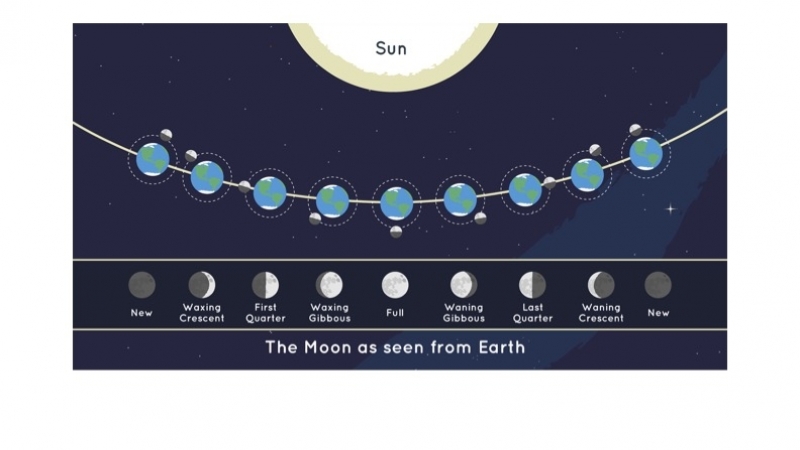
The lunar month starts with the sighting of the new moon (the crescent, the thin sliver of moon that becomes visible in the evening sky after sunset). The birth of the moon is that point in its cycle when it is perfectly aligned with the sun and the earth. This is called conjunction and the moon is completely invisible. It is a dark disk.
It takes between 28 days and five hours to 29 days for the moon to complete its cycle around the earth. After conjunction (the moon’s birth), it requires between 18 to 20 hours for the moon to move sufficiently away from the earth’s shadow to have some light reflected on its surface.
The moon’s visibility is based on the amount of sunlight reflected from the earth’s surface. This explains the various phases of the moon in each lunar month.
In addition to age, the other factors determining visibility include the time of moonset (before or after sunset), and how long it remains in the sky after sunset. The angle of separation between the sun and the moon is also crucial. Even if the moon sets after sunset, if it is at or near the same spot as the sun, its chances of visibility are virtually nil because of dispersion of sunlight.
While the birth of the moon can be determined precisely, the other factors introduce considerable uncertainty. Weather also plays a part. In most parts of North America and Europe, during winter months, the sky is often overcast for weeks (it is the case at present). The chances of moonsighting are almost impossible.
While Muslims have historically followed the physical sighting of the moon, based on Prophetic hadiths (Sahih Muslim, Hadith # 2378, 2379, 2380…), other Muslims have opted for determining the sightability criteria using scientific data. This latter approach has been adopted in recent years to remove uncertainty about the start and end of Ramadan, especially in countries where Muslims are a minority. This assumes added significance in winter months.
The uncertainty about when to start and end Ramadan has implications for arranging holidays from work. It is even more acute for children at school who are often ridiculed when some Muslim children celebrate Eid on one day and others on the next.
Let us look at the scientific data for this year’s Ramadan moon. It was born on February 17 at 12:01 pm Universal time (UT). Muslims can calculate what was the time in their locality. For instance, 12:01 pm universal time is 7:01 am Toronto time.
In Saudi Arabia, it was 2:01 pm (afternoon). Sunset in Makkah on February 17 was around 6:21 pm. Thus, the age of the moon at sunset was 4 hours and 20 minutes. Moonset was also at about the same time: 6:22 pm.
Given the age of the moon (4 hours+) and the time of moonset vis-à-vis sunset, it was astronomically impossible for the moon to be visible, not even with the most powerful telescope. The moon was simply not formed.
An additional complicating factor this year was the annular solar eclipse. All these factors made it impossible to sight the moon or to be sightable anywhere in the world except in the remote islands of the Pacific Ocean.
The time difference between those islands and the rest of the world (17-18 hours) meant practically those islands had started a new day (February 18).
The dilemma
How to resolve the dilemma between physical moonsighting and scientific data? Even proponents of physical moonsighting rely on scientific data about the birth and age of the moon. The only difference is that they want evidence from two credible witnesses for actual moonsighting.
Another complicating factor is the issue of the location of moonsighting. Is there a geographical limit, and if so, how is it determined? Some Muslims follow local sighting while others say the country’s geographical boundaries determine the limit. These are arbitrary decisions.
Followers of scientific calculations also make assumptions that raise serious questions. For instance, they take the entire globe as one matla (horizon), meaning the new moon visible anywhere in the world should be followed by everyone. This woud work if the earth were flat but it isn’t.
Between Australia and North America, there is a time difference of 17 to 20 hours. In North America, the age of the moon is much greater than anywhere else because of time lapse after the moon’s birth.
Thus, any sighting or sightability criterion in North American cannot be followed by people in Australia because they have already started a new day. These issues have to be resolved with clear Islamic and scientific evidence.
Call for unity
Some Muslims argue that for the sake of unity, we should all follow the Saudi announcement. Is there any ayat in the Qur’an or the Prophet hadith that supports such a position? What is special about the Beduoin-ruled kingdom that is rapidly hurtling toward western hedonism?
The call for unity, while admirable, is impractical because the Muslim world is already divided into nation-states. For unity to be meaningful, it must start at a much more basic level.
Why do the Bani Saud indulge in such mischief every year by making false claims? One reason could be that they want to assert their authority as “leaders” of the Muslim world and the moonsighting claim is used as a kind of referendum.
If this is the case, then the overwhelming majority of Muslims from Australia to North America rejected the Saudi moonsighting claim. Only a few countries in West Asia (aka the Middle East) accepted their announcement.
Unfortunately, Muslims are hopelessly divided on most major issues. Look at the plight of the Palestinians. What have the Muslims done for them as they face zionist genocide?
At present, the only practical solution seems to be to follow local sightings or sightability criteria. Unity must be achieved locally before seeking it globally.


This year again, as so often in the past, the Ummah has been divided unnecessarily on the dates of Ramadan, primarily by a blatantly nonsens...
Every year there is confusion in the Ummah over the correct days for marking the beginning and end of Ramadan. ZAFAR BANGASH, Director of t...
Later this month, Muslims all over the world will mark the beginning of the blessed month of Ramadan, undoubtedly the most special time of y...