
 Archives
Multimedia
Donate
About
Sign In



 Askia Wejd


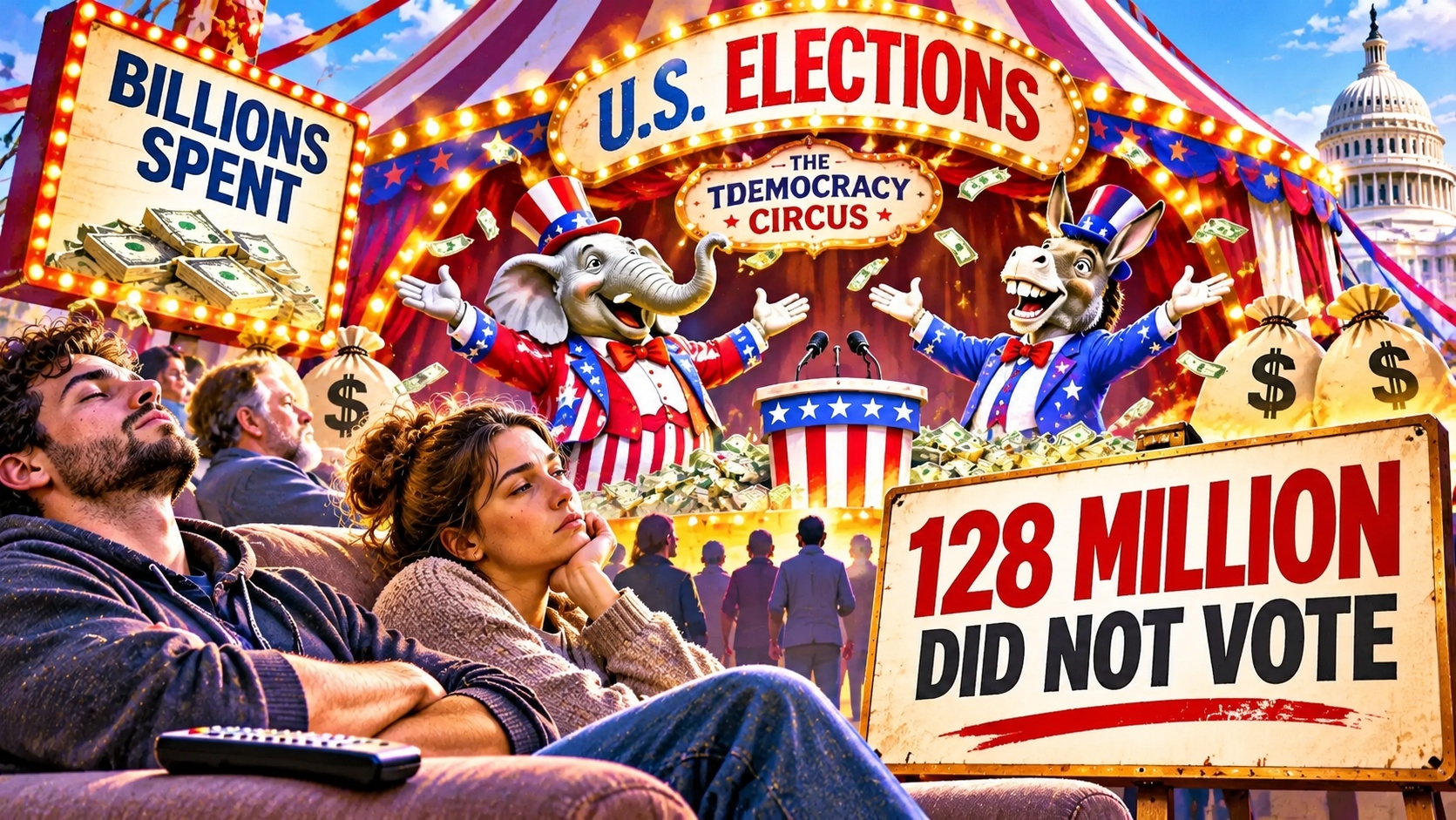
To accurately assess the implications of the recent US midterm elections, it is essential to consider a crucial number. After the extraordinary amounts of money spent on election campaigns, the second most important number for understanding the US political system is 128 million. That is approximately the number of eligible Americans who did not vote in the November 2026 midterm elections.
In other words, more than half of the country's eligible voters stayed away from the circus packaged as “elections.” The political significance of this reality is not possible to dismiss in the self-proclaimed leading democracy of the western world. The majority of eligible voters did not participate in the process that supposedly determines their political future.
Yet the deeper problem extends well beyond voter participation. The American political system is not merely experiencing a crisis of representation. It is built around an institutional architecture that makes the translation of popular preferences into political action extraordinarily difficult.
Its defenders describe this arrangement as a sophisticated system of checks and balances. In practice, it has increasingly become a mechanism through which political paralysis is normalised, responsibility is dispersed and meaningful change is obstructed.
This is why the expectations surrounding the Democratic gains in the midterms should be treated with considerable scepticism. The assumption that a change in congressional control will somehow produce a fundamental shift in the direction of American policy reflects a misunderstanding of how power operates in Washington.
Electoral victories can alter the political balance, complicate the president’s legislative agenda and create opportunities for congressional investigations. But none of this necessarily translates into the capacity to reverse established strategic priorities, particularly in foreign policy.
The US constitutional system contains numerous institutional veto points. The separation of powers divides authority between the executive and legislative branches, while the bicameral structure of Congress introduces another layer of competing interests and procedural obstacles.
The Senate filibuster, for example, means that most ordinary legislation requires a supermajority of 60 votes to overcome procedural obstruction. Presidential vetoes create another barrier, requiring two-thirds majorities in both chambers to override them. Federalism further disperses authority between Washington and individual states.
The cumulative effect is a political architecture in which preventing action is often considerably easier than implementing it. A party can win elections, gain congressional seats and claim a popular mandate, only to discover that its ability to translate that mandate into policy remains severely restricted.
The system does not simply encourage compromise; it can make compromise structurally elusive. And when political actors cannot agree, the default outcome is frequently inaction.
A political system that makes it exceptionally difficult to implement the preferences of elected representatives cannot credibly claim that the mere existence of elections guarantees meaningful popular sovereignty. The ability to vote is not the same as the ability to influence the direction of government.
The continuity of US foreign policy offers an even more compelling illustration. When Joe Biden entered the White House in 2021, he presented himself as a departure from Trump’s approach to international relations. Yet his regime did not dismantle the central economic pressure mechanisms established by its predecessor against China. The tariffs imposed under Trump remained largely in place. In 2024, the Biden regime concluded its review of the existing Section 301 measures and decided to retain them, while increasing tariffs on selected Chinese products, including electric vehicles.
This was not an incidental detail. It demonstrated that the strategic confrontation with China had become embedded in the American political establishment to such an extent that a change of president did not produce a fundamental reassessment of the policy. Biden could criticize Trump’s methods, present himself as a defender of multilateralism and promise a more predictable foreign policy, but the underlying strategic direction remained largely intact.
The same pattern can be observed in the relationship between presidential rhetoric and the actual operations of American imperialism.
A particularly revealing example appeared in a recent article in The Atlantic, titled “The Man in the Middle of Trump’s Deeply Conflicted Ukraine Policy”.
In the article one intelligence officer in the Baltic states, who works closely with the Americans to counter Russian influence, reportedly told the author that, despite what Trump's rhetoric might suggest, CIA operations had become “much more aggressive” than they were under Biden.
This observation deserves attention because it exposes the distance between the political theatre of Washington and the operational machinery of US imperialism. Trump may publicly question the extent of American involvement, criticize Kyiv or signal a desire to reach an accommodation with Moscow. Yet the intelligence establishment continues to operate according to its own institutional priorities and established framework. Presidential rhetoric, in other words, does not necessarily describe the full reality of American policy.
The example demonstrates how much of US foreign policy is conducted through the imperial agenda that cannot simply be switched on or off in response to the political messaging of the moment.
It also illustrates why the prospect of a Democratic-controlled Congress fundamentally changing Trump's foreign policy should not be exaggerated.
Congress will create headaches for the MAGA regime. But intelligence operations, executive authorities and established national-security commitments do not fall within the reach of ordinary legislative intervention. Even a very determined congressional opposition may find itself better equipped to obstruct selected initiatives than to impose an entirely different strategic direction.
Both major parties operate within a political establishment whose understanding of American global hegemony, strategic competition and the preservation of geopolitical influence is deeply entrenched. Their disagreements are often superficial and tactical. The Democrats simply object to Trump's bluntness stemming from his lack of statecraft and outright stupidity, while remaining committed to many of the same strategic objectives.
This is precisely why interpreting American politics through the simplistic framework of Republican versus Democrat, or Trump versus anti-Trump, is naive at best. The political spectacle is highly polarised, but the underlying structures of power display considerable continuity. A change in congressional majorities may alter the intensity of domestic political conflict without fundamentally altering the country's strategic trajectory.
The midterms, therefore, should not be mistaken for a mechanism through which the American political system can suddenly correct its structural deficiencies. Nor should Democratic electoral gains be interpreted as evidence that the country has discovered a coherent alternative to Trump's political project.
They may reflect widespread dissatisfaction with the regime, economic frustration or opposition to particular policies. But dissatisfaction does not automatically translate into a unified political programme, much less the institutional capacity to implement one.
The deeper crisis is that the American system increasingly appears incapable of reconciling its competing political interests, translating popular preferences into effective governance or producing a coherent strategic direction. Its institutional architecture was designed for a different historical era, under conditions that bear little resemblance to the political, economic and geopolitical realities of today.
What was once defended as a safeguard against concentrated authority has become an increasingly rigid and highly dogmatic structure, ill-equipped to respond to a society experiencing profound political and economic crisis.
The empire in decline may continue to hold elections, change presidents and redistribute congressional seats. It may even produce dramatic electoral headlines. But none of these developments should be confused with the capacity for fundamental political transformation. The American oligarchy remains remarkably resistant to change, even as public confidence in the system erodes internally and externally.
The central question is no longer who wins the next election. It is whether a political system designed primarily to restrain and obstruct power can still govern a country whose internal contradictions and external ambitions are becoming increasingly difficult to reconcile.


Is America heading for a civil war following the November 3 presidential election? Given the polarization and deep hatreds that have been ar...

Contrary to popular myth, the US presidential race is not an election; it is a process of selection. And it does not matter who enters the W...
While it is satisfying to see that American voters have rejected Donald Trump and his Republican Party in the midterm elections, it is unrea...
