 Archives
Multimedia
Donate
About
Sign In
Archives
Multimedia
Donate
About
Sign In



 Zia Sarhadi


The Taliban celebrated the fifth anniversary of their return to power with music and dancing on August 15. Yes, you read that correctly. So, music per se is not banned in Afghanistan under Taliban rule. It is certain type of music—the western vulgar variety—that is not permitted in the country.
Islamic songs and music blared from loudspeakers in Kabul, the capital city. Armed Taliban fighters even danced in the streets. So much for western propaganda against the “primitive”, “evil” Taliban. This nonsense is also repeated in some Muslim countries, notably Pakistan whose military bosses had hoped to have the Taliban under their control once the Americans fled the landlocked country.
The Pakistani mindset reflects a lack of understanding of Afghan culture. It is a major failing of the Pakistani generals that they assume things that do not pan out. Then they express surpise at the turn of events.
It was exactly five years ago (August 30, 2021, 11:59 pm), that the last American soldier slunk out of Kabul airport under the cover of darkness. The huge C-17 transport plane taking the last remaining US soldiers roared into the night sky and flew towards the Pakistan border. American troops held their collective breath for fear of a Taliban attack.
The slow moving C-17 plane could have been blown out of the sky but unlike the treacherous Americans, the Taliban, for all their faults, kept their word to not attack the fleeing Americans. Another empire had bitten the dust in a country dubbed the “graveyard of empires”.
Tempting as it may be to reminisce about the defeat of the self-proclaimed superpower by the rag-tag band of Taliban fighters, it would be more helpful to consider the Taliban’s performance in the five years since they returned to power.
The US/NATO allied occupation of Afghanistan —euphemistically referred to as the “coalition of the willing”—cost $1.26 trillion. Spanning 20 years, it spawned a culture of corruption and extreme lawlessness in the country. Armed gangs roamed free and terrorized ordinary Afghans as the Americans and allied forces battled the Taliban.
With the Taliban’s return to power, the country, especially Kabul, is no longer terrorized by armed thugs. There are no road blocks anymore as was the case during US occupation.
Ordinary Afghans go about their daily life unmolested or fearing for their safety.
Unlike their first stint in power—August 1996 to November 2001—this time the Taliban control all the provinces of Afghanistan. This has prevented the warlords—Uzbeks, Tajiks and others—to act as guns for hire to the highest bidder.
Even the much-dreaded Islamic State-Khorasan Province (ISKP) group that reared its ugly head in the final years of US occupation has been contained. Amid security and economic challenges, the Taliban have significantly weakened the terrorist outfit. It no longer poses a serious threat. The ISKP is funded and backed by the US through the Pakistani generals that are always available to offer their services for bakhsheesh.
True to their duplicitous nature, while the Americans fled, they refuse to return Afghanistan’s $10 billion deposits held in US banks. Americans are bandits and thieves. And Donald Trump is the quintessential thief besides being a child rapist, a certified crook and a compulsive liar.
The withholding of Afghan funds has created major economic problems for the Taliban. The Americans had also spawned a culture of corruption and dependency in Afghanistan.
With the departure of US troops, such funding also stopped. During US/NATO occupation, economic activity was largely sustained by international aid. Its abrupt termination undermined the economy that had become totally dependent on aid during the 20-year occupation.
The Taliban, however, have managed the economy reasonably well. Several factors have contributed to this. They have managed to reduce corruption considerably. Top officials lead a simple life. This has earned them respect among the people.
Similarly, by imposing a ban on foreign currency trading, they have stabilized the local currency, the Afghani. In the past, money changers displayed stacks of notes—US dollars, euros, Pakistani rupees, Saudi riyals and others—openly. People could purchase foreign currency.
The Taliban decreed that people can only use the Afghani inside the country. This increased demand for the local currency. Today, one US dollar fetches 66 Afghanis. Compare that to the Pakistani currency which stands at around Rs 278 to the US dollar!
While few countries have established formal diplomatic relations with the Taliban government, 17 countries maintain diplomatic missions. Russia, China, Japan, Iran, Pakistan, Turkiye, Turkmenistan, Kazakhastan, Tajikistan, Uzbekistan, Qatar, the UAE and India, among others, maintain diplomatic missions.
Russia, China and Iran also have ambassadors in Kabul. The European Union has a diplomatic mission while the US maintains an interest section under Qatar’s diplomatic cover. It is, however, the Taliban’s relations with the Central Asian Republics, plus Russia, Iran and China that have opened avenues for trade.
Pakistan’s thuggish generals have lost out on this and are fuming that the Taliban maintain good relations with India. If they were to improve their manners, the generals might reap the rewards of good behaviour. They have closed the border with Afghanistan, forcing the Taliban to seek alternate routes for trade.
The other area where the Taliban have moved ahead is in the mining sector. Contracts have been signed with Chinese companies for copper, iron ore and gas exploration. While the pace is slow, it is moving in the right direction.
The Chinese have built a road through the narrow Wakhan corridor. It was a difficult undertaking from the engineering point of view but it has linked China to Afghanistan. In the west, Iran has built the Khaf-Herat railway that now links land-locked Afghanistan to Iran’s vast railway network.
With the Pakistani route closed, Iran’s Chahbahar port has become an important entry and exit point for Afghan goods. A number of agreements have also been signed with Central Asian Republics including revival of the the Turkmenistan–Afghanistan–Pakistan–India (TAPI) gas pipeline and extensions of electricity transmission networks with Uzbekistan.
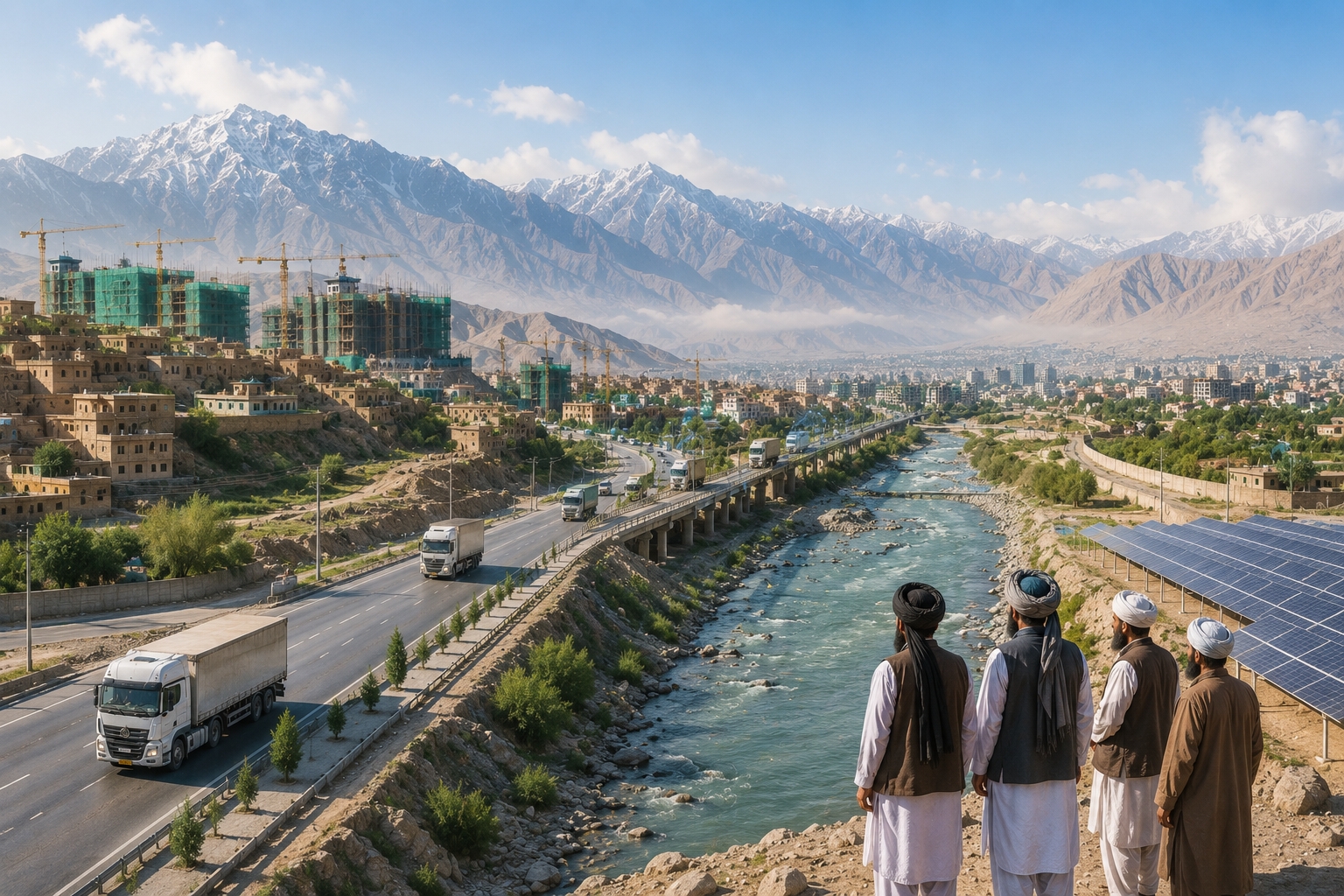
They may appear simple, dressed in their traditional oufit (Shalwar Qamees), but the Taliban understand what the country needs. Several roadwork and construction projects have been completed. Others are under way across the country.
On August 18, the Taliban government launched the construction of 14 development projects in northern Afghanistan’s Baghlan province, the official Bakhtar News Agency reported. These will include the construction of roads, recreational parks and water canals.
The projects are funded by the United Nations Office for Project Services (UNOPS) and will be implemented on the outskirts of Pul-e-Khumri, the provincial capital. Their economic benefits are clear.
Western media outlets keep harping on lack of educational facilities for girls and women. This is true but if they were really concerned about the well-being of Afghan girls and women, they should demand that the American bandits release Afghan funds they have illegally held. This might incentivise the Taliban to open up colleges and universities for girls as well.


The sudden collapse of the Taliban under the attack of the US surprised and disappointed many Muslims. Dr Perwez Shafi, of the Institute of ...
The Taliban’s ascendance in Swat and their brief foray into the town of Buner to the south sent leaders of the self-proclaimed superpower ...
Economic pressure and exploiting political differences among the Taliban are tools the US-Nato combine will use to undermine Afghanistan. Th...
The Taliban may not have achieved formal recognition from any country so far but they continue to be received by neighboring states. They ce...