 Archives
Multimedia
Donate
About
Sign In
Archives
Multimedia
Donate
About
Sign In



 Abu Dharr


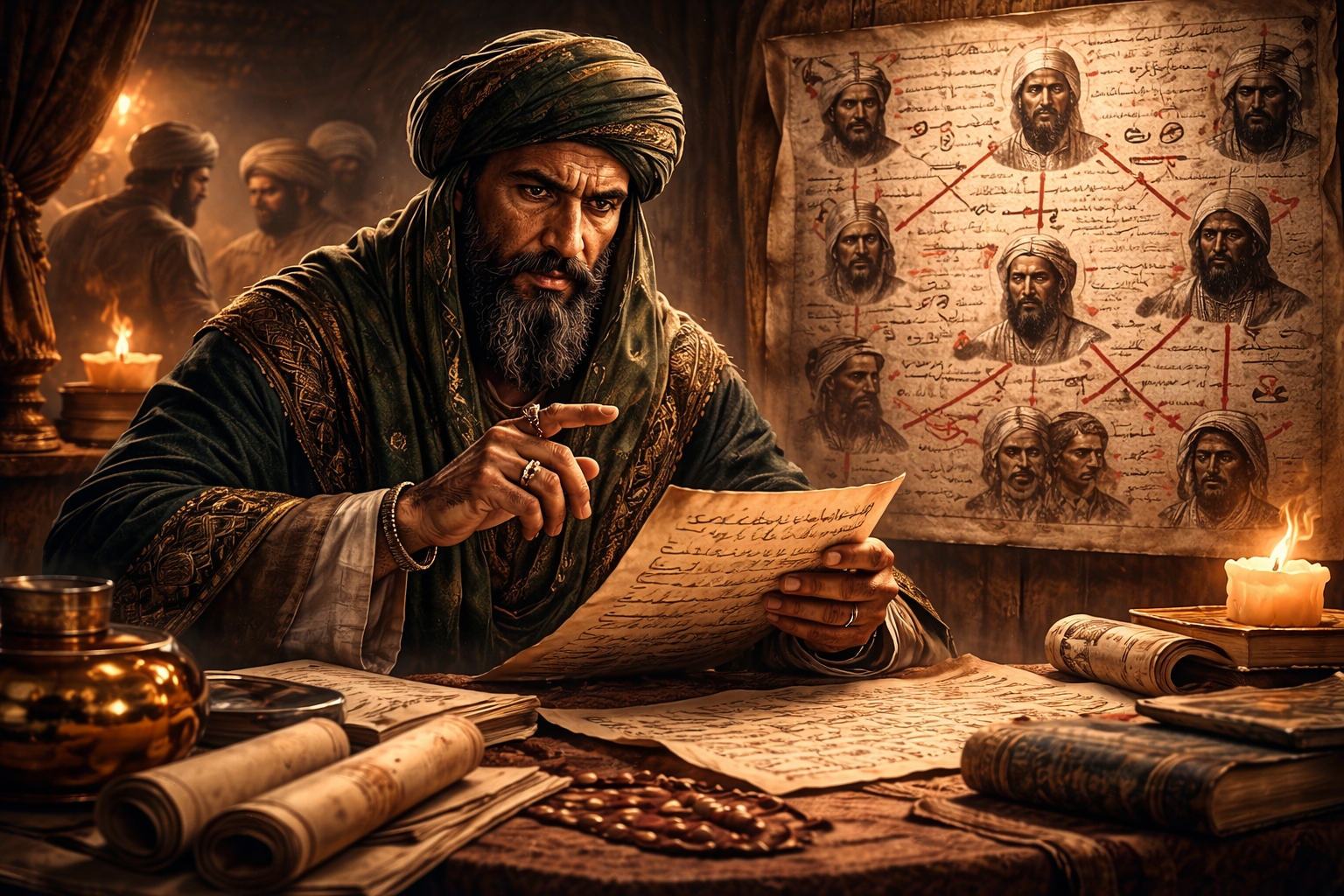
There is another shabby chapter pertaining to the time period ‘Uthman was in office. It has been overworked and overplayed by latter day historians to such an extent that some would say it is central to understanding the dilemma of ‘Uthman and the destabilization of Islamic governance with all the divisiveness and divisions that followed and continue up until this very day.
This chapter has to do with a person named ‘Abdullah ibn Saba’ who is referred to by some as Ibn al-Sawda’ (the black lady’s son). Some chroniclers identify him as a Yahudi hailing from San‘a’, Yemen whose mother was Abyssinian (East African) and became a muslim during ‘Uthman’s time in power.
This person, we are told, began traveling from one region to the other spending most of his time instigating public opinion against ‘Uthman. He spread rumors and propaganda in a way that disturbed and spoiled public opinion in matters pertaining to religious faith, practice, experience and governance.
It is said that he traveled to al-Basrah, and when he arrived there, the governor ‘Abdullah ibn ‘Amir forced him out. Then Ibn Saba’ went to al-Sham (the Levant) where he met Abu Dharr. Ibn Saba’ took issue with Mu‘awiyah about whether public wealth belongs to Allah (swt) or to the muslim population. It is alleged that Ibn Saba’ had an effect on Abu Dharr who also took issue with Mu‘awiyah.
Then Ibn Saba’ met ‘Ubadah ibn al-Samit and approached him with the same rhetoric that he expressed to Abu Dharr. Thus did Mu‘awiyah expel Ibn Saba’ from al-Sham. Then Ibn Saba’ travelled to Egypt where he found a receptive audience for his claims and “conspiracy theory.”
Now let us get a better understanding of the assertions reportedly pedaled by Ibn Saba’. First, he claimed that Prophet Muhammad (ﷺ) is more deserving of a second coming than Prophet ‘Isa ibn Maryam (ﷺ). And to corroborate his assertion he quotes the ayah: Verily, He who has mandated this Qur’an upon you [O Muhammad] will certainly bring you back to where you [rightfully] belong (Makkah, and eventually the hereafter). [al-Qasas, 85]
Ibn Saba’ also asserted that for every Prophet there is a wasiy (administrator, executor, regent), and that the wasiy (substitute/proxy) for Prophet Muhammad (ﷺ) is ‘Ali ibn Abi Talib. ‘Ali is the last wasiy in the same sense that Prophet Muhammad (ﷺ) is the last Prophet.
Some canvassers trace all the dissimilarities and disagreements among the muslims during ‘Uthman’s rule to Ibn Saba’. Some would even go as far as to say that Ibn Saba’ was so conniving and conspiring that he set up “secret societies” that worked together to reach a common objective of undermining Islamic governance. These “secret societies” and conclaves kept on chipping away at the legitimacy of Islamic governance until the day when “all hell broke loose” and ‘Uthman was assassinated.
It appears that there is quite a bit of embellishment in some of our history books about the extent and ability of Ibn Saba’, if ever there was such a person. The first observation is that Ibn Saba’ is not mentioned in the reliable Islamic reference books that focus on the conflicting issues that erupted during the reign of ‘Uthman.
The historian Ibn Sa‘d does not mention Ibn Saba’ when he chronicled the events leading to and surrounding the assassination of ‘Uthman. The historian al-Baladhuri does not mention Ibn Saba’ in his book Ansab al-Ashraf, which is one of the most important if not the most important and detailed historical account of that time period. Ibn Saba’, though, is mentioned in the chronicle of al-Tabari but on the authority of Saif ibn ‘Umar who turns out to be suspicious and dubious.
We can’t say for sure whether an Ibn Saba’ was a threat to ‘Uthman or not; if Ibn Saba’ was a threat it was petty and inconsequential. The early muslim public during the reign of ‘Uthman was not as small-minded and mean-spirited as to fall for the outrageous shenanigans attributed to a recent and inexperienced Yahudi convert to Islam as Ibn Saba’.
Ibn Saba’s record tells us that he began to agitate against the legitimacy of Islamic leadership all over the Islamic domain since the first day he became a muslim! We don’t find in our history books either ‘Abdullah ibn ‘Amir nor Mu‘awiyah communicating with ‘Uthman about what to do with such a “troublemaker” as they did with others.
‘Abdullah ibn Sa‘d ibn Abi Sarh, the governor of Egypt is not documented to have treated or punished Ibn Saba’ the way he treated his two opposition figures Muhammad ibn Abi Hudheifah and Muhammad ibn Abi Bakr knowing that Ibn Saba’ appears to be much more confrontational and offensive against ‘Uthman and the legitimacy of Islamic governance in al-Madinah.
If Ibn Saba’ is the conspiratorial figure that some make him out to be, then why didn’t Ibn Abi Sarh write to ‘Uthman to permit him to “bring down the power of the state” on Ibn Saba’ the way he wrote to ‘Uthman to permit him to “bring down the power of the state” on the two Muhammads and ‘Ammar ibn Yasir? These governors appointed by ‘Uthman were keen on sniffing out any opposition figure but when it comes to Ibn Saba’ they are strikingly absent in doing so!
One of the most eye popping claims in these pages of history about Ibn Saba’ is that he was the one who coached and inculcated into Abu Dharr the belief that wealth belongs to Allah (swt) and not to muslims. Further, that Abu Dharr learned from Ibn Saba’ how to take issue with tyrannical rulers, the superrich… that these types who hoard and monopolize gold and silver will have their foreheads, backs and bodies burned and branded with hot irons.
This stands out to be one of the most outrageous allegations. Abu Dharr who had been a committed Muslim since the early years of the Prophet’s mission in Makkah was in no need of a neophyte ex-Yahudi who had recently become a muslim to teach him about the rights that poor people have over affluent people, and that severe punishment awaits those who control and cartelize wealth rather than spending it for the cause of Allah (swt) and as outlined by Allah (SWT) in His Qur’an.
Abu Dharr was not as ignorant as to have such a person teach him that legitimate war proceeds, the zakat money, the relevant dues and levies paid into the treasury by citizens of the Islamic ummah is money that belongs to and should be circulating among the people and inhabitants of the ummah. These ABCs of Islam were well known to Abu Dharr who needed no tutor like an Ibn Saba’ to give him a grounding in. As a reminder, Abu Dharr preceded all of the Ansar and many of the Muhajirin in becoming a committed muslim.
He was a very close companion of our dear Prophet (ﷺ) for decades before this so called Ibn Saba’ popped up on the pages of some reporters. Abu Dharr had memorized the Qur’an and behaved Qur’anically. He was one of those who recounted and related the statements of the Prophet (ﷺ).
Abu Dharr was a confidant of the Prophet (ﷺ) and the two successors to him (Abu Bakr and ‘Umar) as they managed the Islamic treasury. Abu Dharr was aware and sensitive to what is halal and what is haram; just like his colleagues the companions of the Prophet (ﷺ) were.
Those who claim that Abu Dharr was influenced and guided by an Ibn Saba’ are fooling themselves and degrading Abu Dharr while uplifting and dignifying Ibn Saba’, an ex-Yahudi turned amateur muslim and raising his status incorrectly and erroneously.
The following ayahs were understood and cherished by Abu Dharr for many years before this ostensible Ibn Saba’ showed up:
O you who are firmly committed [to Allah]! Behold, many of the rabbis and reverends do indeed wrongfully devour people’s wealth and [by doing so] divert [others] away from the path leading to Allah. And for those who hoard gold and silver and do not spend them for the sake of Allah give them [ironically] the clear news of grievous suffering [in the life to come]: on the Day when that [hoarded wealth] shall be heated in the fire of Hell and their foreheads and their sides and their backs branded therewith, [those religious sinners shall be told,] “These are the treasures you have amassed for yourselves! Taste, then, [the evil consequences of] your hoarded treasures!” [al-Tawbah, 34-35]


The persons around the Prophet (pbuh) were the founding fathers of Islamic self-determination. While not all of the same ranking, they were ...
When the Prophet (pbuh) left this earthly abode, the vast majority of Muslims were newcomers to Islam, hence not fully immersed in the value...
The third Khalifah, Uthman’s deviation from the policy established by the Prophet and his two successors (Abu Bakr and ‘Umar) by apporti...
If the early Muslims had an opportunity to put in place a proper institutional framework, the tragedy that erupted during Uthman’s khilafa...