 Archives
Multimedia
Donate
About
Sign In
Archives
Multimedia
Donate
About
Sign In



 Abu Dharr


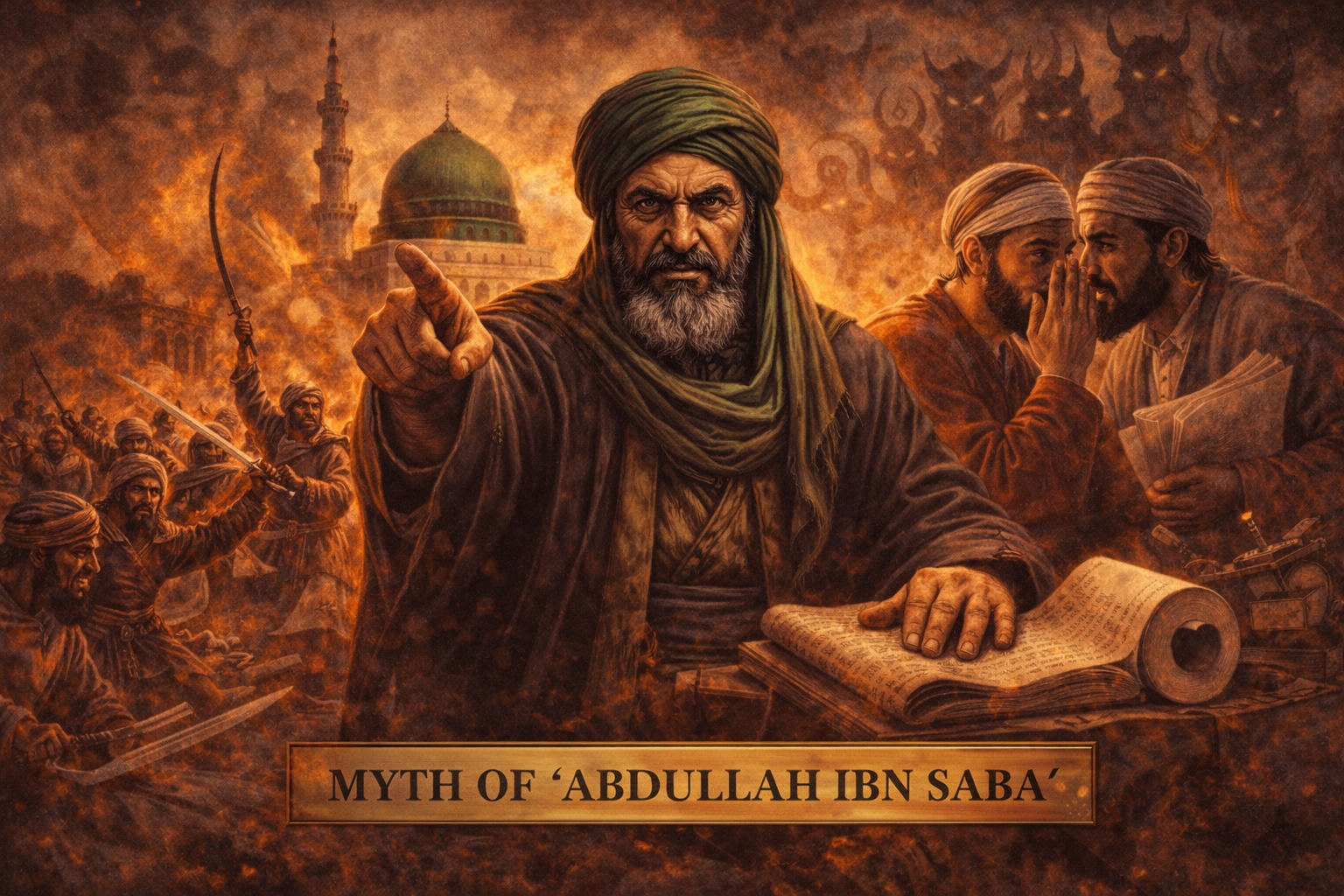
Here is another anecdote that should expose the tall tale about ‘Abdullah ibn Saba’ and what is alleged to be his sway over Abu Dharr.
Chroniclers tell us that one day Abu Dharr after returning from al-Sham to al-Madinah met with ‘Uthman and said to him: It does not befit a person who pays only his zakat to think that he has fulfilled his fiduciary responsibility until he provides to an alms-seeker and feeds the hungry and spends his money for the cause of and on a course to Allah. Ka‘b al-Ahbar happened to be in attendance and he said in response to Abu Dharr: whoever has paid his zakat due has lived up to his fard [mandatory] obligation.
Abu Dharr was infuriated and said to Ka‘b: You son of a Yahudiyah [Jewess]! Who do you think you are? Do you suppose you can teach us our deen? Then Abu Dharr struck him with his crosier (stick).
Here we have Abu Dharr taking issue with Ka‘b al-Ahbar and rebutting his attempt to try to instruct muslims about their deen. Abu Dharr could not tolerate an opinion even from such a Yahudi-turned-muslim person – knowing that Ka‘b al-Ahbar became a muslim much much earlier than Ibn Saba’.
Ka‘b al-Ahbar was a resident of al-Madinah who spent mornings and evenings in the company of the Islamic community of the Muhajireen and Ansar. He was contemporaneous with both ‘Umar and ‘Uthman.
Even though that was the position of Ka‘b al-Ahbar, Abu Dharr had no qualms about “cutting him down to size” when the issue was one of Islamic tenets and Quranic rules. And if this is the case it would be harebrained to say that Abu Dharr was influenced by a neophyte Yahudi Ibn Saba’ when he [Abu Dharr] did not tolerate the chutzpah of an “old hand” Yahudi Ibn Ka‘b.
Even if we were to go along with the hoopla surrounding Ibn Saba’, it would appear that his troublemaking was not the initial provocation that generated the revolt against ‘Uthman. Rather, he exacerbated an opposition that had already taken shape.
It only stands to reason that the enemies of the pro-Imam ‘Ali muslims during the Umayyad and ‘Abbasid rule conflated the Ibn Saba’ storyline to justify their hold on power. They did this to sow seeds of doubt about the validity of criticizing ‘Uthman’s governors or even ‘Uthman himself when he erred, thereby dishonoring Imam ‘Ali and his supporters.
Anyone who buys into this early chapter of official propaganda begins to think that ‘Uthman was countered and then assassinated by “Shi‘is” who can be traced to the Yahudi ‘Abdullah ibn Saba’! Because of the inherited historical sectarian bias there seems to be a very serious difficulty by officials in the highest offices of “Sunni” governments who would ascertain in a rational and balanced way that Imam ‘Ali was right all along; the same way we have today individuals in the highest positions of “Shi‘i seminaries who cannot concede in a rational and balanced way that ‘Uthman made mistakes but was not malicious.
Let’s snap out of this suspicious sectarianism and mature enough to agree that we should not be as naïve as to think that al-Muhajireen and Ansar were “light weights” who could be tricked and trapped by a nobody from San‘a’ whose father was a Yahudi and mother was ‘black’.
This little piece of misinformation in some of our un-scrutinized history books presents a valid question: look around and how often do you see a Yahudi man marrying a black woman with their philosophical racism and genetic bigotry?!
This Ibn Saba’ comes from a Yahudi lineage, who then, we are told, becomes a muslim not because he was fervent in his commitment to Allah and His Prophet but because he had a hidden agenda and thus entered the fray against ‘Uthman. He rabble roused some muslims against the khalifah until they killed him. Before and after that tragic assassination of ‘Uthman this Ibn Saba’ divided the muslims who eventually became the sectarians that they still are today.
This whole line of history does not sit well with our understanding of the Qur’an and the Qur’an’s definition and description of the Muhajireen and Ansar and Aal Muhammad.
Taking a look at the larger picture of the geography, demography and historiography of that generation, we may comfortably say that there is no doubt that the circumstances of Islamic growth and development was accompanied by a variety of opinions, and pileup of sentiments and thus an initiation of different political trends.
There were definitely those who were well grounded in the Qur’anic revelation and the Prophetic education and they had to deal with developing issues. Some of them were exceedingly strict like ‘Umar and while others were excessively lenient like ‘Uthman. The younger Quraishi and non-Quraishi generation was coming of age and they too now had to wake up to a new and unfamiliar world.
Some of them were selfless while others were selfish. In this quick sequence of unfolding events there appeared to be competition for power and wealth. This was enough to become a demarcation line between the self-sacrificing generation of the Prophet (ﷺ) and the self-seeking generation of a recently consolidated Arabia and beyond.
For the first time in history, a spiritual Islam was moving out of Arabia and a materialistic “Islam” was making its way into it with the vigor of life’s early stages: money and fortunes were quickly accumulating in the Islamic treasury.
No wonder that we had appointed governors who succumbed to the flow of finances and the sapping of spirit. Not surprisingly, we had a less than admirable competition among certain rulers in al-Sham, ‘Iraq, and Egypt as previously detailed.
In this fickle flux those who came from Quraish began to accumulate more than others. And those who hailed from the Umayyah clan got the lion’s share of wealth and power during ‘Uthman’s time in office.
The indisputable historical fact is that ‘Uthman sacked Sa‘d ibn Abi Waqqas and appointed al-Walid ibn ‘Uqbah over al-Kufah. ‘Uthman also dismissed Abu Musa al-Ash‘ari and appointed ‘Abdullah ibn ‘Amir as governor of al-Basrah and during ‘Uthman’s reign Mu‘awiyah ibn Abi Sufyan consolidated his grip on all of al-Sham [Greater Syria]. This broader region was previously governed by a number of other non-Quraishi administrators beside Mu‘awiyah.
‘Uthman also assigned ‘Abdulllah ibn Abi Sarh to rule over Egypt after having fired ‘Amr ibn al-‘As. All of these governors/rulers were close relatives of ‘Uthman. One of them was his half-brother by his mother, the other his brother by breast feeding, the other his maternal uncle and others who were from his ancestry bloodline.
All of these are undeniable facts. No one can say that Ibn Saba’ was responsible for these governmental appointments.
Human nature as human nature considers such nepotism-cum-oligarchy-cum-plutocracy to be unacceptable if not offensive. Thus, the muslim citizens of the Islamic state during ‘Uthman’s time are not beyond human nature and thus were averse to what was becoming a “ruling family.”
O Apostle [of Allah]! Be not grieved by those who vie with one another in denying the truth [pertaining to Allah’s worldly authority and earthly power], such as those who say with their mouths, “We commit ourselves [to Allah],” the while their hearts are not committed; and such of the Jewish faith as eagerly listen to any falsehood, [and] eagerly listen to other people without having come to you [for enlightenment]. They distort the meaning of the [revealed] words, taking them out of their context, saying [to themselves], “If such and such [teaching] is vouchsafed unto you, accept it; but if it is not vouchsafed unto you, be on your guard!” [Be not grieved by them] for, if Allah wills anyone to be tempted to evil, you cannot prevail with Allah on his behalf in any way. It is they whose hearts Allah is not willing to cleanse. Theirs shall be infamy in this world, and theirs shall be awesome suffering in the life to come. [al-Ma’idah, 41]


The persons around the Prophet (pbuh) were the founding fathers of Islamic self-determination. While not all of the same ranking, they were ...
When the Prophet (pbuh) left this earthly abode, the vast majority of Muslims were newcomers to Islam, hence not fully immersed in the value...
The third Khalifah, Uthman’s deviation from the policy established by the Prophet and his two successors (Abu Bakr and ‘Umar) by apporti...
If the early Muslims had an opportunity to put in place a proper institutional framework, the tragedy that erupted during Uthman’s khilafa...