 Archives
Multimedia
Donate
About
Sign In
Archives
Multimedia
Donate
About
Sign In



First there was the troika - the president, prime minister and army chief - that ruled Pakistan. Now it is a foursome, with the chief justice elbowing his way in. In a perverse sense, it could be called progress towards democracy by 25 percent.
As Bangladesh aid donors met in Dhaka on November 4, they got a glimpse of the problems confronting the country. The opposition Bangladesh Nationalist Party (BNP) held a noisy rally in the capital condemning the regime’s performance.
The schizophrenic existence of the Pakistani ruling elite was on display during the six-day visit of Queen Elizabeth, the British monarch, to the ‘land of the pure’ from October 6 to 12.
Even the most ardent admirers of Benazir Bhutto do not deny that the former first family plundered the country’s wealth. Their defence of Benazir and her husband, Asif Ali Zardari, an even bigger crook, is that it is nothing uncommon.
Pakistan launched its golden jubilee celebrations by a radio and television address by prime minister Nawaz Sharif at one minute past midnight on August 14. Then there was flag-hoisting ceremony at the parliament building attended by the country’s top brass while the people rejoiced in the streets waving flags and releasing thousands of balloons.
That the drug problem is a global menace is beyond dispute. What is less well known is that there are many big timers in this murky business.
Elaborate plans are underway for golden jubilee celebrations in both Pakistan and India. Pakistan had kicked off its celebrations last March with a summit of the Organisation of Islamic Conference and an impressive military parade on the main thoroughfare in Islamabad.
The Developing Eight (D-8) economic cooperation group got off to a shaky start on June 15 in Istanbul as its most passionate advocate, prime minister Necmettin Erbakan of Turkey struggled with his hawkish generals to hang on to power.
Mir Aimal Khan Kansi is not our favourite terrorist. This scribe and the paper he works for, make no secret of their hatred for these seedy types especially when they are known to have worked for the most despicable agency (CIA) of the most despicable regime (the US) in the world.
General Abdul Rashid Dostum’s tiny kingdom in northern Afghanistan collapsed around him suddenly. A major blow was delivered by generals Abdul Malik and Gul Mohammad, brothers of a slain former chief of staff of Dostum’s militia, Rasul Pahlawan.
Had Benazir Bhutto been the prime minister of Pakistan, she would surely have said, why don’t they eat cakes in response to people rioting in Peshawar for flour. Nawaz Sharif of course is no Marie Antoinette.
February 5 is traditionally observed as Kashmir Day in Pakistan. This year it was no different although it was somewhat overshadowed by the just-concluded elections in Pakistan.
When a former senior bureaucrat in Pakistan was waylaid recently (this being the second time that this misfortune was befalling him and his family) his daughter-in-law who was sitting with him in his BMW asked one of the dacoits who had seized them as to why he had taken to this profession.
Pakistan appears to be repeating its three-year cycle of political instability. On July 21, Karachi, Lahore and a number of other cities were virtually paralyzed over a transport strike organised by the opposition parties protesting against massive taxes imposed in the June 13 budget.
Whatever else one may say about the state of affairs in India, there is one thing for which Indian policy makers deserve credit. No matter who is in power, the policies of State have a consistency about them, unlike in neighbouring Pakistan.
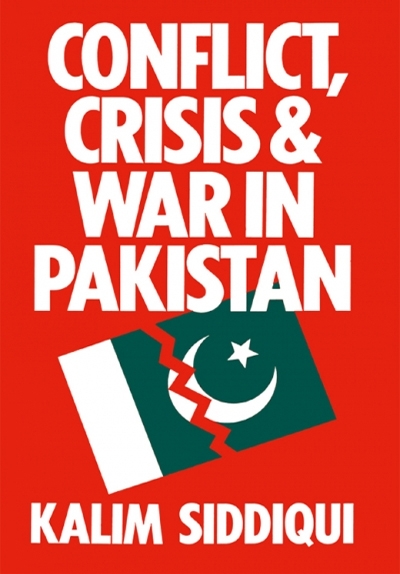
This book can be seen as having a particular significance in Dr Kalim’s intellectual development. It was both the culmination of one phase of his life – with a focus on Pakistan – and the starting point of another, which led to the establishment of the Muslim Institute. Conflict, Crisis and War in Pakistan is a product of this personal experience. It combines the insight of his academic work and the passion of his commitment to Pakistan as a cause and a project, rather than a nation-state. This is well expressed in his preface to the book, included in the section attached below. Also included is the first chapter, on the legacy of the colonial period.
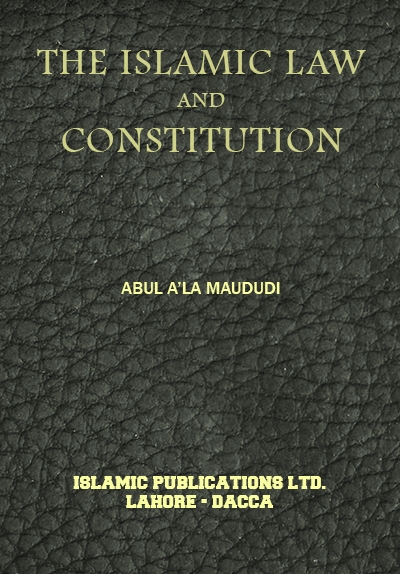
A book like the present one, which has not been written in the common textbook style, may not cater to all the academic needs of a student or Islamic Law and Constitution, who wants to study the subject in all its multifarious details, but I do hope, it will prove of immense help to all those persons who want to study the nature of the Islamic State, its theory, form and underlying principles, and who wish to understand how the Islamic Law can be implemented in a modern state. Today there are many countries whose Muslim population is, after attaining independence, naturally eager to base its polity on those principles and traditions of Islam which are a demand of its faith and conscience.The people want that the Islamic Law should be introduced in their respective countries so that they may follow a law which they owe their honest and sincere allegiance.
1