 Archives
Multimedia
Donate
About
Sign In
Archives
Multimedia
Donate
About
Sign In



 Yusuf Dhia-Allah


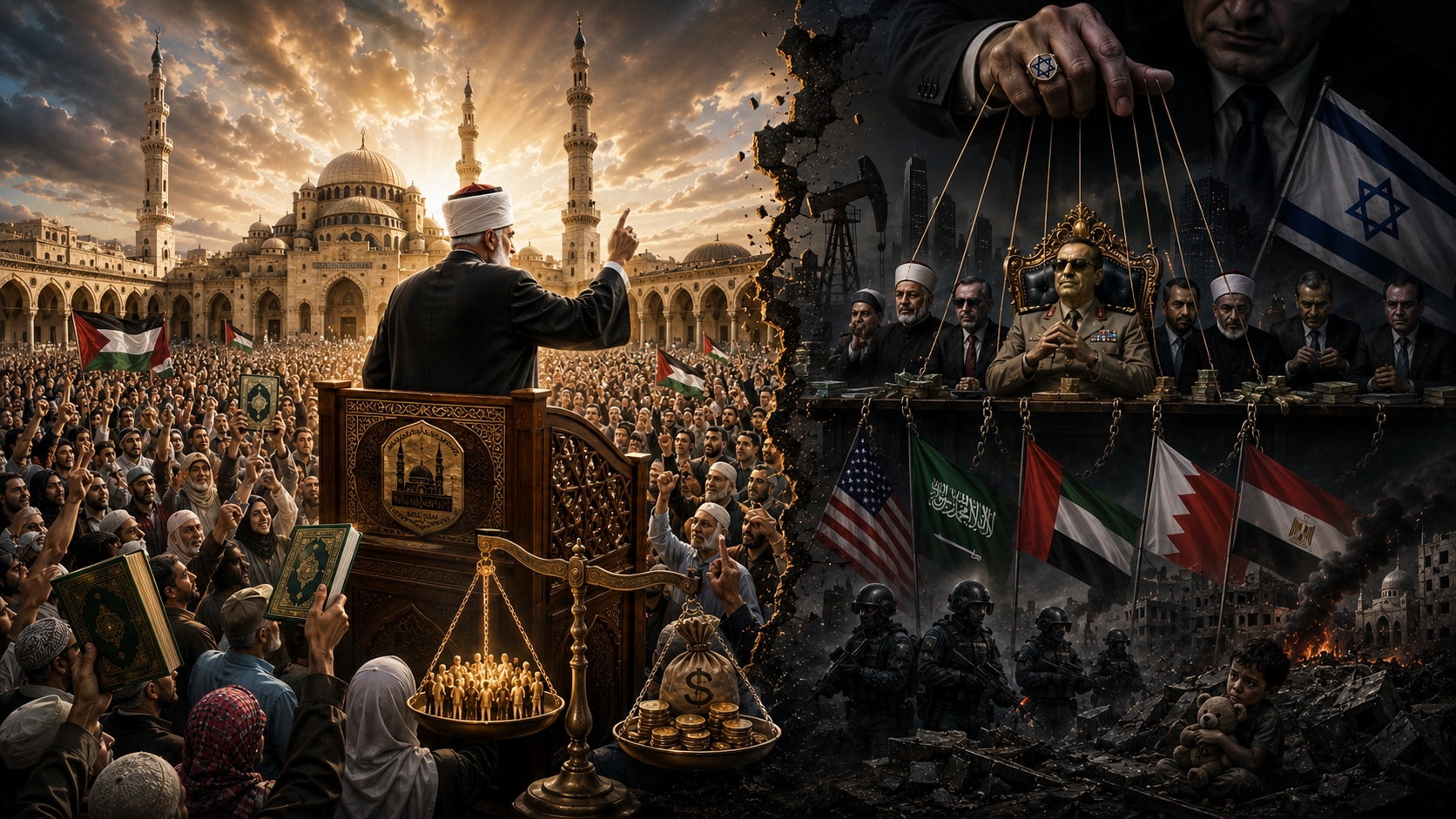
For much of Islamic history, the Muslim world produced its greatest intellectual, political, and civilizational achievements when Islamic scholarship maintained a significant degree of independence from state authority.
The scholars’ authority was not rooted in coercive power, military institutions, or ruling dynasties, but in moral credibility among the people. From the great jurists of Baghdad and Damascus to the scholarly networks of Cairo, Fez and Delhi, Islamic institutions historically exercised influence precisely because they often stood apart from rulers rather than function merely as extensions of the state.
Conversely, those scholars who acted as legitimizing agents of the ruling elites’ policies lost respect among the masses. In Muslim societies, such figures often came to be viewed as “palace scholars”—religious authorities whose role was not to guide and organize society according to Islamic principles, but to provide theological cover for corrupt and despotic rulers.
Throughout Islamic history, the distinction between independent scholars and palace scholars carried enormous significance because Muslim societies instinctively understood that once scholarship was subordinated to the whims of rulers, its moral authority began to erode.
Today, Al-Azhar stands at a historic crossroads where it can potentially reclaim part of that legacy. The political and emotional earthquake unleashed across West Asia by Israel’s genocide in Palestine has transformed the regional landscape in ways that may give Al-Azhar unprecedented leverage against both domestic state pressure and the wider western imposed regional order.
According to a recent report by Middle East Eye (MEE) western-backed Egyptian dictatorship is pressuring Al-Azhar to publicly align with the Arabian regimes on the western shore of the Persian Gulf against Islamic Iran.
According to MEE, the Sisi regime pressed Al-Azhar to avoid condemning American and Israeli strikes on Iran while issuing statements condemning Iranian retaliations against the GCC regimes, especially the UAE.
MEE reported that the warning issued to Al-Azhar was framed around the claim that Egypt’s strategic economic relations with Gulf regimes and the US could not be jeopardized under the current economic conditions.
These revelations expose more than a political disagreement. It reveals the widening gap between the sentiments of Muslim societies and the priorities of western-backed regimes.
This pressure reveals the extent to which western-backed regimes increasingly view Islamic institutions as instruments of geopolitical management rather than independent authorities. Yet it also reveals something more: the regimes themselves understand the enormous influence Al-Azhar still possesses among the Muslim masses.
That influence becomes particularly significant during moments of historic public anger and the current regional atmosphere.
Across West Asia, millions have watched Israel commit genocide while western regimes continued supplying diplomatic, military, and political backing. At the same time, many Arabian regimes limited themselves to carefully calibrated statements and symbolic gestures while avoiding meaningful confrontation with either Israel or Washington. This has produced a profound legitimacy crisis across the region.
The issue is no longer simply Palestine. Gaza has become the lens through which populations are reassessing the entire regional order. Large segments of the Muslim public increasingly perceive western-backed regimes as completely detached from the realities, emotions, and aspirations of their own societies.
This disconnect creates an opening that institutions like Al-Azhar have not possessed in generations.
Unlike governments whose authority rests on military power, intelligence services, and foreign patronage, Al-Azhar’s legitimacy derives from history, scholarship, and religious credibility. For over a thousand years, Al-Azhar has symbolized continuity within Sunni Islam. Even after decades of state influence and bureaucratic control, its voice still carries immense symbolic weight throughout the Muslim world.
The Sisi regime’s apparent anxiety over Al-Azhar’s statements demonstrates this reality.
Cairo understands that in the current climate, even a cautious statement from Al-Azhar criticizing Israel, condemning western support for Israeli crimes, or refusing to adopt Gulf’s geopolitical narratives could resonate powerfully across the region. Such statements would not merely reflect public sentiment; they could legitimize and mobilize the Muslims Ummah.
This is what makes the present moment historically unique.
For years, western powers and their regional puppets attempted to reshape West Asian politics around sectarian polarization and normalization with Israel. Iran was framed as the overriding regional threat while Palestine was steadily pushed to the margins. The Abraham Accords represented the clearest expression of this strategy.
But Gaza shattered much of that framework.
Regardless of their views of Iran or regional rivalries, millions across the Muslim world watched Palestinian civilians endure bombardment, starvation, displacement, and destruction with direct western backing.
The result has been a massive political and psychological shift. Palestine has returned to the center of Muslim political consciousness, and with it has come renewed anger toward regimes perceived as passive or complicit.
The Muslim street in West Asia is no longer politically dormant. It is emotionally galvanized and increasingly radicalized by the events in Palestine. This radicalization should not be understood narrowly through the prism of militancy alone, but rather as a broader rejection of the legitimacy of the current regional order.
This creates conditions in which moral authority can become more politically potent than formal state power.
Historically, Islamic scholarship exercised its greatest influence precisely during periods when scholars maintained independence or semi-independence from rulers. The classical Islamic world thrived intellectually because scholars were often financed through independent endowments, merchant networks, and public support rather than direct state patronage.
Institutions of waqf allowed scholars, jurists, and educational centers to preserve autonomy from political authority.
That independence enabled scholars to critique rulers, mediate social tensions, and maintain credibility among the population. Once religious institutions became fully absorbed into state bureaucracies in many parts of the Muslim world, much of that credibility eroded.
Today, Al-Azhar has an opportunity to partially reverse that trajectory.
The institution does not need to openly revolt against the Egyptian state to fundamentally alter regional dynamics. Even measured assertions of independence could have enormous impact under current conditions.
If Al-Azhar positions itself as a principled moral authority aligned with the sentiments of ordinary Muslims rather than the geopolitical calculations of regimes, it could re-emerge as a genuine vanguard of the people.
This possibility explains why governments remain so sensitive to its positioning.
Under current regional conditions, that influence could become even more significant. Public trust in official narratives has deteriorated sharply.
Governments increasingly appear dependent on external powers and detached from popular sentiment. In contrast, institutions perceived as maintaining even partial independence can rapidly accumulate political and moral authority.
This is the reality confronting many western-backed regimes today. They possess overwhelming military power, vast financial resources, and sophisticated security apparatuses, yet they increasingly lack emotional and Islamic legitimacy among their own populations.
Al-Azhar, by contrast, has no army or wealth, but it retains something the regimes are steadily losing among the masses: credibility.
If Al-Azhar chooses to assert that credibility more openly, it could reshape the balance between religious authority and state power throughout the Muslim world.
The current regional atmosphere strongly favors such a transformation. Societies across West Asia are angry, politically awakened, and deeply disillusioned with western-imposed regimes whom they view as ineffective or subordinate to foreign interests. The more regimes attempt to suppress or manage this sentiment, the more they expose their own insecurity.
Al-Azhar, therefore, stands before a rare historical opportunity. It can either remain constrained within the calculations of state diplomacy and the Arabian potentates’ sensitivities, or it can cautiously reclaim its historical role as an independent moral center capable of articulating the aspirations and frustrations of the Muslim masses.
If it chooses the latter path, it may not merely influence regional politics. It may help fundamentally re-chart the political and intellectual dynamics of the modern Muslim world.


The military-installed regime in Egypt is determined to crush all forms of dissent. Its recent victims are students, even those at Al-Azhar ...
Shaykh el-Qaradawi continues to grab headlines. His latest announcement about resigning from the advisory Committee of Ulama at Al-Azhar has...
The world’s probably most obsequious elite is still celebrating the Egyptian parliament’s nomination of president Husni Mubarak for a fo...
This once venerable institution has been reduced to a shell and its head doing the bidding of the corrupt rulers. It is a sad reflection to ...