 Archives
Multimedia
Donate
About
Sign In
Archives
Multimedia
Donate
About
Sign In



 Waseem Shehzad


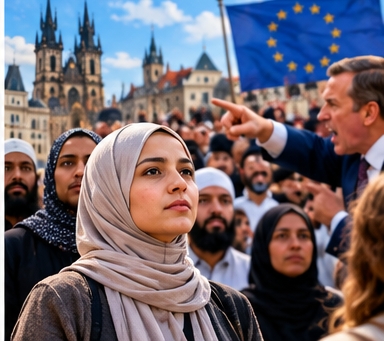
Italian Prime Minister Giorgia Meloni has apparently discovered another grave threat confronting one of Europe’s largest economies: the burqa.
Speaking at a Brothers of Italy youth gathering on September 20, Meloni announced plans to ban burqas and niqabs in schools, limit the number of foreign students in classrooms and require some foreign parents to learn Italian.
There are legitimate debates about integration and language in public institutions. But the political significance of Meloni’s announcement lies elsewhere. It illustrates Europe’s accelerating retreat from serious socioeconomic politics toward the politics of fear and convenient scapegoating.
Italy has problems considerably larger than the number of Muslim girls wearing niqab.
Some 5.7 million Italians were living in absolute poverty in 2024. Italy simultaneously faces weak productivity, depressed real wages, enormous public debt, aging population and a collapsing fertility rate. Its healthcare system faces serious staffing and funding pressures, while younger Italians struggle with insecure employment and housing costs.
None of these problems will be solved by removing the niqab from classrooms. That is precisely why the niqab is politically so useful.
The politics of a convenient enemy
Across Europe, ruling establishments face structural problems requiring politically difficult solutions.
Affordable housing requires construction and public investment. Healthcare requires doctors, nurses and sustained funding.
Industrial competitiveness requires infrastructure, affordable energy and long-term planning. Poverty requires productive employment and redistribution.
None provides an instant political spectacle.
A Muslim woman wearing distinctive clothing does.
France faces weak growth, enormous public debt, pressure on purchasing power and chronic fiscal difficulties. Germany’s once-vaunted industrial model struggles with high energy costs, demographic pressures, deteriorating infrastructure and years of inadequate investment.
Berlin elections illustrated the contradiction perfectly. Rents have soared while the city estimates that another 211,000 houses will be required by 2040.
That is not a hijab problem. It is not a mosque problem. It is a housing-policy problem.
But constructing hundreds of thousands of houses is difficult. Blaming immigrants for their absence is easy.
Berlin is a signal
That is why Berlin’s September 20 election deserves attention beyond Germany.
Approximately 1.85 million Berliners participated. Die Linke received about 468,000 second votes, or 25.7%, while the Alternative für Deutschland (AfD) received approximately 296,000, or 16.3%.
The simultaneous advance of forces conventionally described as the far left and far right is more significant than the labels themselves.
Results in Berlin should be understood as a signal that the European political elites are detached from their societies.
In a situation where declining public services, housing shortages, economic insecurity and stagnation persist, while the ruling regimes deflect by popularizing cultural battles for socioeconomic solutions, political and social crisis are inevitable.
How “far” is Europe’s far right?
There is also something increasingly artificial about Europe’s distinction between a supposedly respectable political mainstream and the “far right.”
On Muslims, immigration, asylum and national identity, the more revealing question is increasingly not whether European politics has moved rightward, but how far rightward different political actors are or are prepared to travel.
Positions once confined to the margins have steadily migrated into establishment discourse.
Mass deportations, restrictions on Islamic clothing, mosque financing, “political Islam,” border closures and endless debate about whether Muslims are culturally compatible with Europe were and are a routine feature of mainstream politics.
The supposedly impermeable wall separating respectable conservatism from the radical right increasingly resembles a revolving door.
The road to 2026 began in 2001
None of this emerged with the rise of Meloni, Marine Le Pen or the AfD. The ideological infrastructure was constructed over decades.
September 11, 2001, was a decisive turning point. The US-led war of terror transformed the vocabulary through which Muslims were discussed by western regimes.
Muslims increasingly became objects of security policy. Mosques became objects of surveillance. Muslim organizations were discussed through the language of radicalization. Islamic clothing became a political issue. Immigration, terrorism, Islam and demographic anxiety were gradually fused into the same political conversation.
The far right, therefore, did not have to invent an entirely new discourse. It inherited one from the so-called mainstream.
For a quarter-century, western political and media establishments helped normalize the treatment of Muslims as an exceptional category requiring surveillance, integration tests and perpetual demonstrations of loyalty.
What today’s right-wing parties did was remove many of the qualifications.
Ideas initially presented through the sanitized language of counter-terrorism, security and integration could eventually be articulated openly as hostility toward Islam, immigration and multiculturalism.
The political fringe learned to speak a language the establishment had spent two decades teaching Europeans to understand.
Fear has a political economy
There is another dimension that should not be overlooked. Europe’s increasingly militarized political atmosphere also produces economic winners.
A BBC report subtly popularized the concept of how Europe’s struggling automobile industry might find salvation through rearmament. European manufacturers confronting weak demand, industrial overcapacity and intense international competition are examining military production as another source of business.
BBC’s headline captured the emerging logic perfectly: “Europe’s car makers are in crisis. Will the threat of war rescue them?”
Once hundreds of billions of euros begin flowing toward weapons, military vehicles and defence industries, militarization ceases to be merely a foreign-policy question.
Corporations, investors, contractors and industrial regions develop a material interest in maintaining military expenditure.
For sections of Europe’s business elites, therefore, crisis is not necessarily bad for business.
Crisis is often the business model.
This does not require imagining a conspiracy in which European industrialists manufacture Islamophobia simply to sell weapons. The relationship is more structural.
A society saturated with fear is easier to militarize. And militarization has beneficiaries.
Here the post-9/11 construction of Muslims as a permanent security problem becomes particularly significant.
After 25 years during which Muslims have repeatedly been associated with terrorism, radicalization, extremism and security threats, they constitute an unusually convenient population around which politics of insecurity can be constructed.
The Muslim immigrant becomes a cultural threat at home. The mosque becomes a security concern. Migration becomes an invasion metaphor. Muslim-majority regions become theatres of permanent instability requiring western military intervention.
Fear generates political capital. Militarization generates economic capital. The two increasingly reinforce each other.
When the establishment runs out of answers
This helps explain why establishment parties increasingly borrow rhetoric from parties they publicly condemn.
A regime unable to provide affordable housing can promise tougher borders.
A political establishment unable to restore purchasing power can regulate Muslim clothing.
Parties incapable of explaining why younger generations face increasingly insecure economic futures can provide them with a visible cultural antagonist.
The immigrant becomes the explanation. Muslim becomes the symbol. Hijab becomes the battlefield.
While Europe faces genuine issues concerning immigration, asylum and integration, serious societies should discuss them seriously. Immigration cannot become the universal explanation for structural failure.
Italy’s poverty will not disappear if Meloni removes niqabs from schools. Berlin’s housing shortage will not be rectified because Germany deports more refugees.
France’s public debt will not shrink because another restriction is imposed on Islamic clothing.
Germany’s trains will not suddenly arrive on time because politicians deliver another speech about “integration.”
These problems require investment, industrial strategy, redistribution and competent governance.
Identity politics offers something considerably cheaper: an enemy.
This is why Europe’s political landscape is not simply shifting rightward. It is undergoing a deeper political regression in which increasingly crude identity politics substitutes for serious socioeconomic policy while the material conditions generating public anger remain unresolved.
The burqa is politically useful precisely because it cannot answer for Europe’s poverty, stagnant productivity, housing shortages, deteriorating infrastructure or public debt.
And when ruling establishments repeatedly substitute convenient enemies for difficult solutions, the underlying anger does not disappear. It accumulates.
Combine all of the above with the fact that zionist Israel is openly advocating for meddling in European socio-political processes to undermine Muslims, the future is not difficult to predict, a Europe heading for severe internal destabilization.