 Archives
Multimedia
Donate
About
Sign In
Archives
Multimedia
Donate
About
Sign In



 Javed Akbar


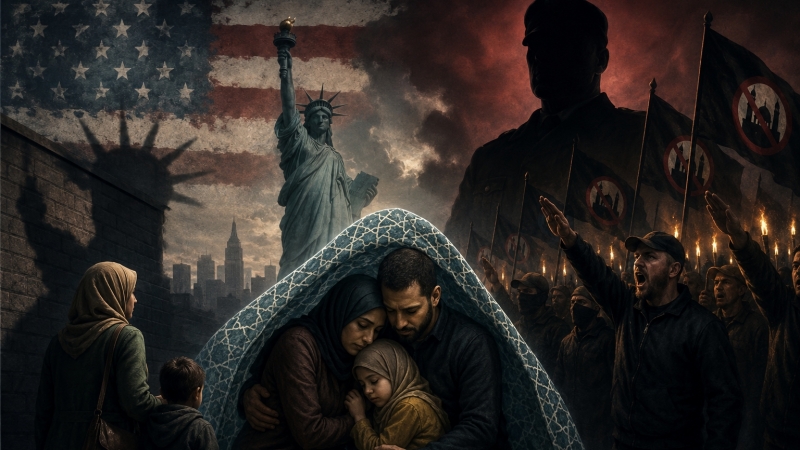
The attack on the Islamic Center of San Diego is not merely another entry in America’s grim ledger of mass shootings.
They managed to kill three Muslims—security guard Amin Abdullah, Mansour Kaziha, and Nader Awad—before the terrorists apparently shot themselves.
Yet for the Muslim families who gathered there — and for the children attending the Islamic day school on the premises—such technical distinctions offer no refuge.
Fear does not negotiate in geography.
It settles in the body, in memory, in the silence before stepping out the door.
To treat this as an isolated burst of violence is to misunderstand the pattern.
The United States has grown disturbingly accustomed to mass shootings in schools, churches, synagogues, concerts, and shopping malls.
But when the target is a mosque, the act does not emerge from a vacuum of randomness alone.
It is incubated in a cultural atmosphere where anti-Muslim suspicion has been steadily normalized, repackaged as politics, and laundered through the language of security, patriotism, and “civilization.”
The May 18 attack on the Islamic Center of San Diego is now being investigated as a possible hate crime.
Early reports suggest the assailants were teenagers influenced by anti-Muslim rhetoric and generalized hate ideology.
A security guard who attempted to intervene was killed.
Children were evacuated in panic.
These are not just statistics; they are fragments of a society’s moral failure.
This failure is not new
In Canada, the memory of the January 2017 Quebec City mosque shooting still lingers as a national wound.
Six worshippers were murdered during evening prayers—men who had come seeking nothing more radical than peace and community.
Then came the June 2021 attack in London, Ontario, where four members of a Muslim family were deliberately run over by a pick up truck in an act of targeted violence that orphaned a child and shocked a country that often prides itself on tolerance.
These are not disconnected tragedies; They form a continuum
Mosques across North America have endured bomb threats, vandalism, harassment, and armed intimidation.
Muslim women wearing hijab describe navigating public spaces with a constant awareness of vulnerability.
Parents quietly calculate risk before sending children to religious classes.
A sanctuary, by definition, should not require security assessments.
The deeper danger lies in how such hostility becomes thinkable.
Hate does not begin with violence; it begins with permission.
And permission is often granted not by fringe actors alone, but by the steady drip of political and media rhetoric that reduces an entire faith to a problem to be managed.
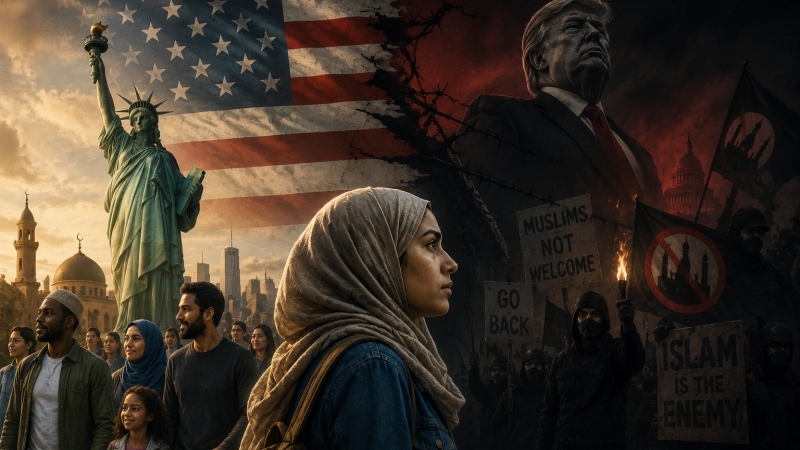
The normalization of anti-Muslim narrative accelerated dramatically after Donald Trump entered the political stage in 2015, transforming suspicion of Muslims from fringe discourse into mainstream political currency.
Demonization of Muslims reached a peak when calls for banning Muslims from entering the country entered mainstream political discourse.
Even when softened later, the underlying message lingered: suspicion is acceptable, exclusion is defensible, fear is rational.
Words matter more than their speakers often admit
No serious argument suggests that political rhetoric directly loads a gun.
But it is intellectually dishonest to deny that sustained demonization alters the moral weather.
It lowers the threshold of empathy.
It tells the unstable that their fears are shared, their anger justified, and their fantasies of “defense” socially intelligible.
There is also a troubling asymmetry in public response.
When perpetrators are Muslim, entire communities are subjected to interrogation, as though collective guilt were self-evident.
When Muslims are victims, the language shifts: “isolated incident,” “mental health crisis,” “tragedy without context.”
The imbalance is not merely semantic.
It shapes whose suffering is politicized and whose is quietly absorbed.
This is not only a Muslim concern; it is a societal problem.
In a society where people fear their places of worship, civic trust is already eroding.
Democracy does not collapse only through coups or constitutional crises; it erodes when fear becomes routine and belonging becomes conditional.
Canada and the US now face a clear test.
They can either confront anti-Muslim hatred with the same moral urgency applied to other forms of extremism, or continue treating it as ambient background noise—regrettable, periodic, but ultimately tolerable.
Condemnation after each tragedy is no longer sufficient.
What is required is political discipline: a refusal to weaponize identity for electoral gain; a media culture that resists outrage as spectacle; and digital platforms that acknowledge their role in accelerating ideological radicalization.
Above all, there must be a cultural insistence on one principle: no group should be rendered suspect by default.
Because history is unambiguous on one point.
When people are repeatedly described as alien, dangerous, or incompatible, it is only a matter of time before someone decides that elimination is a form of clarity.
The families affected in San Diego deserve more than condolences.
They deserve an honest reckoning with the climate that made their fear predictable.
And Muslim communities across North America deserve something that should never have been in question: the simple, fundamental right to gather, to pray, and to live without looking over their shoulder.
Javed Akbar is a freelance writer whose opinion columns have appeared in the Toronto Star and numerous digital platforms. He can be reached at: mjavedakbar@gmail.com