
 Archives
Multimedia
Donate
About
Sign In
Archives
Multimedia
Donate
About
Sign In



 Crescent International


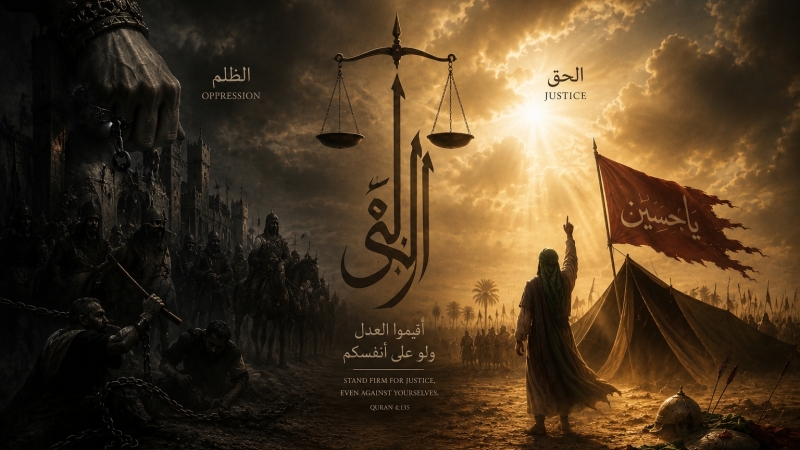
Why Yaum al-Ashura (the Day of Ashura) matters?
On this day—coinciding with the 10th of Muharram—Imam Hussain (ﷺ) and 71 members of his family and supporters were martyred on the scorched plains of Karbala in southern Iraq.
Among those murdered in cold blood were also infants.
The perpetrators, all claiming to be ‘Muslim’, belonged to the army of Yazid, a tyrant and usurper.
He demanded allegiance upon pain of death.
Barring a few exceptions, most people succumbed to Yazid’s threats except Imam Hussain.
Not wishing for physical confrontation, Imam Hussain, accompanied by family members including women and children, set out to Makkah to perform Hajj.
He felt that since fighting and killing are forbidden in Makkah, especially at the time of Hajj as commanded in the noble Qur’an (2:197), there would be peace.
Unfortunately, Yazid and his army of murderers were not constrained by Qur’anic commands.
They pursued Imam Hussain and his family even in Makkah.
To avoid bloodshed in Makkah, he left without performing Hjj and set out for Kufa where the people had promised him allegiance and help.
The Hussaini caravan was intercepted by Yazid’s army and trapped in Karbala.
It is a harsh inhopitable desert on the banks of the Euphrates River.
The tyrant’s soldiers demanded allegiance from Imam Hussain (ﷺ).
He refused, stating categorically that a man like him could not give allegiance to a man like Yazid.
It is crucial to understand the reason behind Imam Hussain’s refusal.
It was not because he wanted power.
The real reason was Yazid’s illegal usurpation of power.
Yazid’s father Mu‘awiyya, another usurper, used threats and coercion to appoint his son.
Muslims did not give their consent.
Regrettably, barring a few exceptions—Abdullah ibn Zubayr, for instance—the vast majority of Muslims remained silent.
Yazid’s immoral conduct—he was a womaniser, consumed alcohol and played musical instruments—disqualified him to be the leader of Muslims.
Further, his imposition as ruler broke the process of bay‘ah (allegiance through the willing consent of the people), established by the Prophet’s successors to become ruler.
The father-son combine—Mu‘awiyya and Yazid—violated this process and reimposed the jahili tradition banished by Islam’s system of fairness and justice.
Had this imposition gone unchallenged, Islam would have been dealt a mortal blow and perhaps proved fatal to its survival.
By challenging the usurpation of power and sacrificing his life and that of his family and close companions, Imam Hussain shut the door on all future tyrants to usurp power through illegal means.
Imam Hussain’s principled position and sacrifice offer important lessons for all Muslims.
First and foremost is the principle of legitimacy.
A person can only assume power through legitimate means.
To qualify, he must be knowledgeable about Islam and follow its teachings.
Second, he can only assume power by the willing consent of the people.
The lessons of Imam Hussain’s struggle and sacrifice must also be applied today.
Muslims cannot indulge in passion play and ignore the great sacrifice by smothering it with details of the examples of earlier Prophets.
They are important but they must not lead to overlooking the lessons of Karbala.
Imam Hussain showed immense courage in standing up to the tyrant Yazid.
He sacrificed his own life and that of his family to uphold Islamic principles.
Who are the present-day Hussains and Yazids?
The people of Palestine, especially Gaza, Lebanon, Iran and Yemen are all today’s Hussains.
In all these places, their leaders sacrificed their lives, like Imam Hussain, for the sake of truth, justice and dignity.
In the rest of the Muslim world, the rulers are camp followers of Yazid.
Like the tyrant of old, many of these rulers have also assumed titles of kings, amirs and so on.
Further, they have aligned themselves with the forces of kufr, shirk and dhulm.
These rulers claim to be Muslim but they fall under the category of munafiqs.
If we consider ourselves among the followers of Imam Hussain, then we must take a clear, unambiguous stand against these tyrants.
Millions of non-Muslims have also imbibed this lesson.
We cannot cry for Imam Hussain yet stand as supplicants in the court of Yazid.