 Archives
Multimedia
Donate
About
Sign In
Archives
Multimedia
Donate
About
Sign In



 Waseem Shehzad


If attendance at mosques for prayers were a measure of a society’s commitment to Islam, Pakistan would be the most Islamic country in the world. The reality, however, is very different.
People going to mosques to pray has become a habit. True, it is a good habit but devoid of sincerity, it becomes a mere show. The Qur’an states: “Announce what has been revealed to you [O Prophet] of the scripture in an organized manner and institutionalize [and systematize] the salah: for indeed, salah curtails moral perversion and social vice” (Surat al-Ankabut, verse 45).
The Qur’anic command is clear; the problem lies in people’s habits. Hypocrisy has become ingrained in their DNA. They see no contradiction between their participating in prayers and indulging in corruption and other vices. Adulteration in food and medicines is widespread.
Gouging people is common. This is best depicted by what happens during Ramadan. Prices of items of every day necessity shoot up astronomically. When asked about such increases, the standard response is that these items have become scarce. Why does this happen every Ramadan?
Such unjust practices are not confined to retail stores. In offices an even greater degree of dishonesty prevails. In government offices—and that constitutes a majority of the country’s work force—people come to work late because, well, it is Ramadan. Even when they do show up, they do not work properly because they say they are fasting!
Does fasting excuse a person from work? Muslims engaged in the battle of Badr (2 AH) in the first year when fasting was ordained for them. They did not offer the excuse that they cannot fight because they are fasting. A similar spirit of self-sacrifice was evident before the battle of Ahzab (5 AH) when Muslims were digging the trench as a defence mechanism. The march to liberate Makkah in Ramadan of 8 AH also displayed the same spirit.
Equally important is the fact that many facilities available today—cars for transport, heating and airconditioning at homes and offices etc—were not available during the time of the Prophet (ﷺ). People walked on foot or at best rode a camel, if they owned one. There was scarcity of food and water. Yet never did they complain that life was tough and made more difficult because they were fasting.
The only people who complained were the munafiqs that the Qur’an has condemned in strikingly harsh terms. There were no munafiqs in the battle of Badr. The following year, for the battle of Uhud, 300 munafiqs broke away from the ranks of Muslims and in the battle of Ahzab, they constantly tried to undermine the morale of the committed Muslims.
We need to understand who the munafiqs are. Outwardly, they pretend to be Muslim but in reality they are only concerned about their own selfish interests. This is what manifests itself in Pakistan among people at every level.
We need not detain ourselves with the anti-social attitude of people only during Ramadan. It has become the norm and it begins at the top.
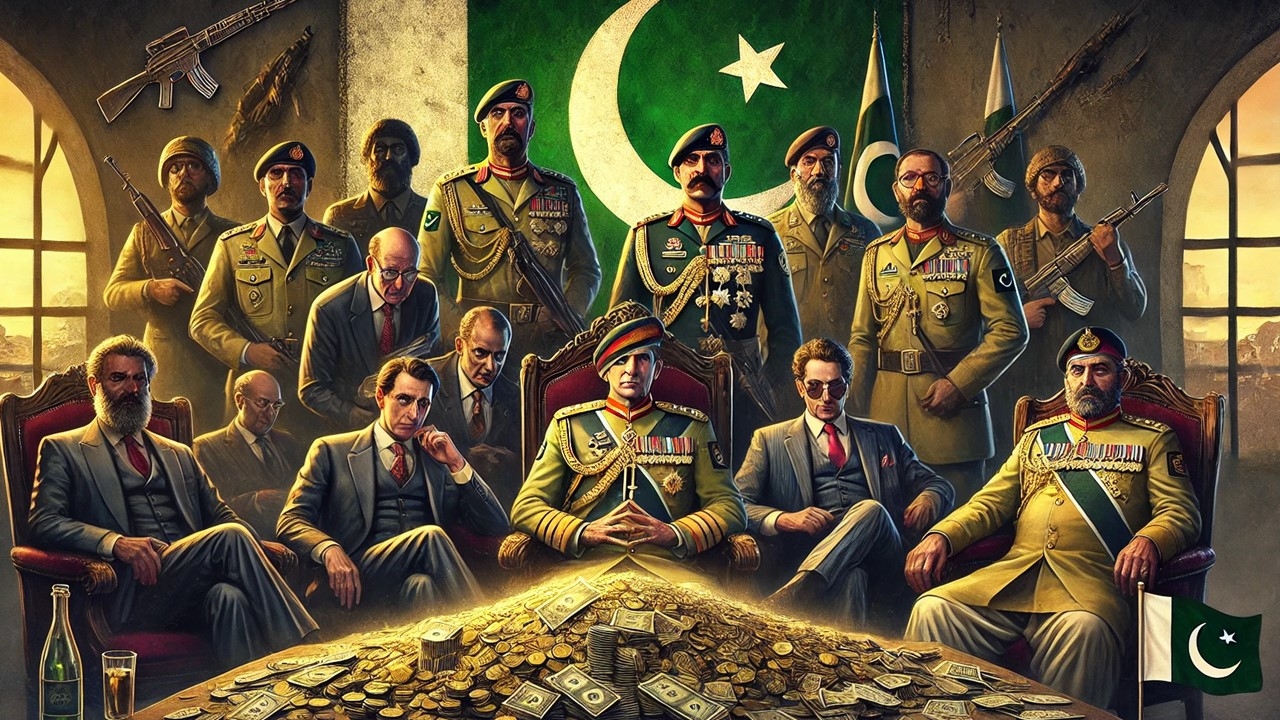
Since there is no rule of law, power flows from the barrel of the gun, as the Chinese leader Mao Zedong famously said. The army dictates what passes for acceptable behaviour in Pakistan because it has the weapons and a force of 700,000.
These parasites consume the bulk of the country’s budget and resources. They proclaim adherence to Islam but violate every tenet of it religiously.
Pakistan is one of the most militarized states in the world. This is on full display on such occasions as Pakistan Day (March 23) and Independence Day (August 14). Last month’s Independence Day celebrations reflected this.
Colourful parades were held in Islamabad to martial music. The smartly dressed personnel of the armed forces of all branches were supposed to impress the hapless people and supposedly terrorize the enemy (India and Afghanistan, currently). The military’s performance in numerous wars has been dismal.
Such parades, however, cannot conceal a more fundamental dilemma: Pakistan is not an independent entity. Not only politically but even economically it is dependent on outside help. It must always seek Washington’s permission to adopt any policy. This is a constant in Pakistan’s policy. Displeasing Uncle Sam is considered a greater sin than violating Allah’s commands (nastaghfirullah).
Senior appointments are made with a view to not offending the Washington warlords. Leaders are overthrown—by the army, of course—when the US demands. Imran Khan is a prime example.
He has languished in prison for more than three years because he wanted to make Pakistan truly independent. For the men in khaki, such thoughts are heresy. Whither Pakistan’s independence?
Unable to confront arch-enemy India or liberate Kashmir from its clutches, the thugs in uniform conquer their own hapless people every few years. This has now been entrenched under what is euphemistically called the “hybrid system”. Theoretically, it means combined civilian-military rule but in reality it is the army that dictates policy. Civilians serve at its pleasure.
At the passing out parade at the Pakistan Military Academy (PMA), smartly dressed cadets march in formation to the martial beat of Allahu Akbar. It is an impressive display and would warm the heart of any Pakistani making their adreneline run faster.
They take an oath that they will abide by the constitution and never indulge in politics, making Allah as their witness. Despite this solemn pledge, the moment they step outside the academy, their itch to interfere in politics comes alive. True, these young officers do not make such decisions but they obey every illegal order from their superiors including shooting at and killing their own people.
Such hypocrisy has become part of the army DNA that has led to successive bouts of martial law being imposed on the country. People’s opinion be damned; the generals know best.
But they don’t. They have made a mess of everything. The only thing they have finessed is grabbing prime land in major cities that they turn into defence housing colonies. These gated communities have mushroomed across the country. What have they done to deserve such privileges?
Pakistani generals have become billionaires. Their families have acquired citizenship of countries in North America, Europe and Australia. They have bought huge properties abroad with stolen wealth. Upon retirement, the generals and their families move abroad.
At home, they determine who is a patriot and who is to be denounced as a traitor. What determines such designation is people’s attitude to army’s role in politics. Drumbeaters for army are rewarded, critics of its illegal intrusion in politics are denounced and often consigned to long prison terms.
They offer a third option. The army arranges a carefully choreographed press conference at which the critic is made to recant his, and in rare instances, her sins. They declare fealty to the army and are let go.
Currently, thousands of Pakistan Tehreek-e Insaf (PTI) members are languishing in prison. Their only crime is membership of the PTI and loyalty to Imran Khan, the party leader who is also languishing in prison.
Thousands of other former PTI members have recanted, distanced themselves from Imran Khan and been set free. True, in most cases, severe pressure was exerted including the arrest and threats of sexual abuse of mothers, sisters and wives. Given people’s sensitivity to the honour of their women, they have been forced into giving up.
That the army at all levels would indulge in such degrading behaviour speaks volumes for their low character. It is not only hypocrisy but disgusting behaviour. The zionists in occupied Palestine would be proud of such conduct.
Both are armies of occupation. The only difference between the degrading conduct of the zionist army and the Pakistan army is that the former targets another people (the Palestinians) while the latter oppresses and terrorizes its own.

The army gets itchy fingers whenever there is political turmoil in Pakistan. Will the current impasse lead to another martial law?
Production of this issue of Crescent International has been considerably hampered by the fact that it has coincided with the series of one-d...
Pakistan turns 72 this month. We examine how it has fared during this time and whether it has realized its true potential. If not, who is re...
Life has become intolerably difficult for the vast majority of people in Pakistan because of skyrocketing prices, endemic corruption and the...