
 Archives
Multimedia
Donate
About
Sign In
Archives
Multimedia
Donate
About
Sign In



 Crescent International


By Arshad Cader
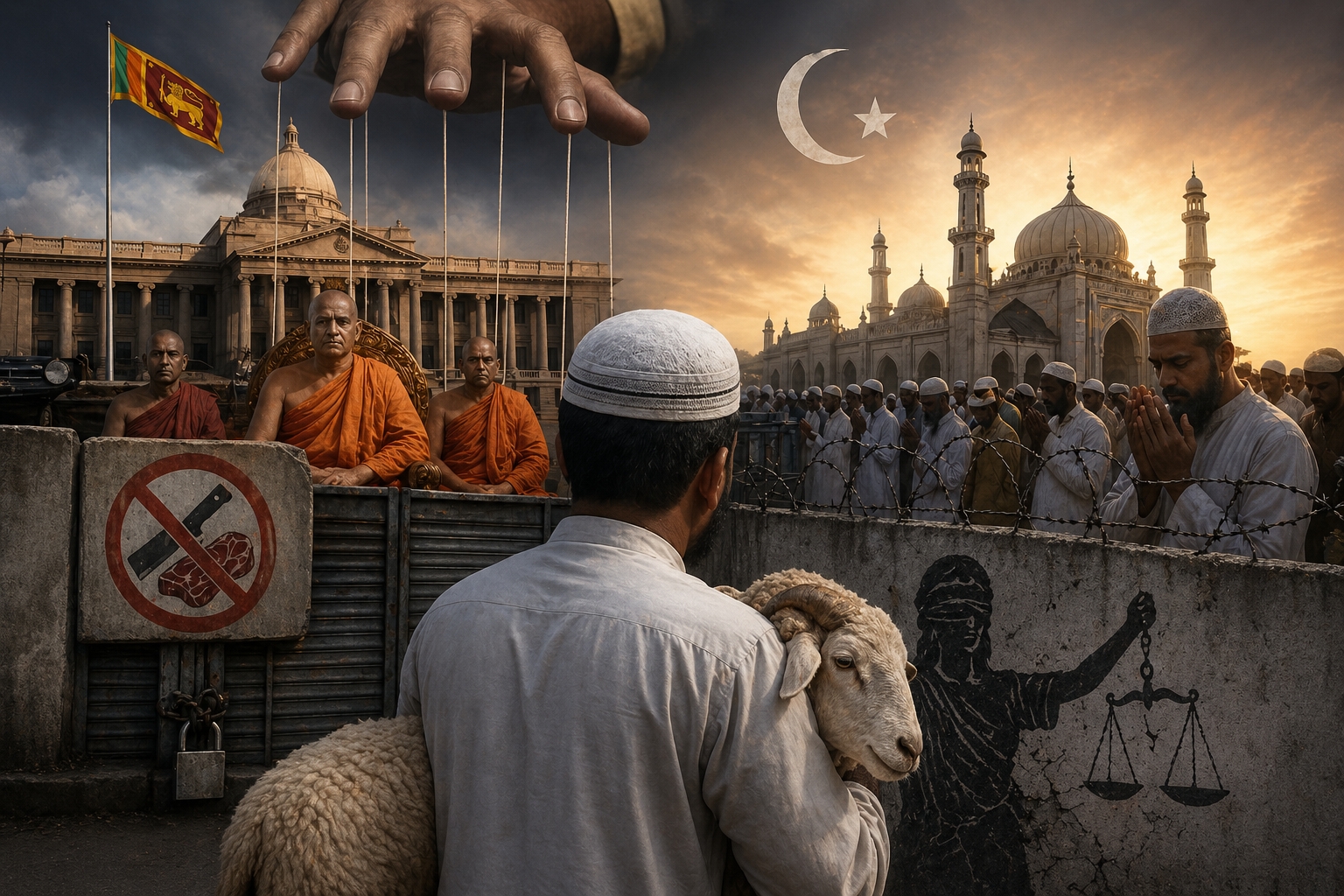
The recent announcement by the Sri Lankan government of a “Vesak Week” beginning May 27, 2026, is far more than a bureaucratic scheduling error.
It is a calculated erasure of minority religious space.
While Vesak is a sacred time for the Buddhist majority, the state’s decision to extend what is religiously a single-day (or two in the case of Vesak, that too falls in the first week of the May observance) into a full week of prohibitions, deliberately overlapping with the Islamic festival of Eid-ul-Adha (Hajj), is an act of structural coercion.
By forcing an unofficial “week” of bans on meat and slaughterhouses onto a calendar already governed by specific Poya day regulations, the government is creating a climate of intimidation.
This atmosphere emboldens local authorities and vigilante groups to disrupt the Udhiyya (animal sacrifice) ritual, the most essential religious obligation for Muslims during Hajj.
This isn’t an act of devotion to Buddhism; it is the weaponization of the majority faith to stifle the religious expression of a minority.
The most dangerous signal came from Minister Nalinda Jayatissa during the cabinet press conference.
When questioned about the impact on the Hajj festival, the minister stated that the government would “discuss the matter with Buddhist religious leaders.”
This is a deeply troubling admission which confirms that the current administration, like its predecessors, does not view the rights of minorities as fundamental constitutional entitlements.
Instead, these rights are treated as conditional privileges that must be negotiated with, and approved by, the Tri-Nikaya, clergy of the majority faith.
The state should not, under any circumstances, give the authority of deciding how minorities practice their religion to the Maha Sangha.
When a state minister outsources governance to a religious hierarchy, he effectively admits that the law of the land is secondary to clerical approval.
It sends a message to every citizen that the rights of minorities are not protected by the state, but are subject to the whims and “permission” of the religious majority.
This is the inevitable consequence of the institutionalized hegemony embedded in article 9 of the Sri Lankan Constitution.
By mandating that the state give the “foremost place” to Buddhism, the constitution has codified a hierarchy of citizenship.
This article is the single biggest obstacle to true coexistence.
It creates a framework where the state’s primary duty is interpreted as protecting the sensibilities of the majority at the direct expense of the rights of everyone else.
It forces Muslims and other minorities into a position where they must effectively apologize for their religious practices, or hide them, to avoid “offending” a state-sponsored religious atmosphere.
True coexistence is impossible when the state actively manages the calendar to favor one community while treating the sacred needs of another as an “inconvenience” to be managed through clerical negotiation.
The government has a fundamental duty to ensure that the Hajj festival proceeds without interference or the threat of unauthorized bans.
Minorities should not have to beg for permission to practice their faith in a supposedly democratic country.
If the state cannot protect a minority’s basic right to celebrate their festival without the shadow of religious policing, then all talk of equality is nothing more than a hollow performance.
The problem is not just the scheduling.
It is a system where a minority's right to exist in public space is constantly under review by the majority.
It is time to stop the religious outsourcing of our laws and demand a state where justice is truly blind to the robes one wears or the faith one follows.


Muslims are being attacked everywhere. Even the non-violent, peace-loving Buddhists have got in on the act as the Muslims of Sri Lanka have ...
Buddhists are supposed to be non-violent and peaceful people. Many no doubt are. Their monks dress in simple clothes and lead a frugal exist...
The peace talks between the Sri Lankan government and the Tamil Tigers have hit a snag: the Tigers have boycotted the meeting to be held in ...
Sri Lanka's one-and-a-half million Muslims (8 percent of the island's population) feel that they are caught between the hammer and the anvil...
