 Archives
Multimedia
Donate
About
Sign In
Archives
Multimedia
Donate
About
Sign In



 Crescent International


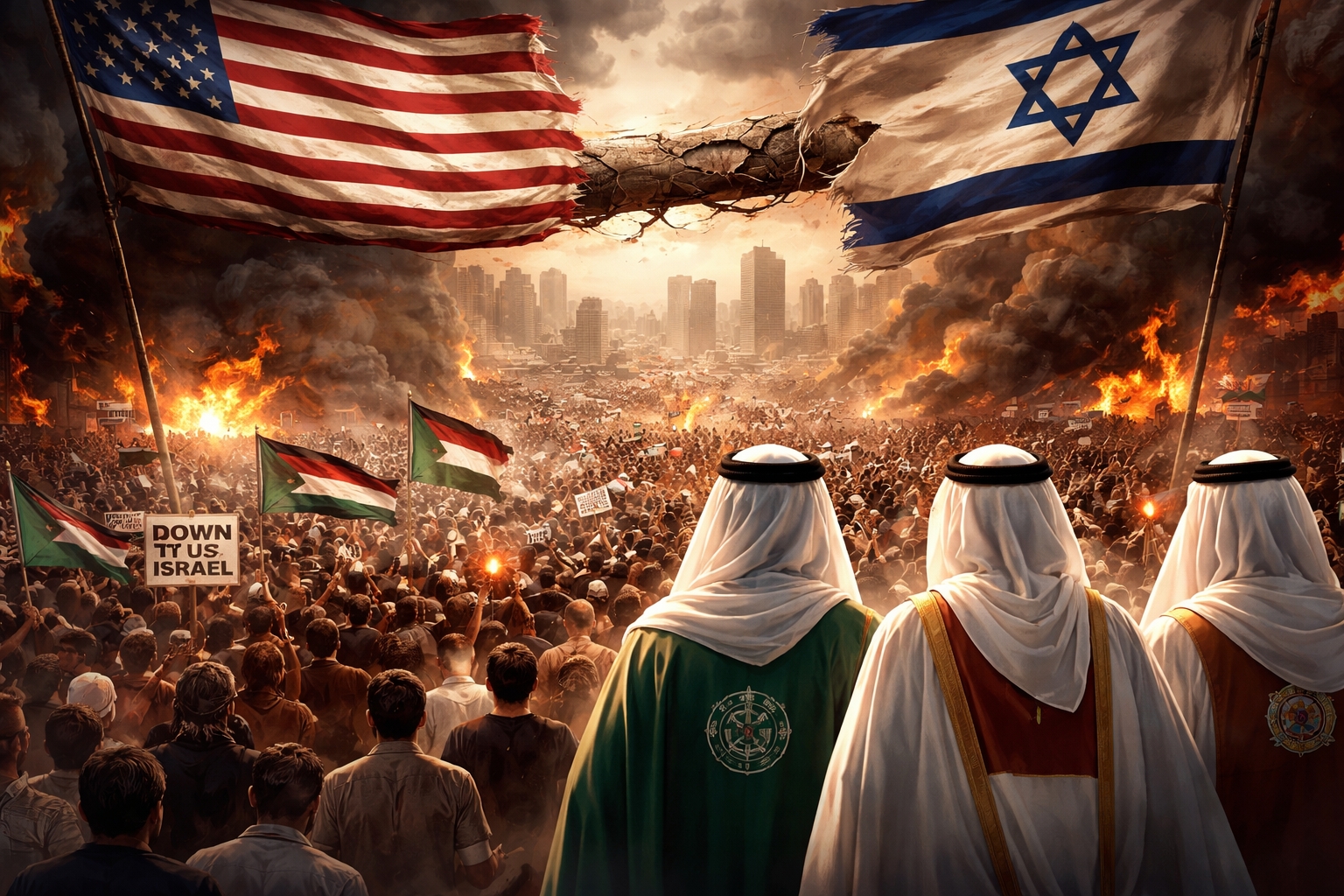
For decades, western-backed GCC dictatorships have sold a primitive geopolitical narrative to their populations and to the wider Muslim world: align with the US, move closer to Israel, and you will get security, stability, and prosperity.
It was a line that was assiduously peddled after the Islamic Revolution in Iran.
Iran and its popularly-backed Islamic state system became the boogeyman, and subjugation to the US and Israel was presented as the supposed solution.
This policy has now completely collapsed.
Despite deep military, political, and economic ties, the GCC regimes have found themselves helpless against Iran, a country that has been under severe economic sanctions for decades.
Stability, which was presented as the natural outcome of being subservient to western regimes and promoted as a master plan of foreign policy, collapsed in less than a week.
Islamic Iran continues to pound American and Israeli assets across the entire GCC, while the local dictatorships, equipped with multibillion-dollar western weapons, are unable to stop Iran.
The biggest impact is not military, but political.
It is faced by the GCC regimes, the US, and Israel.
If the US and Israel are not able to stop Iran from pummelling them directly, what is the point of regional regimes in West Asia allying themselves with the terrible duo?
This question strikes at the very foundation of the long-standing strategic doctrine.
The central justification for alignment was not merely political convenience, but the promise of guaranteed security under a superior military umbrella.
If that guarantee is exposed as limited, conditional, or ineffective in moments of real escalation, then the rationale for dependency begins to erode.
In such a scenario, alliance no longer appears as a source of strength, but as a liability that invites risk without ensuring protection.
This shifts the strategic calculus for regional western-backed regimes, forcing a reassessment of reliance on their traditional “protectors”.
Apart from this aspect, the “day after” question poses an even bigger problem.
The GCC regimes have little else to offer beyond the subjugation framework, which has now been severely undermined.
What comes next is likely to be far more alarming for American vassals in the region than the current military phase of the ongoing regional war.
As this interval of the military phase of the war subsides, the “what now” question in the realm of foreign policy for GCC regimes will become a painful reckoning with reality.
Considering the vast disconnect between regional realities and the wider population in the Arab world, the GCC regimes will have to reinvent a new foreign policy framework that appeases the “street” more.
This will inadvertently put the GCC regimes on a collision course with western regimes and Israel.
In realistic terms, the GCC regimes have two options.
First, they could lean more towards Türkiye and package the new foreign policy framework as a ‘Sunni Muslim’ bloc.
This approach, however, will lack coherence and durability, as Ankara will seek to dominate the GCC regimes—a setup they will not accept.
The GCC regimes barely get along with each other, and bringing Türkiye into the mix will only complicate matters further.
The second option is to tilt more towards a “neutral” position by asking China and Russia to mediate with Islamic Iran and create more favorable conditions for Iran in the region by degrading western and Israeli presence in the GCC countries.
In return, Iran, China, and Russia would guarantee that in the next phase of the regional war, the GCC regimes will not be touched.
It is yet to be seen which of these approaches, if any, the GCC regimes will take, but what is certain is that Iran will no longer allow the GCC regimes to provide their territories to the US and Israel to be used as military, economic, and intelligence platforms against Islamic Iran.
This position is increasingly reinforced by recent developments, where Iran has demonstrated a willingness to directly target assets and infrastructure linked to US presence across the GCC, signaling a shift toward imposing clear costs for being American and Israeli vassal regimes.