 Archives
Multimedia
Donate
About
Sign In
Archives
Multimedia
Donate
About
Sign In


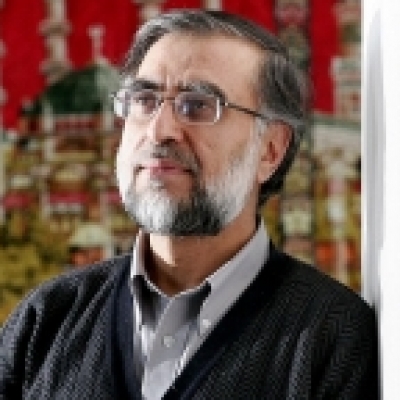 Zafar Bangash


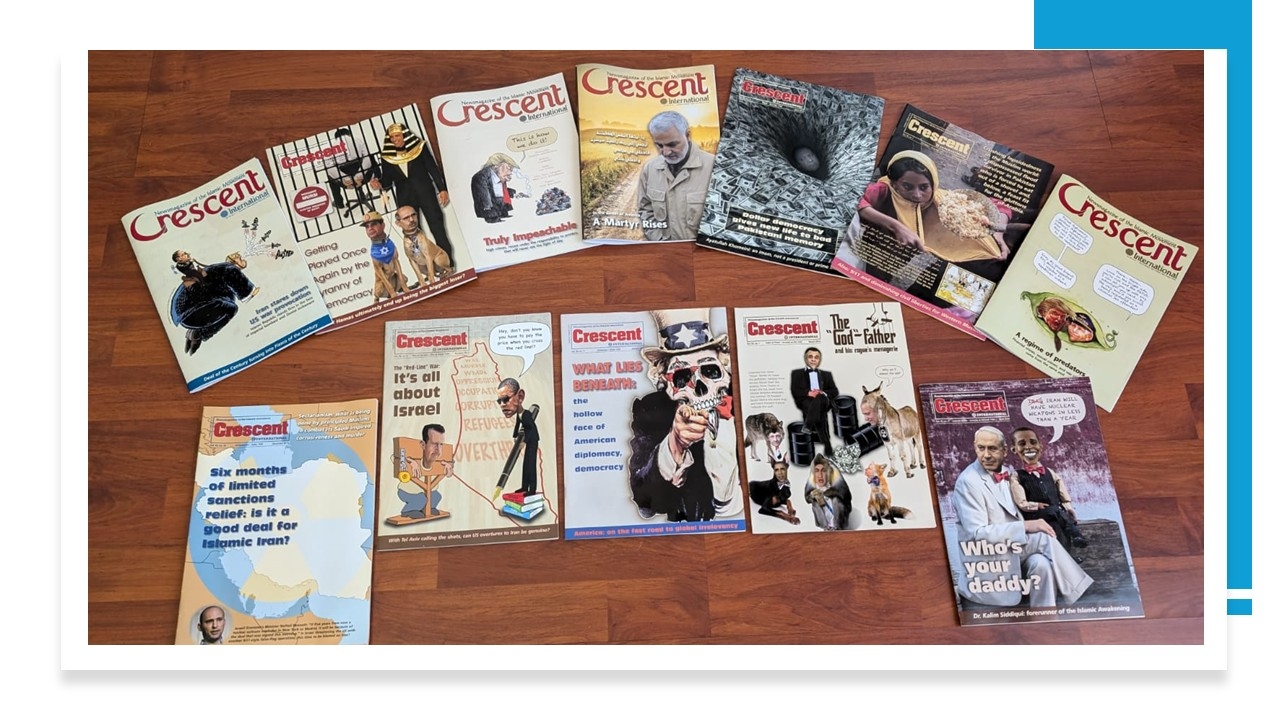
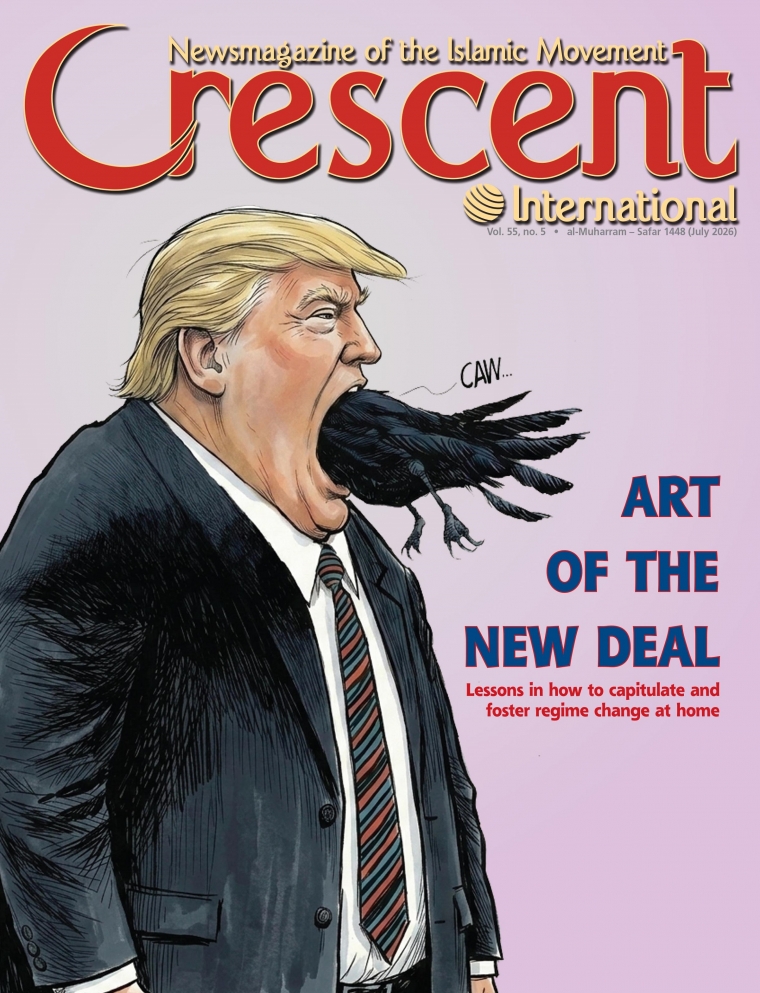
Outside the Islamic Republic of Iran, Crescent International is perhaps the only English language publication that has strived to explain the significance of the Islamic revolution to the rest of the world, especially Muslims.
It provided this service by transforming from a local community newspaper in Toronto into what it has remained for nearly five decades: an English language Islamic publication on current affairs with a genuine global reach.
Established in 1972, by the end of the decade this writer took over as editor. I was a member of the Muslim Institute preparatory committee in London but moved to Toronto in 1974 after completing my studies. It was perhaps providential that the Muslim Institue and Crescent International would link up to serve the global Islamic movement.
In 1980, Kalim Siddiqui proposed that the paper be converted into the newsmagazine of the global Islamic movement, and from then on, Crescent became essential reading for Islamic movement activists around the world.
Annual compilations of its articles were published under the title Issues in the Islamic Movement from 1982 to 1988. An Arabic edition appeared as Al-Hilal al-Dawli; and the same team ran a news syndication service called Muslimedia for several years.
The philosophical underpinning of Crescent International has always been a conscious rejection of the western liberal model of “neutral” journalism. We do not pretend that neutrality is possible, or that it is even desirable when confronting imperialism, genocide, and the systematic oppression of people.
Our understanding of journalism is perhaps best reflected by veteran journalist Robert Fisk, who eloquently stated: “We must be neutral and unbiased on the side of those who suffer. Would we give equal time to the stories of the slaves and the stories of the slave-ship captain and interview him for 50% of the report? Our job is to have a moral conscience when we are reporting; the occupier and the occupied should not necessarily have an even playing field.”
We are a publication not working within the secular and western narrative of what journalism should be. We attempt to reflect the global Islamic movement’s perspective on current affairs through deconstructing imperialism, exposing the shallowness of relativist, secular, and materialistic thought, and confronting oppression within the Qur’anic legal and philosophical framework.
This is not a posture we adopted for effect. It is the logical consequence of taking seriously the command of Allah (اللهُ سُبْحَانَهُ وَتَعَالَى) that we stand for justice—comprehensively, without exception, regardless of who it discomfits.
Our terminological framework is part of this commitment. Words are not neutral. “Middle East” is a British colonial coinage that centers western geography. We insist on calling the region “West Asia.”
The colonial nation-state is not a “nation” in any sense that Islam recognizes; it is an administrative unit imposed to divide and pacify. We call it a “state” or a “country.”
We refuse the language of our adversaries because their language encodes their assumptions—about sovereignty, about identity, and about who deserves to be heard and who does not. Our well-thought-out and thorough terminology is our brand.
This has not made us popular in every quarter. Our frank and honest message is hard to digest for many. We are the complete opposite of news organizations that demonstrate little conscience when it comes to the dirty activities of their sponsors. We have been dismissed, marginalized, and misrepresented—often by those who have far greater resources but little intellectual honesty. We accept this as the cost of integrity.
What we do not accept is the suggestion that we compromise with imperialism in the name of “balance.” There is no balance to be struck between the oppressor and the oppressed. The Qur’an does not instruct us to be neutral on the question of justice.
The Crescent International staff consists of Muslims from different schools of thought. Even non-Muslims participate in our work, allowing readers to be exposed to different perspectives of socially committed and active people. A veteran correspondent associated with the magazine mentioned that one cannot easily determine whether Crescent writers are Sunni or Shi‘i—and that this is how you know who has truly understood Islam. There has never been a better measure.
ICIT: Continuing the Work When Institutions Fail
Dr. Kalim had hoped that the Muslim Institute and Muslim Parliament would survive him and carry forward the intellectual project he had initiated. That hope was not fulfilled.
The Institute of Contemporary Islamic Thought was established in 1998, when it became clear that the Muslim Institute was in terminal decline, and some members decided that it was more important to continue the work than to engage in petty politics of intrigue.
The lesson is one that Dr. Kalim himself drew explicitly in his writings: institutions matter, but they are servants of ideas, not their masters. When an institution becomes a vehicle for ego, faction, or inertia, it must be rebuilt or replaced.
The hadith of the date palm does not say to protect the institution; it says to continue the planting. ICIT was established to continue the planting.
Together with colleagues, we established the ICIT that I serve as its director. As a member of the Preparatory Committee, I was instrumental in the establishment of the Muslim Institute in the early 1970s. And as editor of Crescent International, I remained close to Dr. Kalim throughout his life. I was with him before his death in South Africa in April 1996.
Others involved in the ICIT include Imam Muhammad al-Asi, Afeef Khan, and Imran A Khan—each of whom brings distinct scholarly and activist competencies to a shared intellectual mission.
ICIT’s main work involves publications. It maintains Crescent International, and has published posthumous editions of Dr. Kalim’s writings. It is also publishing a major tafsir of the Qur’an by Imam Muhammad al-Asi, The Ascendant Qur’an as well as a series of books on the Seerah of the Prophet (ﷺ) that I work on.
The tafsir project deserves particular emphasis. The production of serious Qur’anic scholarship—analytical, contextual, resistant to both literalism and liberalism—is not peripheral to the political project of Islamic renewal. It is central to it.
Dr. Kalim understood that without an epistemological foundation rooted in the divine text, all political organization would eventually be colonized by alien frameworks. The Ascendant Qur’an is that foundation in the process of being laid, volume by volume, with the rigor and care the task demands.
ICIT’s advocacy for unity across sectarian lines is not a diplomatic gesture or a piece of strategic optics. It flows directly from Dr. Kalim’s core analysis: that the division of the Ummah along Sunni-Shi‘i lines is a colonial project maintained by post-colonial regimes precisely because unity would threaten their existence.
Dr. Kalim insisted that all parts of the Ummah and all schools of thought are part of a single endeavor. He did not say that differences do not exist, or that they are unimportant. He said that they are subordinate to the shared obligation of submission to Allah (اللهُ سُبْحَانَهُ وَتَعَالَى) and the shared project of building a civilization that reflects His commands.
Those who exploit sectarian differences—whether in Riyadh, Tel Aviv, or Washington—do so because they understand, even if many Muslims do not, that a unified Ummah is the most formidable challenge for oppressors.

With this issue Crescent International enters its 45th year of publication. It has not been an easy journey by any stretch. That we have sur...
1After several months of selfless work by individuals seeking no worldly benefit whatsoever, with minimal material resources, we are grateful...
5I want to thank the entire staff of CI for providing us information and analysis that is not available anywhere else.
The newsmagazine of the Islamic movement offers critical information lacking in other media outlets, says this reader.
1