
 Archives
Multimedia
Donate
About
Sign In
Archives
Multimedia
Donate
About
Sign In



 Crescent International


By Dr Mubeen Shah
For decades, Kashmiris from Indian-occupied Jammu and Kashmir (IOJK) have consciously and deliberately refrained from commenting on or becoming involved in the local politics of Azad Jammu and Kashmir (AJK).
The wise leadership of the Kashmiri movement from IOJK, including leaders of the All Parties Hurriyat Conference and many political, intellectual, and civil society figures, advised their constituents to remain above AJK’s local political contests.
Their reasoning was simple and sound: involvement in local political disputes would inevitably make us a party to local controversies.
It was also believed that such involvement would distract attention from the larger and unresolved question of the right to self-determination of the people of the entire erstwhile State of Jammu and Kashmir.
Successive generations of political activists, intellectuals, and civil society members in Indian-occupied Kashmir observed this principle in both letter and spirit.
Their energies remained focused on the broader question concerning the future of the State of Jammu and Kashmir as it existed in 1947.
However, recent developments in Azad Jammu and Kashmir, including loss of life, injuries, arrests, and growing public unrest, have generated deep concern and anxiety among people in Indian Occupied Kashmir .
AJK has never been viewed merely as a geographical territory by Kashmiris living under Indian rule.
It has represented hope, refuge, protection, and continuity.
It has been seen as a place where Kashmiris could find support in difficult times and where the collective aspirations of our people continued to find expression as the base camp of Kashmiri struggle .
It is, therefore, particularly painful to witness unrest in this region leading to violence, confrontation, and casualties.
Such developments cause anguish not only among the people of AJK but also among Kashmiris across the divide.
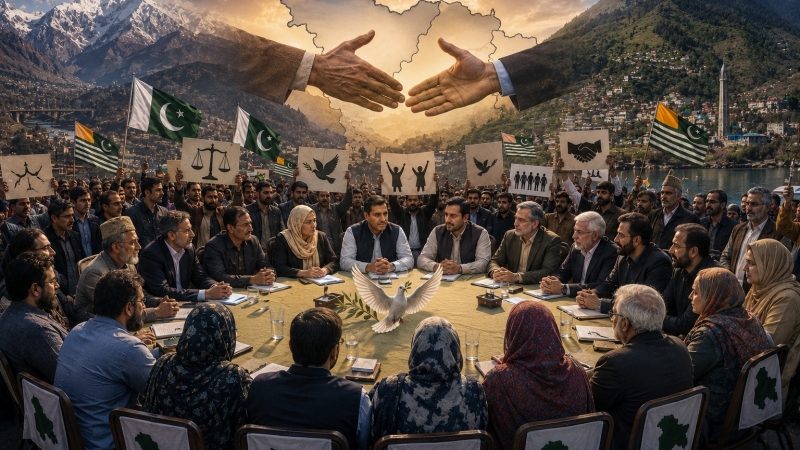
We, therefore, consider it our moral duty to appeal for dialogue, restraint, and democratic engagement.
The demands raised by the Joint Awami Action Committee concern political, constitutional, administrative, and economic questions.
These are matters that can and should be addressed through discussion, consultation, and negotiation rather than coercion or confrontation.
In this spirit, we urge the Government of Pakistan, the Government of Azad Jammu and Kashmir, political parties, civil society organizations, public representatives, and the leadership of the Joint Awami Action Committee to engage in a meaningful dialogue process based on the following principles:
Every effort must be made to prevent further bloodshed. No political disagreement should be allowed to result in the loss of innocent lives. The sanctity of human life must remain paramount.
The public has a right to accurate and timely information regarding all casualties, injuries, arrests, detentions, and the circumstances surrounding recent events. Transparency is essential for restoring public confidence and preventing misinformation.
Deaths, injuries, or allegations of excessive use of force should be subject to an independent, transparent, and impartial investigation. Accountability is essential for justice, public trust, and long-term stability.
Each demand should be examined on its merit through institutional dialogue and democratic consultation rather than confrontation.
A representative forum comprising government officials, political parties, civil society organizations, professional bodies, and public representatives should be constituted to discuss outstanding grievances and recommend practical solutions.
The issue of refugee representation has become a matter of legitimate public debate and deserves a comprehensive review through democratic, constitutional, and consultative means.
The objective of reform should not be to diminish refugee representation but to ensure that refugee populations remain meaningful stakeholders in the political process and continue to have an effective voice in public affairs.
A practical and mutually acceptable formula can be developed through consultation, comparative study, constitutional reform, and consensus-building among all stakeholders.
Any future arrangement should reflect democratic principles, demographic realities, good governance, and the aspirations of all sections of society.
We consider all those who lived within the boundaries of the State of Jammu and Kashmir as it existed in 1947 to be part of a common historical, political, and civilizational community, regardless of language, ethnicity, region, or sect.
The strength of Jammu and Kashmir has always been in its diversity and interconnectedness.
The various regions of the State have historically contributed to a shared political experience and collective consciousness that transcend regional boundaries.
While local governance issues are important and deserve attention, they should not obscure the larger and internationally recognized question concerning the political future of the entire State of Jammu and Kashmir.
The right to self-determination remains the core issue that unites Kashmiris across regions and political divides.
Political stability and social harmony can only emerge through accountability, representation, constitutional governance, and meaningful engagement with citizens.
Democratic institutions must be strengthened rather than weakened during periods of public discontent.
A Shared Responsibility
We call for reforms that address public concerns while ensuring that no community is marginalized in the process.
Refugees should not be treated as part of the problem but as partners in the search for solutions.
Their cooperation and participation should be encouraged in building a more representative, democratic, and inclusive political framework.
We urge all stakeholders to demonstrate wisdom, patience, and statesmanship. Reforms should be pursued through consensus.
Differences should be resolved through dialogue. Public grievances should be heard and addressed.
Above all, human life must be protected. The responsibility for preserving peace, protecting democratic space, and preventing further loss of life rests upon all stakeholders, including the Government of Pakistan, the Government of Azad Jammu and Kashmir, political parties, civil society organizations, public representatives, and popular movements.
At this difficult moment, restraint, dialogue, transparency, and justice offer the only sustainable path forward.
Dr Mubeen Shah is Chairman Kashmir Diaspora Coalition


In its relentless policy to make the occupation of Kashmir permanent, India pursues a multi-pronged approach: army brutality including tortu...
