 Archives
Multimedia
Donate
About
Sign In
Archives
Multimedia
Donate
About
Sign In



 S. Haider Mehdi


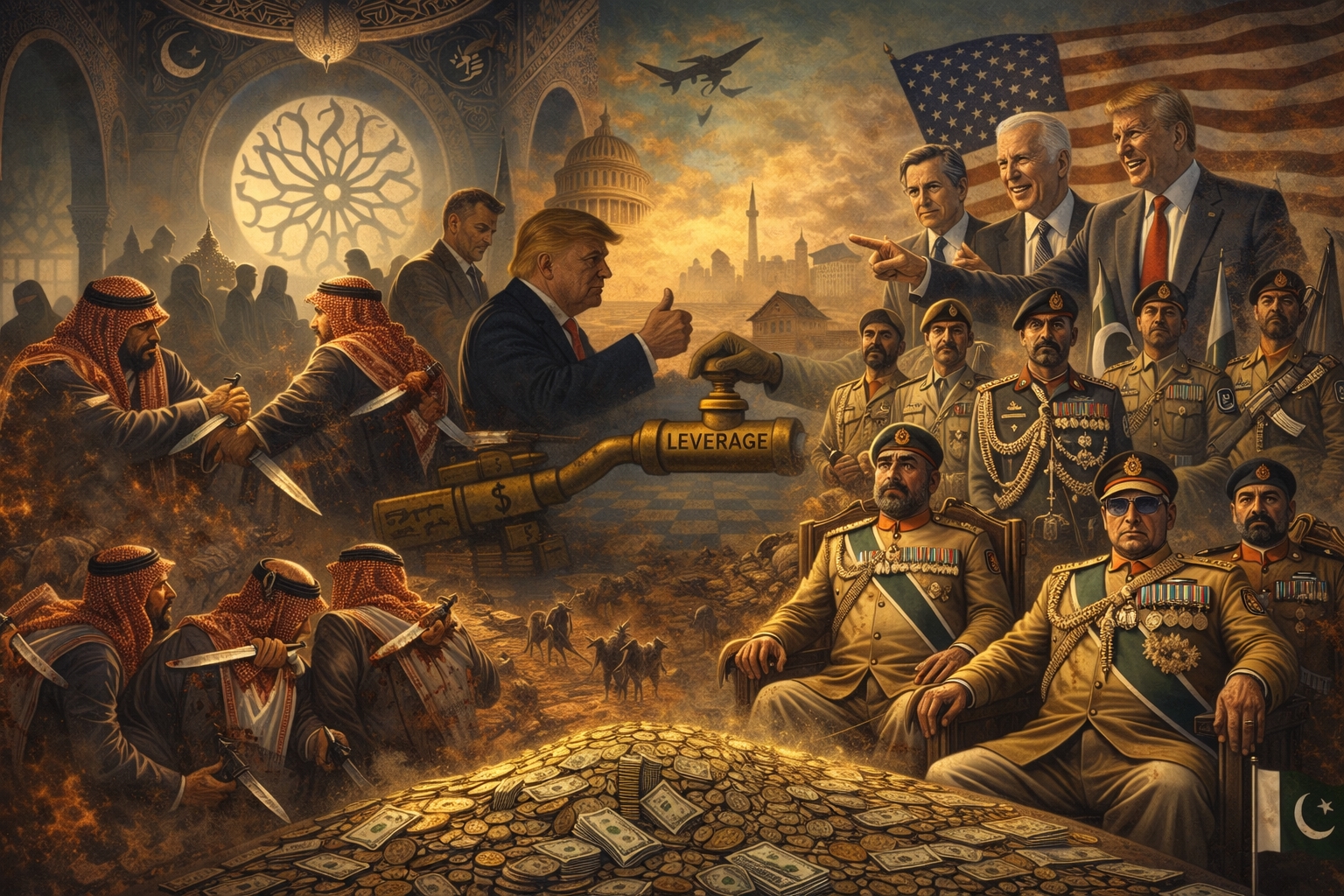
Pakistan now sits at the fault line of a remade Middle East. This is not a metaphor. It is a literal description of where the country is being placed by decisions taken without public consent, parliamentary oversight, or constitutional authority.
What Pakistanis are witnessing is not merely a foreign policy error or a tactical miscalculation. It is the slow conversion of Pakistan from a sovereign state into a strategic utility for external powers.
This transformation is not being driven by elected representatives but by the military elite, with General Asim Munir at its apex. The consequences are not abstract. They are horrific in scope and existential in implication.
The Middle East power struggle Pakistanis must understand is no longer framed by Arab nationalism, ‘Islamism’, or even oil. It is shaped by the transition from direct American dominance to outsourced regional control.
The US is not withdrawing from West Asia (aka the Middle East). It is delegating. The preferred subcontractor is the United Arab Emirates (UAE), operating in open strategic alignment with Israel and with full American approval.
This axis does not prioritize stability in the classical sense. It prioritizes control over ports, logistics corridors, energy flow, maritime chokepoints, and fragmented political systems that can be influenced without the burden of governance or accountability. Libya, Yemen, Sudan, and the Horn of Africa are not peripheral conflicts. They are experimental theaters.
Libya: The Emirati model
Libya is the Emirati model’s crudest form. Pakistan has entangled itself in it. Khalifa Haftar is not a national leader of Libya. He is a warlord sustained by foreign financing, militia loyalty, and control of territory rather than legitimacy. For the UAE, Haftar offers strategic depth across North Africa, leverage over Mediterranean ports, influence over migration routes into Europe, and a military corridor linking the Sahel to the Red Sea.
Munir’s visit to Haftar last month was not ceremonial. It was transactional. Pakistan’s military leadership has reportedly entered into a multi-billion dollar arms arrangement for Haftar’s forces, widely understood to be financed by Abu Dhabi.
This places Pakistan directly inside an Emirati proxy architecture that serves Emirati, Israeli, and American interests. It does nothing for Libyan peace and even less for Pakistan’s security. Pakistan is no longer exporting diplomacy. It is exporting militarization for rent.
Yemen unmasks conspirators
Yemen is where the mask slipped and the rivalry turned kinetic. Saudi Arabia wants a unified Yemen that neutralizes threats to its borders and allows Riyadh to exit a costly war with minimal strategic loss. The UAE backs the Southern Transitional Council (STC), a secessionist force controlling Aden and southern ports, accountable not to Sana‘a but to Abu Dhabi.
When Saudi aircraft bombed UAE-backed STC units, this was not a mistake or miscommunication. It was a deliberate signal that Riyadh will not tolerate Emirati sponsored fragmentation at the very moment it is negotiating an exit from the conflict.
It matters deeply for Pakistan because Asim Munir has aligned Pakistan with the Emirati approach rather than the Saudi one, despite Pakistan’s historical reliance on Saudi political and economic support.
Sudan’s grim preview
Sudan offers a grim preview of the Emirati end state. It should terrify Pakistanis. The UAE backs militia forces because they are cheaper, deniable, and easier to control than states. They dominate gold routes, manpower pipelines, and logistics networks that can be repurposed across conflicts from Libya to the Sahel.
Saudi Arabia, by contrast, still speaks the language of state integrity, even if inconsistently. Sudan shows the terminal stage of the Emirati method: fragmentation, endless violence, elite capture, and economic collapse. Pakistanis must ask why their military is aligning itself with a model that destroys states when Pakistan itself is economically fragile and socially fractured.
UAE as Israel’s proxy
The most uncomfortable truth Pakistan must confront is the UAE’s evolving role as Israel’s forward strategic partner. This is no longer conjecture. Since normalization, the UAE has become Israel’s most effective regional facilitator, providing access, legitimacy, intelligence reach, and operational depth.
Israel’s strategic objectives have not changed. It seeks permanent military and technological superiority, the absence of independent regional powers, and the neutralization of any Muslim state capable of posing an existential challenge. Pakistan is the only Muslim nuclear power.
Disarming Pakistan does not require bombs or invasions. It requires leverage, dependency, debt, elite capture, and gradual erosion of sovereignty. By tying Pakistan’s military economy to Gulf financing and personal relationships with foreign rulers, Munir is making Pakistan acutely vulnerable to pressure precisely when its nuclear deterrent is under increasing international scrutiny.
US not a bystander
The United States is not a bystander in this process. Washington has endorsed the UAE-Israel alignment because it reduces American costs while preserving western outcomes. Fragmented regions are easier to manage than confident sovereign states. A financially desperate Pakistan whose generals depend on Gulf patronage is far easier to discipline than a self assured one. This is not a conspiracy. It is classic imperial management adapted to a multipolar world.
India’s role
India’s role in this unfolding scenario is neither passive nor accidental. It is strategically opportunistic. New Delhi today occupies an unusually advantageous position. It enjoys deep strategic alignment with the US, an expanding intelligence and defense partnership with Israel, and a rapidly growing economic and security relationship with the UAE. At the same time, India’s overriding obsession remains China.
From Delhi’s perspective, a weakened, internally consumed Pakistan is preferable to a coherent adversary aligned tightly with Beijing. India does not need to invade or formally annex territory to benefit from Pakistan’s collapse. Balkanization suits it far better.
Regions of Pakistan drifting into economic dependency, internal lawlessness, or foreign patronage reduce Pakistan’s ability to challenge India diplomatically or strategically. India can then concentrate its full weight on countering China while allowing Israel, the UAE, and western powers to manage Pakistan’s decay.
In such an outcome, India emerges as the stable western-aligned pillar of South Asia without firing a shot. Pakistan, meanwhile, is neutralized as a strategic actor rather than defeated as a state.
Iran’s paradox
Iran, by contrast, finds itself trapped in a dangerous paradox it neither controls nor welcomes. Tehran views the UAE-Israel alignment with deep concern, not only because it threatens Iran directly, but because it militarizes fragmentation along its eastern periphery.
A balkanized Pakistan with lawless regions under Emirati patronage, Israeli intelligence reach, and western leverage would place hostile influence uncomfortably close to Iran’s borders, particularly in Balochistan. Iran’s natural instinct would be to support Pakistan’s territorial integrity and resist militia-driven disorder.
Yet Iran is constrained by sanctions, economic pressure, and its own regional burdens. It lacks the financial capacity to stabilize Pakistan and is wary of provoking a direct confrontation with the US-UAE-Israel axis. The irony is stark. Iran needs a sovereign Pakistan more than Pakistan’s current military leadership appears to.
China and Russia
China and Russia are often invoked as saviors, but neither will rescue a country from its own elite. China views Pakistan as a strategic corridor and buffer, not as a liability to be endlessly subsidized. Beijing wants stability, predictability, and protection of its investments.
What it does not want is Pakistani military leadership freelancing with Gulf proxies and inviting western leverage into China’s strategic backyard. Russia sees Pakistan as a potential Eurasian counterweight to western dominance but lacks the economic depth or political appetite to underwrite a state whose leadership is hollowing it out.
Both could counter the US-UAE-Israel axis in theory through financing and diplomatic cover. In practice, neither will do so if Pakistan continues to sell itself piecemeal.
Saudi Arabia
Saudi Arabia remains the reluctant stabilizer and last plausible hedge. Riyadh does not want Pakistan to collapse, nor does it want the UAE to dominate the Muslim world. But Saudi Arabia is cautious, interest driven, and increasingly intolerant of dysfunction. It will hedge, not rescue, if Pakistan continues on its present course. Sentiment and history will not override assessments of viability.
Munir’s legacy, if this trajectory continues, is already visible. History will not remember him as a general who saved Pakistan but as the man who internationalized its internal crisis. By inserting Pakistan into Emirati proxy wars, he has narrowed Pakistan’s diplomatic space. By monetizing military relationships, he has weakened civilian sovereignty.
By entangling Pakistan in distant conflicts, he has exposed it to pressures it cannot control. This is not strategic realism. It is institutional recklessness disguised as necessity.
The existential danger lies not in invasion but in erosion. Pakistan’s greatest historical strength has been strategic ambiguity and independent maneuvering. Its greatest weakness has been elite capture.
The current path strips away the former while entrenching the latter. The most likely outcome, if this course continues unchecked, is balkanization, with parts under Indian and Israeli hegemony and parts reduced to lawless zones dominated by militias operating under UAE patronage.
A Pakistan reduced to a subcontractor will not be permitted an independent nuclear posture, independent diplomacy, or independent economic planning. States do not collapse only when armies cross borders. They collapse when their guardians stop guarding and start trading.
If this course is not reversed, the price will not be paid by generals or Gulf princes. It will be paid by Pakistan itself, in diminished sovereignty, constrained choices, and a future written elsewhere.


Pakistan army chief Asim Munir is not satisfied with elevating himself to the rank of field marshal without any military achievements. Using...